The biggest wealth transfer in modern industrial history is happening right now. Here’s what the data says — and what it means for where capital should be moving.

So the data confirms it! The World Economic Forum (WEF), in collaboration with BCG, confirmed in late 2025 that the global green economy surpassed $5 trillion in annual value, with projections to exceed $7 trillion by 2030.

So The Green Economy Hit $5 Trillion. Most People Are Still Treating It Like a Side Project, why is that?

Let’s start with a number that should stop you mid-scroll.

$5 trillion. 💲💲💲💲💲⬅️

That is the current annual value of the global green economy as of 2025. Not projected. Not aspirational. Not a climate activist’s wish list. Current. Verified. And growing at twice the rate of conventional business revenues.

The World Economic Forum (WEF), in collaboration with BCG, confirmed in late 2025 that the global green economy surpassed $5 trillion in annual value, with projections to exceed $7 trillion by 2030.

Growing twice as fast as traditional industries, this sector is now the second-fastest growing area after:

  1. Technology
  2. Green Economy

The green economy is now the second-fastest growing market on the planet — behind only the technology sector. It is outpacing traditional industry driven by energy and transport. It is attracting premium capital. And it is reshaping global trade in ways that most operators, investors, and business leaders are still not fully pricing into their decisions.

This is not an environmental story. This is an economic story. And if you’re not reading it as one, you’re already behind.


What $5 Trillion Actually Means

Numbers at this scale are easy to dismiss. They feel abstract. So let’s make it concrete.

The global green economy generating $5 trillion annually means it is larger than the entire GDP of Japan — the third-largest economy in the world. It means it is larger than the combined GDP of every country in Africa. It means that the companies, operators, and capital allocators who have positioned themselves inside this market are not operating in a niche. They are operating in a core industrial sector creating infrastructure to support its growth.

And here is the part that matters most for anyone thinking about where to deploy capital or build a business over the next five years:

Green revenues are currently expanding at twice the rate of conventional business revenues.

That is not a marginal advantage. That is a structural one. When a sector grows at double the rate of the broader economy, compounded over five years, the gap between those who are positioned inside it and those who are not becomes very difficult to close.

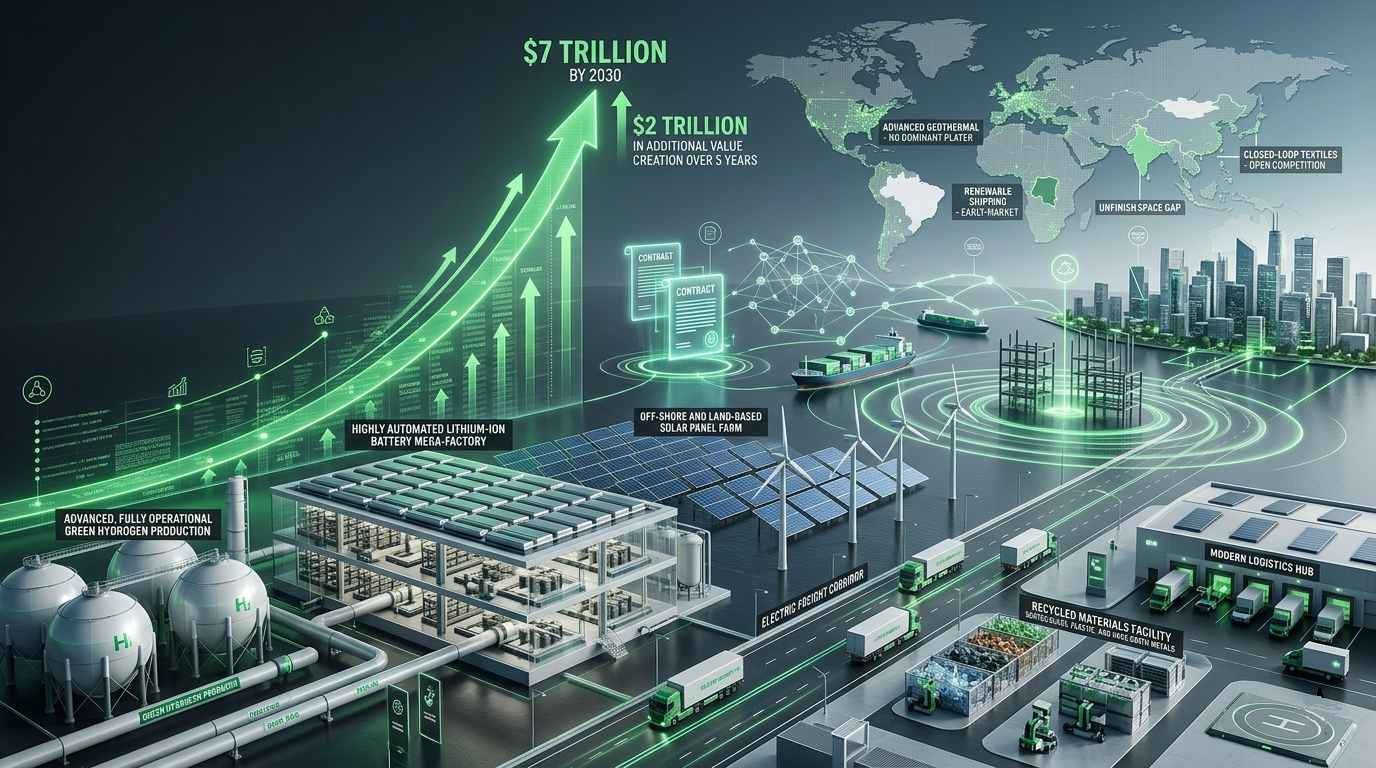
The projection to $7 trillion by 2030 represents $2 trillion in additional value creation over five years. That is $2 trillion in new contracts, new supply chains, new infrastructure, new materials markets, and new business models — most of which do not yet have dominant players.

The window is open. But windows close.
Why This Is Happening Now — The Three Pillars Driving the Surge

Understanding why the green economy has reached this scale is not just academic. It tells you where the durable value is — and where the speculative froth is.

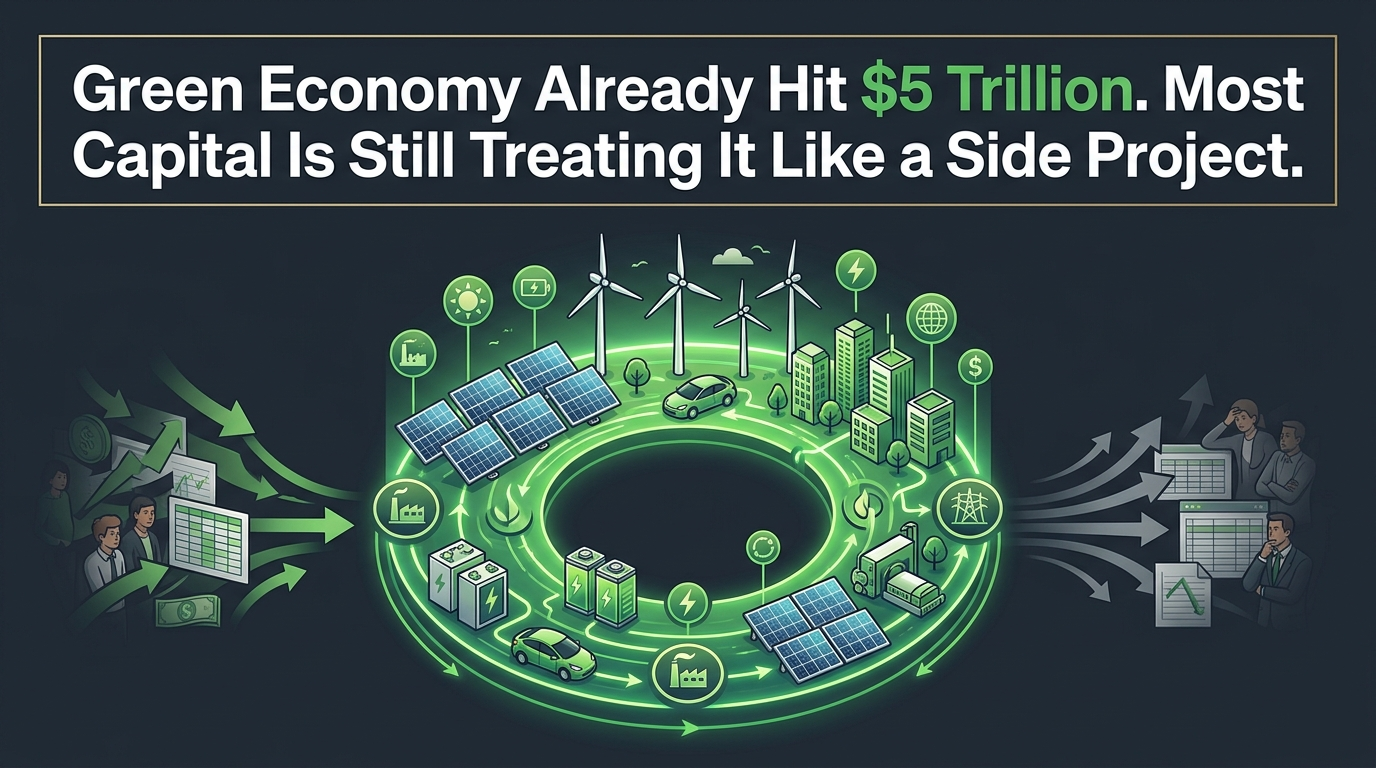
Global industry leaders have identified three operational pillars driving the surge to $5 trillion. Each one has direct implications for where capital should be positioned.

Pillar 1: Technology Maturity

The first wave of the green economy was built on promises. Solar would get cheap. Wind would scale. Electric vehicles would become mainstream. Battery storage would solve the intermittency problem.

Those promises have been kept. The technologies matured. The levelized costs came down. And what was once a subsidized experiment is now a cost-competitive industrial reality.

But here is what most people miss about technology maturity cycles: the biggest returns don’t come from the technology itself. They come from the:

  1. Infrastructure
  2. Materials
  3. Supply chains

that the technology requires at scale.

When solar manufacturing scaled, the demand for industrial-grade silicon, aluminum framing, and specialized coatings scales with it. When electric vehicle production scales, the demand for battery-grade lithium, cobalt, and manganese scales with it. When green construction scales, the demand for certified sustainable building materials scales with it.

The technology is the headline. The supply chain is where the money is made.

The implication: The most durable positions in the green economy right now are not in the technologies themselves — they are in the certified, industrial-grade inputs those technologies require to operate at scale.

Pillar 2: Regulatory Navigation

The second pillar is the one that separates operators who understand this market from those who are still treating it as optional.

The regulatory environment around green economy participation is not softening. It is accelerating.

The Inflation Reduction Act in the United States has deployed hundreds of billions of dollars in subsidies, tax credits, and incentives tied to domestic green manufacturing and clean energy deployment. The Green Deal Industrial Plan in Europe is doing the same across the EU. International climate disclosure frameworks — including mandatory Scope 3 emissions reporting — are moving from voluntary to required in jurisdiction after jurisdiction.

What this means in practice: companies that cannot document the sustainability credentials of their supply chains are going to face increasing friction in accessing capital, winning contracts, and operating in regulated markets. Companies that can document those credentials — with certified, verifiable data — are going to command a premium.

This is not a compliance cost. It is a competitive advantage. And the organizations that understand the difference are the ones building positions right now.

The implication: Regulatory alignment is not a legal department problem. It is a strategy problem. The companies that build regulatory navigation into their core operating model — rather than treating it as a cost center — are going to have structurally lower costs of capital and structurally higher valuations than their peers.

Pillar 3: Industrial Feedstocks

This is the pillar that is least understood — and where some of the most significant near-term opportunity exists.

As the green economy has scaled from theoretical models to practical industrial applications, the demand for certified, industrial-grade sustainable inputs has become a critical bottleneck.

The technologies exist. The regulatory frameworks exist. The capital exists. What is increasingly scarce is the high-quality, verifiable, sustainable raw material that large-scale green manufacturing requires. This is where BioEconomy Solutions exist.

The report is specific about this: high-yield biomass and bio-based materials are transitioning from specialized applications into essential industrial feedstock supply chains. High-density cultivation models producing over 100 to 150 bone dry tons per acre within two to three years are no longer forestry projects. They are industrial supply chain assets.

The language in the report is precise and worth noting: these inputs are becoming essential for meeting the “gold standard” requirements of large-scale green manufacturing.

That language tells you everything about where the pricing power is going to sit in this market over the next five years.

The implication: The scarcest and most valuable resource in the green economy over the next five years is not capital. It is not technology. It is certified, high-quality, industrial-grade sustainable feedstock. The operators who control that supply — with verified credentials, documented yield data, and established supply chain relationships — are going to be in an extraordinarily strong negotiating position.
The Shift That Changes Everything: From Commitments to Execution

Here is the single most important strategic insight in the entire report — and it is stated plainly enough that it is easy to read past it without fully absorbing it.

The market is shifting its focus from “climate commitments” to “operational execution.”

Read that again.

For the past decade, the green economy has been largely driven by commitments. Net zero pledges. Carbon neutrality targets. ESG frameworks. Sustainability reports. The language of intention.

That era is ending.

On page 8 of the report reads:

Growth follows public and private momentum in climate action and adaptation over the last decade The sector’s expansion reflects a sustained momentum in climate action in both national and private spheres.

Today, 142 countries, covering more than 76% of global emissions, have a net-zero commitment in place – up from virtually zero in 2016. Many have implemented regulatory frameworks with increasingly strict emissions standards or have pushed the expansion of low-carbon technologies. Over the same period, corporate decarbonization target-setting has grown exponentially.

By mid-2025, the number of companies with science-based emission reduction targets, or a commitment to set such a target, had surged to 10,949 from just 116 in 2015.9 These companies now represent more than 40% of global market capitalization and approximately 25% of global revenue.

The $2 trillion in additional value projected between now and 2030 is not going to be captured by organizations that make better commitments. It is going to be captured by organizations that execute. That build. That deliver verifiable, measurable, documented results.

This shift has profound implications for every participant in the market — from large corporations to small operators to capital allocators.

For corporations: The ESG report is no longer sufficient. Investors, regulators, and counterparties are demanding operational proof. Supply chain documentation. Verified emissions data. Certified material sourcing. The organizations that can provide that documentation are going to access capital at lower cost and win contracts that their competitors cannot.

For operators and suppliers: The premium is moving to certification and verification. A sustainable material without documentation is worth market price. The same material with certified, verifiable credentials — traceable origin, documented yield, third-party verified sustainability metrics — commands a significant market premium. The report is explicit: certified industrial-grade sustainable materials will command a significant market premium as Scope 3 reporting becomes mandatory.

For capital allocators: The deals worth doing in this market are not the ones with the best climate story. They are the ones with the best operational infrastructure. Verified feedstock supply. Documented performance data. Regulatory alignment. Scalable execution capacity. The capital that flows to those deals is going to generate returns that the commitment-era investments cannot match.

BioEconomy Solutions has produced a standalone platform that offers The ESG Market! (3 T’s) Traceability, Transparency and Trust. Using real-time telemetry and real-time-data.


Where the $2 Trillion Is Going — Sector by Sector

The report identifies specific areas where the expansion from $5 trillion to $7 trillion is expected to concentrate. Understanding the distribution matters for positioning.

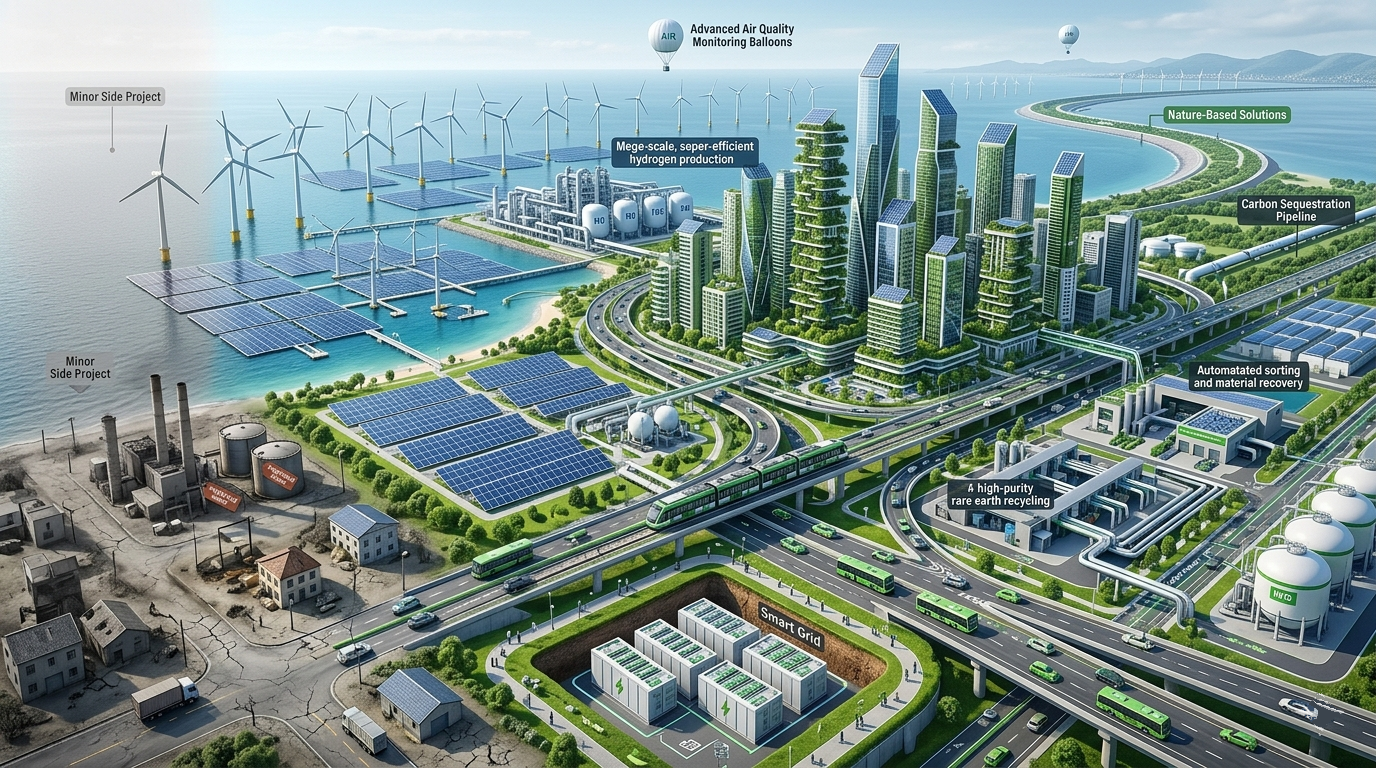
Energy and Transport

These remain the largest segments of the green economy and will continue to attract the largest absolute capital flows. But the growth story in energy and transport is increasingly about infrastructure and supply chain rather than technology. The technologies are proven. The bottleneck is execution — grid infrastructure, charging networks, manufacturing capacity, and the certified materials those systems require.
Green Construction

This is an emerging growth area that is significantly underappreciated in most market analyses. As building codes tighten, as embodied carbon becomes a regulated metric, and as green building certifications move from premium to standard, the demand for certified sustainable construction materials is going to accelerate sharply. This is a market that is large, fragmented, and in the early stages of consolidation around quality and certification standards.

Circular Waste Management

The transition from linear to circular material flows is creating new business models across virtually every industrial sector. The value in this space is in the infrastructure — collection systems, processing capacity, certified recycled material supply chains — not in the concept.

Regenerative Agriculture

This is the sector with perhaps the longest runway and the most significant near-term supply-demand imbalance. As Scope 3 emissions reporting becomes mandatory, the demand for verified carbon sequestration, certified sustainable agricultural inputs, and documented regenerative practices is going to exceed supply for the foreseeable future. The operators who are building verified, scalable regenerative agriculture systems right now are building assets that are going to be extraordinarily valuable in a mandatory reporting environment.

Biomass and Carbon Sequestration

The report is specific and worth quoting directly: “There is an increasing demand for verifiable, high-efficiency biological sources.”

Verifiable. High-efficiency. Biological.

Those three words define the quality standard that the market is moving toward. Not biomass. Verifiable biomass. Not carbon sequestration. High-efficiency carbon sequestration. The premium is in the verification and the efficiency — not just the existence of the resource.

High-density cultivation models producing 100 to 150 bone dry tons per acre within two to three years are explicitly identified as transitioning from specialized forestry into essential industrial feedstock supply chains. That transition is happening now. The supply chain infrastructure to support it is being built now. The operators who are positioned inside that transition — with verified yield data, certified sustainable practices, and established offtake relationships — are building positions that are going to be very difficult to replicate in three to five years.

BioEconomy Solutions provides traceability and feedstock security to all of these sectors.


The Capital Advantage Nobody Is Talking About Loudly Enough

The Lower Cost Capital Advantage

  • Capital Advantage: Companies operating within the green sector are increasingly benefiting from “smart capital,” enjoying lower costs of debt and premium valuations on capital markets compared to carbon-intensive peers.

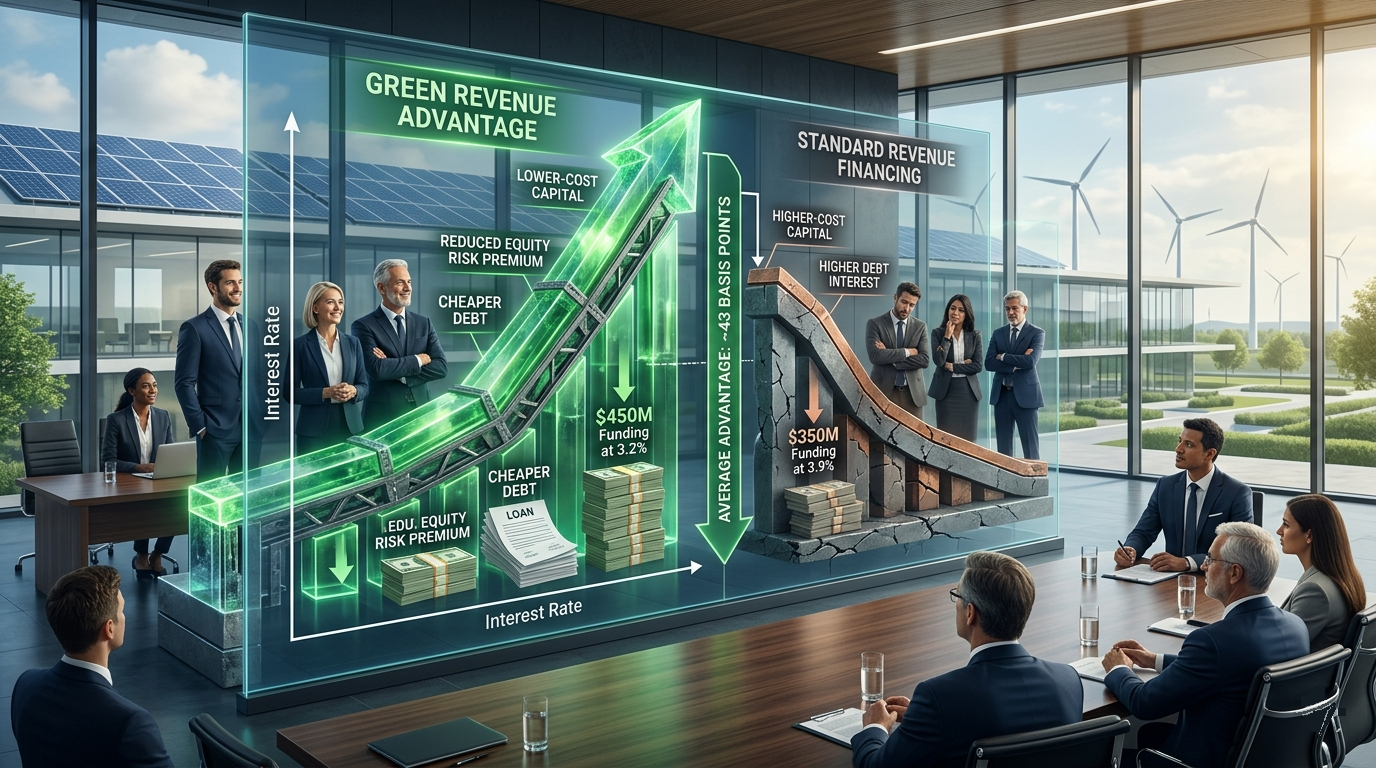
Companies in the green economy typically obtain access to cheaper capital Companies with green revenues can benefit both when raising equity and borrowing capital. They often enjoy better financing terms, including lower weighted average cost of capital (WACC).

BCG analysis found a correlation consistent across all industries that companies with green revenues secure a lower cost of capital at an average of~43 basis points (bps) less than companies without green revenues (see Figure 15 for detailed WACC discounts on selected industries) on page 26 of the report.

Notably, new debt financing vehicles often offer lower-cost financing to companies funding green projects (e.g. green bonds). A lower risk profile of companies in green markets can also justify a lower cost of debt. Leading financial institutions highlight that companies with access to cheaper capital can often generate higher share prices.

This means that secondary share issues and mergers and acquisitions transactions are less dilutive. A better valuation may support lower interest rates, lowering overall capital costs. As a result, companies with access to cheaper capital can invest in green growth opportunities more easily and efficiently – creating a virtuous cycle that improves revenues, overall financial performance and market valuations.

This is not a soft benefit. This is a hard financial advantage that compounds over time.

Lower cost of debt means that green economy operators can finance growth at lower rates than their conventional competitors. Over a five-year capital deployment cycle, that difference in financing cost translates directly into competitive advantage — the ability to bid more aggressively, invest more heavily, and scale faster than competitors who are paying higher rates for the same capital.

Premium valuations mean that when green economy operators access equity markets — whether through private investment rounds, strategic partnerships, or public markets — they are receiving higher multiples for the same earnings than carbon-intensive peers. That premium valuation is not just a paper gain. It is a real cost-of-capital advantage that affects every subsequent financing decision.

The organizations that understand this dynamic are not just building green businesses because they believe in the mission. They are building green businesses because the financial structure of the green economy is fundamentally more advantageous than the financial structure of conventional industry — and that advantage is growing, not shrinking, as regulatory pressure increases and capital markets continue to price carbon risk into valuations.

The BioEconomy Solutions “Industrial-Scale Biogenic Carbon Infrastructure” projects benefit directly from this capital market environment.
The Red Team View — What Could Go Wrong

Any honest analysis of a $5 trillion market opportunity has to include the failure modes. Here are the ones worth taking seriously.

Policy Reversal Risk: Green economy growth has been significantly accelerated by policy support — the IRA, the Green Deal Industrial Plan, and similar frameworks. Policy environments can change. Organizations that are building businesses entirely dependent on subsidy structures rather than underlying economic fundamentals are exposed to policy reversal risk in ways that operators with genuine cost competitiveness are not.

Certification Inflation: As the premium for certified sustainable materials grows, the pressure to dilute certification standards grows with it. The organizations that are building positions based on genuinely rigorous certification — not the minimum viable standard — are going to be better protected against the devaluation of weaker certifications.

Execution Gap: The shift from commitments to execution is real — but execution is hard. The green economy is full of organizations that have made compelling commitments and are struggling to deliver operational results. The capital that flows to this market is going to become increasingly sophisticated about distinguishing between organizations that can execute and organizations that can only communicate.

Supply Chain Concentration: As demand for certified sustainable feedstocks grows faster than supply, there is a real risk of supply chain concentration — a small number of verified suppliers controlling access to materials that large-scale green manufacturing requires. This is a risk for buyers and an opportunity for suppliers who move early to establish verified, scalable supply.


What This Means If You’re Building or Investing Right Now

Let’s bring this to ground level.

If you are a developer, operator, or capital allocator trying to figure out where to position over the next three to five years, the report points to a clear set of principles:

Move toward verification. The premium in this market is moving to certified, documented, verifiable performance. Whatever you are building — whether it is a material supply chain, an infrastructure project, or a manufacturing operation — the investment in rigorous certification and documentation is not a cost. It is a value creation activity.

Think supply chain, not technology. The technologies are largely proven. The supply chains that those technologies require at scale are still being built. The most durable positions in the green economy over the next five years are in the certified inputs, the industrial feedstocks, and the supply chain infrastructure — not in the technologies themselves.

Treat regulatory alignment as strategy. The organizations that are building regulatory navigation into their core operating model — rather than reacting to regulatory changes as they come — are going to have structural advantages in accessing capital, winning contracts, and operating in regulated markets.

Execute, don’t just commit. The market is done rewarding commitments. The $2 trillion in value creation between now and 2030 is going to flow to organizations that can demonstrate operational results — verified data, documented performance, scalable execution capacity.


The Bottom Line

The global green economy is a $5 trillion reality. It is growing at twice the rate of conventional industry. It is attracting premium capital at lower cost. And it is projected to add $2 trillion in additional value by 2030.

The era of climate commitments is over. The era of operational execution has begun.

The organizations that are going to capture disproportionate value in this market over the next five years are not the ones with the best sustainability reports. They are the ones with the best supply chains, the most rigorous certifications, the most verifiable performance data, and the most disciplined execution capacity.

The window is open. The supply chains are being built. The specifications are being written. The capital is moving.

The question is not whether the green economy is real. That question has been answered.

The question is whether you are positioned inside it — with verified assets, certified materials, and operational infrastructure — before the window closes.


Ready to Map Your Position in the Green Economy?

At BioEconomy Solutions, we work with operators, developers, and capital allocators who are building positions in the green economy infrastructure — in biomass supply chains, sustainable infrastructure, carbon sequestration assets, and certified material markets — before they become obvious.

If you are serious about understanding where your specific business, project, or capital fits inside the $5 trillion green economy — and you want a clear strategy mapped around your actual situation, not a generic framework — let’s talk and see if we are aligned.

The market is moving from commitments to execution. The operators who move now build positions that are very difficult to replicate in three years.

Book a strategy call with the BioEconomy Solutions team.

♻️ Share This Post

📢 Comment Below / What are your thoughts?

👉 Follow BioEconomy Solutions for more

🌍 If you found this helpful, “Join my newsletter for deeper insights”. Link in my featured section.

♻️ Repost if you believe profitable reforestation is the future.

👉 Learn More About: Paulownia “G.U.A.R.D.I.A.N. Framework™”: https://www.linkedin.com/pulse/guardian-sustainability-operating-system-bioeconomy-victor-garlington-2dcke/

👉 This Is How We Grow Paulownia: https://bioeconomy-solutions.kit.com/products/paulownia-growers-manual-bio-econom

📧 Email: Mail@BioEconomySolutions.com

📅 Book a consultation 📞call: www.BioEconomySolutions.com/bookcall


Source: WEF Report on Already a MultiTrillion-Dollar Market: CEO Guide to Growth in the Green Economy Dec 2025


#GreenEconomy #Sustainability #ESG #CapitalStrategy #GreenInfrastructure #Biomass #CarbonSequestration #IndustrialFeedstocks #ClimateEconomy #BioEconomySolutions

The G.U.A.R.D.I.A.N. Framework™

Growing sustainable biomass at scale

Unifying industry, farmers, and environment

Achieving net-zero operations

Regenerating degraded landscapes

Diversifying rural income streams

Integrating carbon credit economies

Accelerating climate solutions

Nurturing 35+ year supply chains

BioEconomy Solutions (BES) is pioneering the transition from extractive to regenerative industrial operations through The G.U.A.R.D.I.A.N. Framework™ https://www.linkedin.com/pulse/guardian-sustainability-operating-system-bioeconomy-victor-garlington-2dcke/

Download Your FREE COPY of The G.U.A.R.D.I.A.N. Framework™ E-BOOK - 58pages

The G.U.A.R.D.I.A.N. Framework™ E-BOOK – 58pages
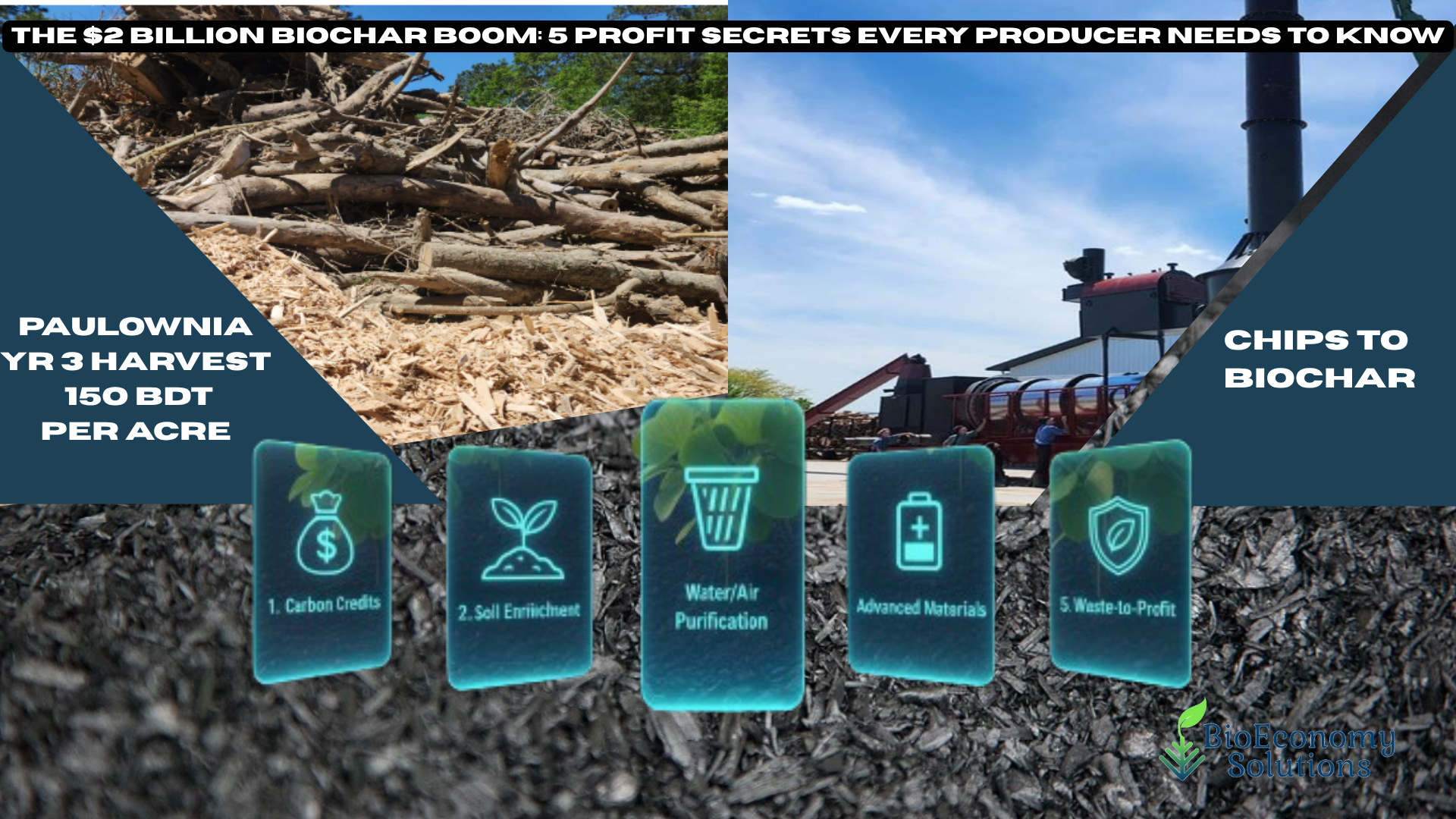
Most biochar companies are leaving money on the table.

Here’s how the smartest producers are turning waste into a goldmine—while everyone else is stuck chasing commodity prices.


The Profitability Crisis Nobody Talks About

You can have the best technology, the greenest mission, and the most passionate team—but if your biochar business isn’t profitable, it won’t last.

The brutal truth:
Most biochar startups struggle with high costs, inconsistent feedstock, and razor-thin margins.

But the market is exploding:

  • $641M in 2022 → $2.1B by 2030
  • Profit margins: 20% to 50%+
  • Premium products: $2,000+/ton

So why are so many companies missing out?


The 5 Profit Levers That Separate Winners from Losers

1. Feedstock Sourcing: The 40% Cost Secret

  • Smart producers co-locate near agricultural or forestry waste sources
  • Tipping fees turn a cost into a revenue stream ($30-50/ton)
  • Result: Up to 40% reduction in total feedstock costs

2. Energy Integration: Turn Waste Gas into Free Power

  • Use syngas from pyrolysis to power your plant
  • Eliminate external energy bills—save $50-100/ton
  • Result: Lower operating costs, higher margins

3. Scale Up or Get Left Behind

  • Bigger plants = lower costs: 20-30% per-ton savings at 10,000 tons/year vs. 2,000 tons/year
  • Better labor and equipment utilization
  • Result: Scale is the fastest path to profit

4. Specialize to Command Premiums

  • Custom blends (compost, nutrients, fungi) sell for 50-150% more than raw biochar
  • Target high-value markets: agriculture, horticulture, water treatment
  • Result: Move from commodity to premium pricing

5. Make It Easy for Customers

  • Pellets, granules, prills—user-friendly forms justify 20-40% price increases
  • Easier transport, storage, and application
  • Result: Higher sales, happier customers

The Playbook for Biochar Profitability

What the best producers do differently:

  • Secure negative-cost feedstock (tipping fees, local partnerships)
  • Integrate energy systems to cut costs and boost sustainability
  • Invest in scale—don’t stay small and hope for the best
  • Develop value-added products for premium markets
  • Get certified (IBI, EBC) to unlock new customers and higher prices

The bonus revenue streams:

  • Carbon credits: Monetize your climate impact
  • Co-products: Bio-oil, syngas for energy or sale
  • New markets: Construction, animal feed, industrial uses

The bottom line:
Biochar isn’t just about saving the planet—it’s about building a business that lasts.


Ready to turn your biochar operation into a profit engine?

Stop chasing commodity prices. Start building a premium, diversified, and scalable business.

Want the full playbook? Contact Us.


CONTACT US
Contact BioEconomy Solutions for a confidential biodiversity credit portfolio assessment.

Your next audit could be a profit opportunity instead of a compliance expense.

Visit our web “Paulownia Carbon Credits” page.

We’re happy to organize a time to speak with you about our paulownia trees and lumber we have for sale. Please book your preferred time to speak directly.

Here’s a link to my online calendar/schedule:

www.bioeconomysolutions.com/bookcall 

BioEconomy Solutions

mail@BioEconomySolutions.com

Office: 843.305.4777

LIKE|SHARE|COMMENT

Join Our Newsletter – Get a FREE copy of Paulownia Carbon Report

#Biochar #Profitability #Sustainability #AgTech #CircularEconomy #StartupGrowth

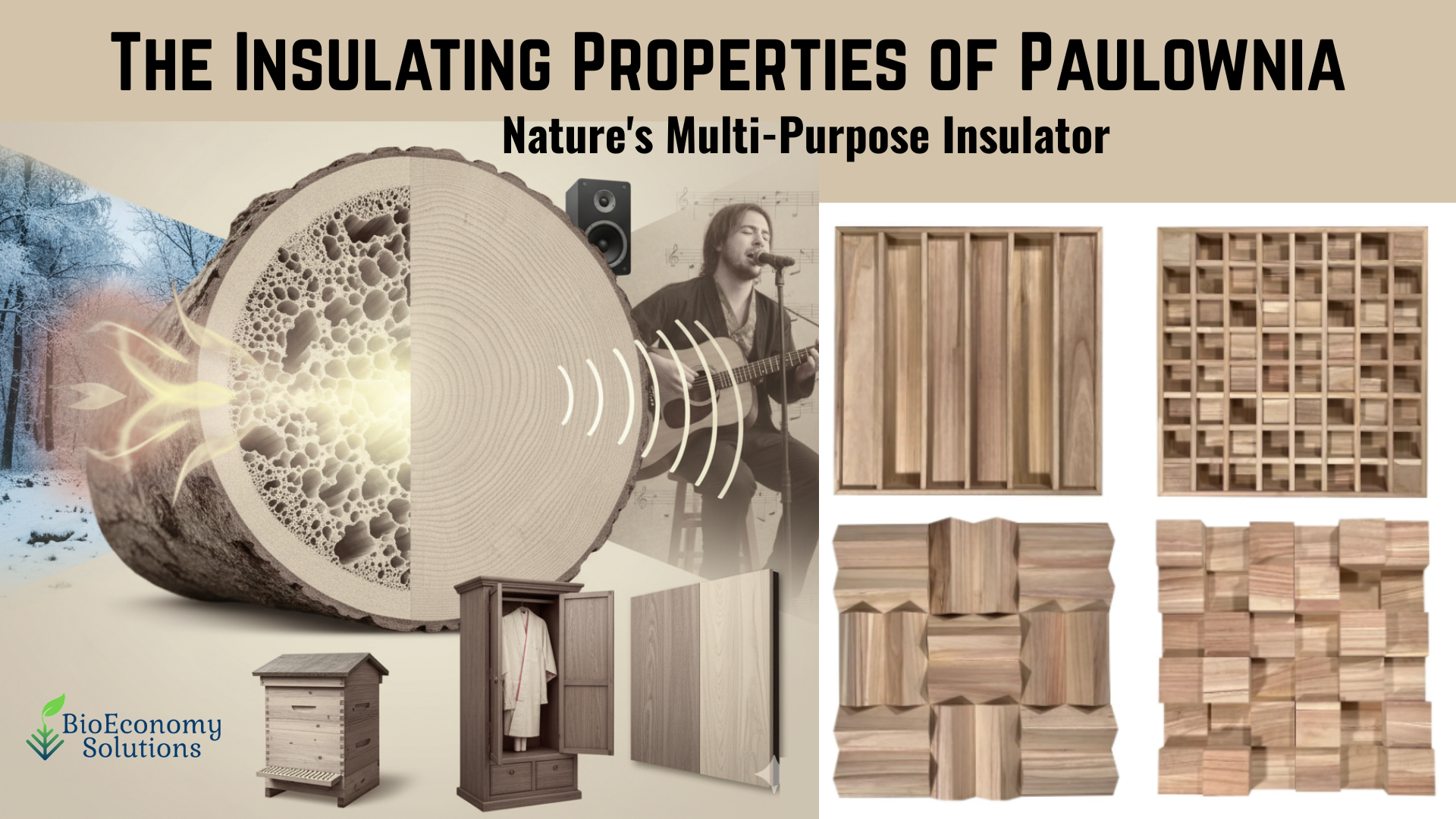
Paulownia wood possesses exceptional insulating properties that make it valuable across multiple applications. Here’s a comprehensive breakdown:

Thermal Insulation Properties

Low Thermal Conductivity

  • Paulownia has one of the lowest thermal conductivity values among all wood species
  • This means it effectively resists heat flow, keeping interiors warm in winter and cool in summer
  • The thermal conductivity becomes even lower after thermal modification (heat treatment)
  • Performance is comparable to standard thermal insulation materials

Structural Basis for Insulation

  • Low Density: One of the lightest woods available (30% lighter than most hardwoods)
  • Honeycomb Cellular Structure: Highly porous internal structure traps air – nature’s best insulator
  • Hollow Center: The characteristic “water highway” creates additional air pockets for insulation

Fire Resistance & Safety

Superior Fire Performance

  • Auto-ignition temperature: ~400°C (752°F) vs. ~220°C (428°F) for common hardwoods
  • Class A Fire Rating: Achieved ASTM E84 flame spread rating (as noted in knowledge base)
  • Self-Protecting Mechanism: When heated, it carbonizes easily, creating a char layer that insulates and protects the wood underneath

Why It Matters

  • Significantly safer for construction applications
  • Reduces fire insurance costs
  • Meets strict building codes without chemical treatments

Acoustic Insulation

Sound-Deadening Properties

  • Light weight combined with porous structure creates excellent sound absorption
  • Natural acoustic dampening without additional materials
  • Reduces noise transmission between spaces

Applications

  • Musical instruments (traditional use for centuries)
  • Recording studios and concert halls
  • Residential sound insulation
  • Commercial acoustic panels

Practical Applications of Paulownia’s Insulating Properties

Construction & Building

  • Wall panels: Natural insulation reduces HVAC costs
  • Roofing materials: Lightweight with thermal protection
  • Interior cladding: Temperature regulation without bulk
  • Mass timber construction: Insulating structural elements

Specialized Uses

  • Saunas: Heat resistance + insulation + moisture tolerance
  • Cold storage: Natural thermal barrier
  • Shipping containers: Temperature-controlled transport
  • Aerospace: Lightweight insulation for aircraft interiors

Traditional Applications

  • Japanese construction: Used for centuries in fire-resistant buildings
  • Furniture: Naturally insulating storage chests and wardrobes
  • Musical instruments: Acoustic properties enhance sound quality

Comparative Advantages

vs. Traditional Insulation Materials:

  • Renewable and sustainable (5-year harvest cycles)
  • No chemical treatments required
  • Structural strength + insulation in one material
  • Natural fire resistance without additives

vs. Other Woods:

  • 2x better thermal performance than most hardwoods
  • Significantly lighter weight
  • Superior fire resistance
  • Better acoustic properties

Economic Benefits

Energy Efficiency

  • Reduces heating and cooling costs
  • Meets green building standards naturally
  • Lower HVAC system requirements

Construction Advantages

  • Lighter weight reduces structural load requirements
  • Faster installation due to workability
  • Multi-functional (structural + insulating)
  • Reduced need for additional insulation materials

Scientific Backing

The insulating properties are well-documented and stem from:

  1. Physical structure: Honeycomb cellular matrix traps air
  2. Low density: Less material = more air pockets
  3. Thermal modification potential: Heat treatment enhances properties
  4. Natural composition: No synthetic additives needed

Future Applications

Given these properties, Paulownia is positioned for:

  • Passive house construction: Ultra-efficient building standards
  • Sustainable architecture: Green building certifications
  • Industrial insulation: High-temperature applications
  • Acoustic engineering: Specialized sound control

The combination of thermal, fire, and acoustic insulation properties makes Paulownia unique among natural materials – offering multiple performance benefits in a single, sustainable, fast-growing resource.


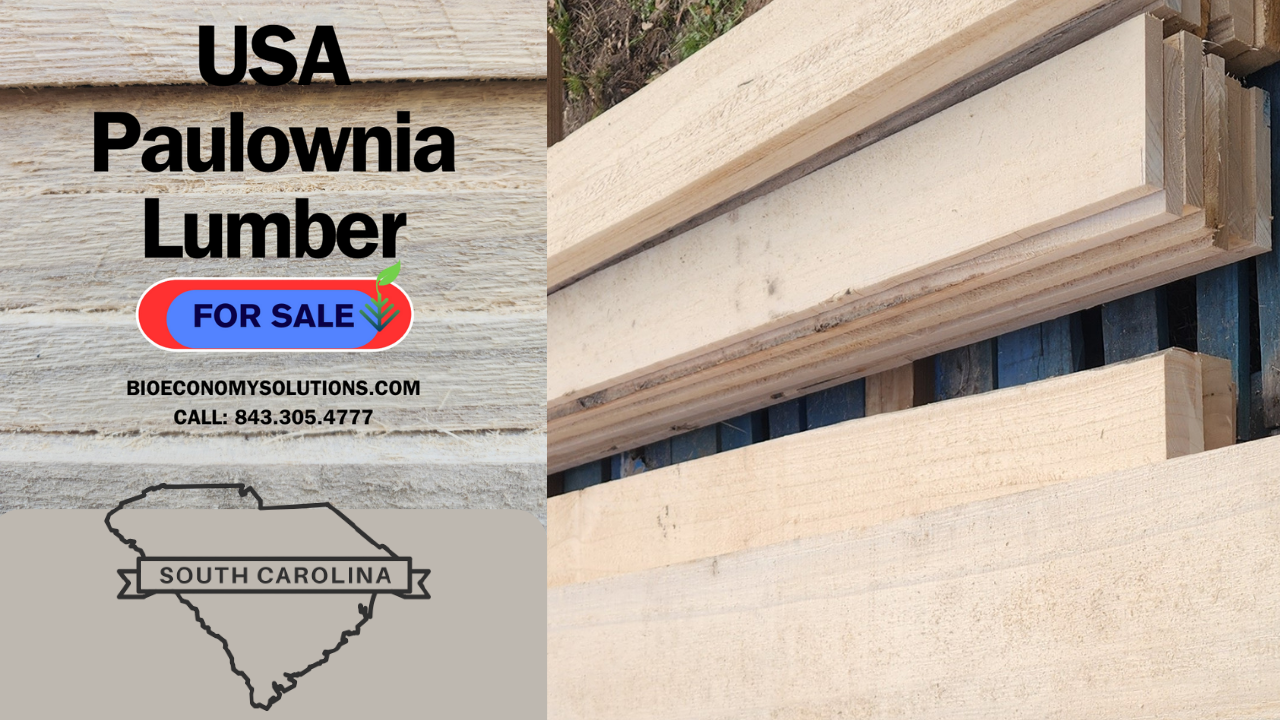
Where To Buy USA Paulownia Lumber?

Need paulownia for your next project?

Where to buy paulownia? We’re harvesting our mature U.S. South Carolina Paulownia Timber and have millions of board foot available. We can mill lumber for your business needs. Contact Us for details. Office: 843.305.4777 | Email: mail@bioeconomysolutions.com Here’s a link to our online calendar, schedule a conference call with us:

www.bioeconomysolutions.com/bookcall

USA Paulownia Wood Lumber For Sale – Need paulownia wood lumber for your next project? https://bioeconomysolutions.com/paulownia-lumber/

You will discover that paulownia wood is the “Light Strong Alternative Wood” used in many processes to obtain many types of products.

Weather you are a hobbyist or full time manufacturing company, paulownia wood grown in South Carolina USA may be a new expression of your talent.

We sell Custom Paulownia boards: rough sawn or planed, we offer various sizes and thicknesses. Our Paulownia boards are processed using sustainable Paulownia hardwood grown right here in South Carolina USA.

If you’re interested in paulownia, want to grow or currently growing, Subscribe to our newsletter: https://bioeconomysolutions.com/carbonreport

LIKE|SHARE|COMMENT

If you enjoyed this article, you may also like “Do Wood Carvers Use Paulownia Wood?

How Paulownia Trees Capture the $340M European Biochar Boom and $20B ESG Market.

The numbers are staggering:

European biochar market: $340M by 2030 US biochar market: $1.3B by 2033 European ESG market: $20.48B by 2030

But here’s what most people miss:

The feedstock bottleneck is about to choke growth.

The Supply Crisis Nobody’s Talking About

Current biochar production relies on:

  • Agricultural waste (seasonal, inconsistent)
  • Forest residues (limited, transportation costs)
  • Energy crops (compete with food production)

Result: 180+ European biochar plants by 2023, but feedstock shortages limiting scale.

Enter Paulownia: The Biochar Game-Changer

Why Paulownia solves the feedstock crisis:

🌱 Consistent Supply:Coppices every 3-5 years, predictable biomass

🌱 High Yield:80-100 green tons per hectare annually

🌱 Purpose-Grown:Dedicated energy crops, not competing with food

🌱 Marginal Land:Grows on degraded soil, doesn’t displace agriculture

🌱 Mechanized Harvest: 80-100 tons/hour processing capacity

The Perfect Market Timing

European Biochar Drivers = Paulownia Advantages:

Sustainable Agriculture ✅

  • Paulownia biochar improves soil structure and nutrient retention
  • Intercropping capabilities support regenerative farming
  • Grows on marginal land, restores degraded soils

Climate Mitigation ✅

  • 2.5-3.3 carbon credits per ton of biochar produced
  • Permanent carbon storage (1,000+ years)
  • Dual sequestration: growth phase + biochar storage

Technological Advancement ✅

  • Optimized for pyrolysis (low ash, high carbon content)
  • Consistent feedstock quality for industrial-scale production
  • Integrated biorefinery potential (biochar + biofuels + chemicals)

Regulatory Support ✅

  • EU Taxonomy alignment for sustainable activities
  • CSRD reporting requirements favor verifiable carbon removal
  • Article 6 carbon market opportunities

ESG Market Integration Strategy

How Paulownia captures the $20B ESG opportunity:

Environmental (E)

  • Verified Carbon Removal: Blockchain-tracked from tree to biochar
  • Biodiversity Enhancement: Habitat corridors, pollinator support
  • Soil Restoration: Degraded land rehabilitation, erosion control
  • Water Management: Improved infiltration, reduced runoff

Social (S)

  • Rural Development: Farmer partnerships, local job creation
  • Community Investment: Processing facilities in rural areas
  • Food Security: Intercropping capabilities, soil improvement
  • Environmental Justice: Restoration of underserved communities

Governance (G)

  • Transparency: Crystal Validator™ compliance controls
  • Traceability: Registry serialization through Xpansiv
  • Risk Management: Diversified revenue streams, climate resilience
  • Stakeholder Engagement: Community-based growing programs

The Competitive Advantage

Traditional Biochar Feedstock:

❌ Seasonal availability

❌ Quality inconsistency

❌ Transportation costs

❌ Competing uses

Paulownia Biochar Feedstock:

✅ Year-round production planning

✅ Consistent quality parameters

✅ Local production networks

✅ Purpose-grown for biochar

Market Capture Strategy

Phase 1: European Market Entry (2025-2026)

  • Partner with existing biochar producers facing feedstock shortages
  • Establish 5,000-hectare demonstration plantations
  • Secure offtake agreements with industrial biochar facilities
  • Target €125-145/ton biochar credit pricing (current CORCCHAR index)

Phase 2: Scale-Up (2027-2029)

  • Expand to 50,000+ hectares across multiple EU countries
  • Develop integrated biorefineries (biochar + biofuels + chemicals)
  • Launch direct ESG partnerships with Fortune 500 companies
  • Capture 5-10% of European biochar feedstock market

Phase 3: Market Leadership (2030+)

  • Achieve 100,000+ hectare production network
  • Establish Paulownia as premium biochar feedstock standard
  • Export model to US market ($1.3B opportunity)
  • Lead consolidation of fragmented biochar supply chains

Financial Projections

Conservative Market Capture (5% of European biochar market by 2030):

  • Market opportunity: $17M annually (5% of $340M)
  • Feedstock premium: 20-30% above agricultural waste
  • Carbon credit revenue: Additional $50-75M annually
  • Total addressable revenue: $67-92M from European market alone

ESG Integration Multiplier:

  • Premium pricing for verified ESG impact: +25-40%
  • Long-term offtake agreements: Reduced market risk
  • Diversified revenue streams: Timber, carbon, biochar, data

The Regulatory Tailwind

EU Taxonomy Alignment:

  • Climate change mitigation (carbon sequestration)
  • Climate change adaptation (soil restoration)
  • Sustainable use of water and marine resources
  • Transition to circular economy (waste-to-value)
  • Pollution prevention and control (soil remediation)
  • Protection of healthy ecosystems (biodiversity enhancement)

CSRD Reporting Benefits:

  • Quantifiable environmental impact metrics
  • Verifiable carbon removal documentation
  • Supply chain sustainability evidence
  • Stakeholder engagement proof points

The Bottom Line

The biochar market is exploding, but feedstock supply is the bottleneck.

The ESG market demands verifiable impact, but most solutions lack transparency.

Paulownia solves both problems:

  • Reliable, scalable biochar feedstock
  • Integrated ESG impact with audit-grade documentation
  • Multiple revenue streams reducing investment risk
  • Regulatory alignment across EU frameworks

While competitors struggle with feedstock shortages and ESG compliance, Paulownia-based solutions capture both the $340M biochar opportunity and the $20B ESG market through integrated, verifiable impact.

The question isn’t whether these markets will grow—it’s whether you’ll be positioned to capture them.


Ready to explore how Paulownia can position your organization in the biochar and ESG growth markets? Contact BioEconomy Solutions to learn how purpose-grown feedstock and integrated ESG solutions create competitive advantages in rapidly expanding markets.

The biochar boom needs feedstock. The ESG market needs proof. Paulownia delivers both.

Contact Us for paulownia saplings and planning assistance.

Where To Buy Paulownia? Paulownia For Sale – QUESTIONS?

Learn more about paulownia carbon projects here: https://bioeconomysolutions.com/paulownia-carbon-credits/

We’re happy to organize a time to speak with you about our paulownia trees and lumber we have for sale. Please book your preferred time to speak directly.

Here’s a link to my online calendar/schedule:

www.bioeconomysolutions.com/bookcall

BioEconomy Solutions

mail@BioEconomySolutions.com

Office: 843.305.4777


Download FREE Paulownia Carbon REPORT

Subscribe to our newsletter

Subscribe to our newsletter & get FREE Paulownia Carbon Report

The $50 Billion Carbon Credit Rush

The $50 Billion Carbon Credit Rush: Why Smart Money Is Buying Trees (Before It’s Too Late)

The market that’s about to explode from $8 billion to $200 billion in the next 6 years – and 99% of people have no idea it exists.

While everyone’s chasing crypto and AI stocks, the smartest investors are quietly buying something that literally grows money from dirt. And the supply is running out faster than anyone expected.

Here’s exactly what’s happening in the carbon credit market and how you can position yourself before this opportunity disappears forever.

SECTION 1: The Market Explosion Nobody Sees Coming

Right now, only 537 companies globally are buying carbon removal credits. But over 10,000 companies have committed to net-zero targets by 2030.

The Math Is Staggering:

  • If just 10% start buying, the market needs to scale 25 times overnight

  • New regulations force companies to buy starting in 2026

  • Current market: $8 billion → Projected: $200+ billion

The Clear Winner: Biochar dominates everything:

  • 86% of all carbon removal deliveries in 2024

  • 80% of buyers choose biochar over other solutions

  • Delivers credits in 1-3 years vs. 20+ years for traditional forestry

But here’s the problem that’s about to make early investors very wealthy..

SECTION 2: The Supply Crisis Creating Millionaires

Supply Is Disappearing Before Our Eyes:

  • 62% of high-quality biochar capacity for 2025: SOLD OUT

  • 28% of 2026 supply: LOCKED UP in contracts

  • Only 30% of biochar projects meet institutional quality standards

Smart Money Strategy: While most people buy carbon credits at market price, companies like Microsoft, Google, and Stripe are signing “offtake agreements” – pre-ordering years in advance at massive discounts.

The Results Speak for Themselves:

  • 15-30% discounts compared to spot prices

  • One company saved $918,750 on a single 3-year deal

  • Historical example: $125/tonne (2022 offtake) vs. today’s $165/tonne

SECTION 3: The Price Explosion That’s Already Started

Why Prices Will Skyrocket:

  • Biochar prices already grew 29.2% annually for 4 consecutive years

  • By 2030, demand could be 6 times larger than available supply

  • 70% of new biochar capacity fails quality standards

The Perfect Storm Is Brewing:

  • 10,000+ companies must start buying by 2026 (regulatory requirements)

  • Each biochar facility caps at 100,000 tonnes/year maximum

  • Less than half of 2030 demand is currently financed

Reality Check: Companies without secured supply contracts risk missing their climate targets entirely due to supply shortages.

SECTION 4: How to Position Yourself in This Rush

Your Investment Options:

1. Direct Offtake Agreements

  • 15-30% discounts vs. spot market

  • 1,000+ ton minimums required

  • Multi-year contracts lock in favorable pricing

2. Carbon Credit Investment Funds

  • Lower minimums for smaller investors

  • Professional management handles sourcing and verification

  • Diversified exposure across multiple projects

3. Biochar Production Investment

  • Highest potential returns (supply-constrained market)

  • Significant capital requirements

  • Direct ownership of production assets

The Critical Timeline:

  • 2025: Last chance for favorable offtake terms

  • 2026: Regulatory requirements kick in, demand surge begins

  • 2027+: Spot market chaos, premium pricing becomes the norm

The Numbers Don’t Lie: This Is Bigger Than Anyone Realizes

Market Reality Check:

  • Current CDR capacity: 0.003% of what’s needed by 2050

  • Demand growth: 78% in 2024 while broader carbon markets contracted 61%

  • Supply concentration: Only 36% of CDR suppliers have registered any sales

  • Quality crisis: 70% of expected biochar capacity by 2026 fails standards

What the Smart Money Knows: Microsoft, Google, and Stripe drove 80% of all CDR purchases in 2024. They’re not buying on the spot market—they’re locking up supply years in advance through offtake agreements.

Why This Opportunity Won’t Last

The biochar landgrab is already underway. Here’s what’s happening behind closed doors:

  • Major corporations are signing exclusive multi-year supply deals

  • High-quality producers are getting locked up by early movers

  • Spot market buyers will be left competing for scraps at premium prices

The window to act is measured in months, not years.

Your Next Move

The carbon credit market is moving from speculation to necessity. In 5 years, you’ll either thank yourself for understanding this early, or watch others profit from the biggest commodity rush of our lifetime.

The facts are clear:

  • Supply is disappearing faster than new capacity comes online

  • Prices are rising at 29%+ annually with no ceiling in sight

  • Regulatory requirements will force 10,000+ companies to become buyers

  • Early movers are securing 15-30% discounts while latecomers pay premiums

This isn’t about saving the planet anymore—it’s about positioning yourself in a supply-constrained market before everyone else figures it out.


Ready to explore your options in the carbon credit rush?

Contact BioEconomySolutions.com and book your private strategy session today. We’ll show you exactly how to position yourself in this market before the opportunity disappears.

The carbon credit landgrab is happening now. The question isn’t whether you’ll participate—it’s whether you’ll be early or late.

Contact Us

BioEconomy Solutions is a Carbon Dioxide Removal (CDR) Project Developer. Talk to us about our TREE PLANTING strategies with Paulownia trees.

We’re happy to organize a time to speak with you about our paulownia trees and lumber we have for sale. Please book your preferred time to speak directly.

Here’s a link to my online calendar/schedule:

www.bioeconomysolutions.com/bookcall

BioEconomy Solutions

mail@BioEconomySolutions.com

Office: 843.305.4777

Visit us at: https://bioeconomysolutions.com/paulownia-carbon-credits/ Let’s chat about paulownia tree solutions for sustainable Forest carbon credits projects.

LIKE|SHARE|COMMENT

Enjoy this article? You may also enjoy “Carbon Developers Choose Paulownia Trees” https://www.linkedin.com/pulse/carbon-developers-choose-paulownia-trees-victor-garlington-imh4e/

Download FREE Guide on “Carbon Credits & Paulownia Trees”

Subscribe to our newsletter

Subscribe to our newsletter

The Perfect Storm Hitting American Construction!

Steve Martinez, a Boise contractor, watches lumber prices swing wildly—sometimes increasing tenfold overnight. Canada has historically accounted for a very high percentage of U.S. softwood lumber imports, typically in the 70–85% range. Recent data shows this percentage has shifted. For example, in 2024, Canada accounted for 84.3% of U.S. softwood lumber imports.

The new potential tariffs jumping from 14.5% to 34.5%, America’s construction industry faces an unprecedented crisis which ultimately the end consumer pays the price.

The numbers are staggering: over 100 million American households can’t afford the median $460,000 home price, while builders struggle with fixed contracts and volatile material costs that make up 15-18% of total construction expenses.

But what if there was a domestic solution growing right under our noses?

Enter Paulownia: America’s Untapped Lumber Goldmine

While politicians debate tariffs and regulations, a revolutionary wood species is quietly proving itself across American soil. Paulownia—often called the “aluminum of lumber”—offers properties that could transform the U.S. construction landscape.

The Paulownia Advantage: Superior Performance Metrics

Strength-to-Weight Champion:

  • 30% lighter than traditional hardwoods
  • Twice as strong as balsa wood
  • Highest strength-to-weight ratio of any wood globally
  • Perfect for reducing transportation costs and construction labor

Built-in Durability:

  • Naturally fire-resistant (higher ignition temperature)
  • Termite and rot resistant without chemical treatment
  • Dimensionally stable—resists warping, shrinking, and cracking
  • Ideal for moisture-prone applications like saunas and pool decks

Construction Versatility:

  • Non-load-bearing structural components
  • Interior finishing and trim work
  • Flooring with superior dimensional stability
  • Natural insulation properties
  • Acoustic panels for soundproofing

Paulownia Bearing The Load

Non-load-bearing structural components are elements of a building that do not support the main weight of the structure, such as the roof or floors. Instead, they primarily serve functions like dividing spaces, providing insulation or soundproofing, or acting as decorative finishes. Examples include interior partition walls, drywall, and exterior cladding.

Paulownia Wood and Load-Bearing Applications

Paulownia wood is exceptionally lightweight, often compared to balsa wood, but it has a high strength-to-weight ratio. While it is naturally a non-load-bearing material by itself, its properties can be enhanced through existing engineered wood technologies to make it suitable for some load-bearing applications.

These technologies generally involve processing the wood to create composite materials with improved structural properties:

Laminated Veneer Lumber (LVL): This process involves bonding thin layers (veneers) of wood together with adhesives. By arranging the grain of all veneers parallel to the long direction, LVL creates a strong, stiff, and dimensionally stable product.

Sandwich Panels: Paulownia wood can be used as the lightweight core material in a sandwich panel, with stronger, denser materials like fiberglass, plywood, or other hardwoods bonded to its surfaces. This structure provides high stiffness and strength while keeping the overall product lightweight.

Glued Laminated Timber (Glulam): Similar to LVL, glulam is made by bonding together smaller pieces of wood into larger, more stable members. This process can utilize the lightweight properties of paulownia for the core while potentially using stronger wood or other materials for the outer laminations to increase its load-bearing capacity.

The use of these engineered wood products allows paulownia to be utilized in structural applications where its natural properties alone would be insufficient, leveraging its fast growth and sustainable characteristics for a greener building industry.

Engineered wood technologies, including laminated veneer lumber (LVL) and cross-laminated timber (CLT), are used in modern construction.

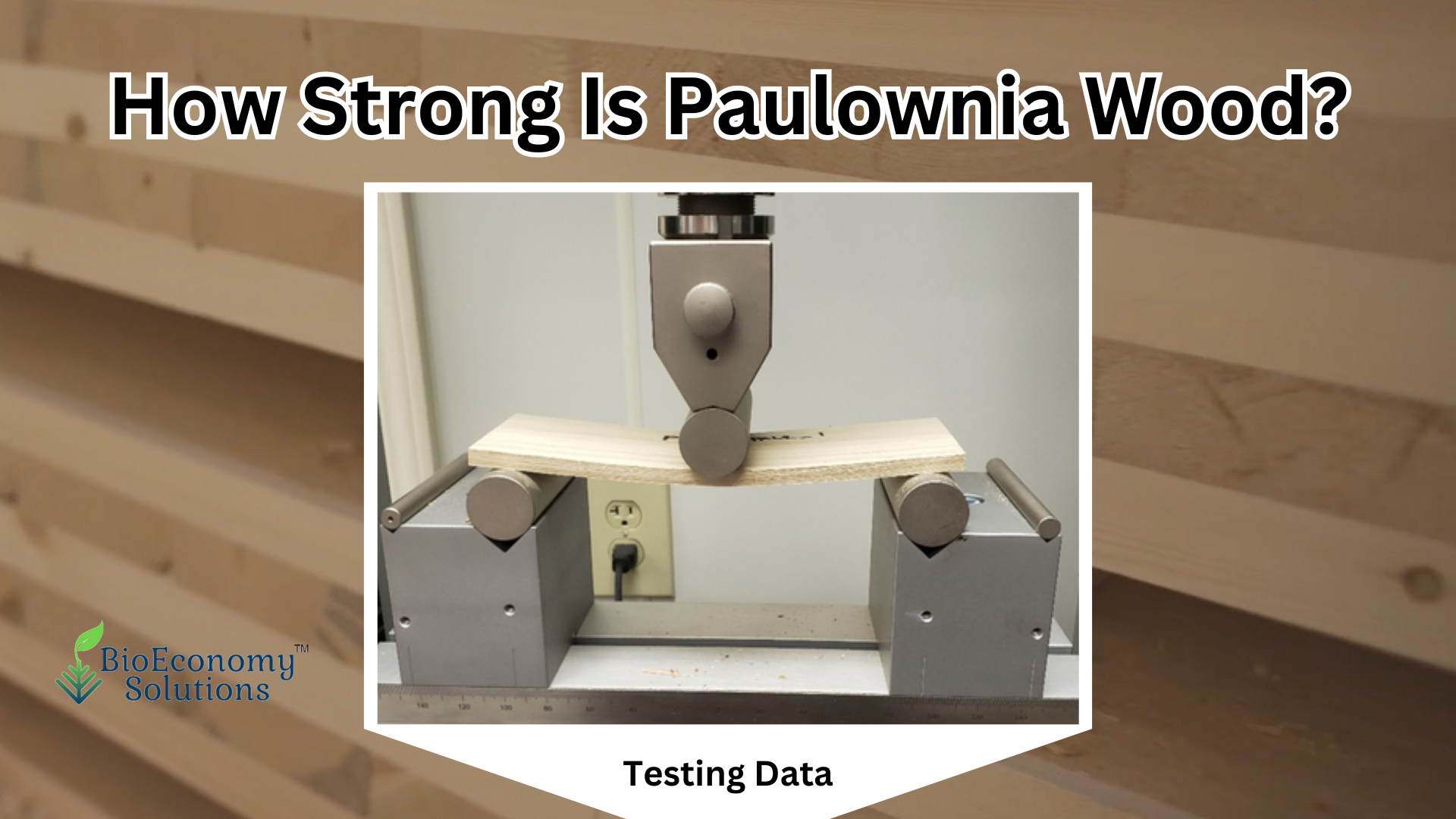
How Strong Is Paulownia Wood?

Solving America’s Lumber Supply Chain Crisis

Speed to Market: The Game-Changer

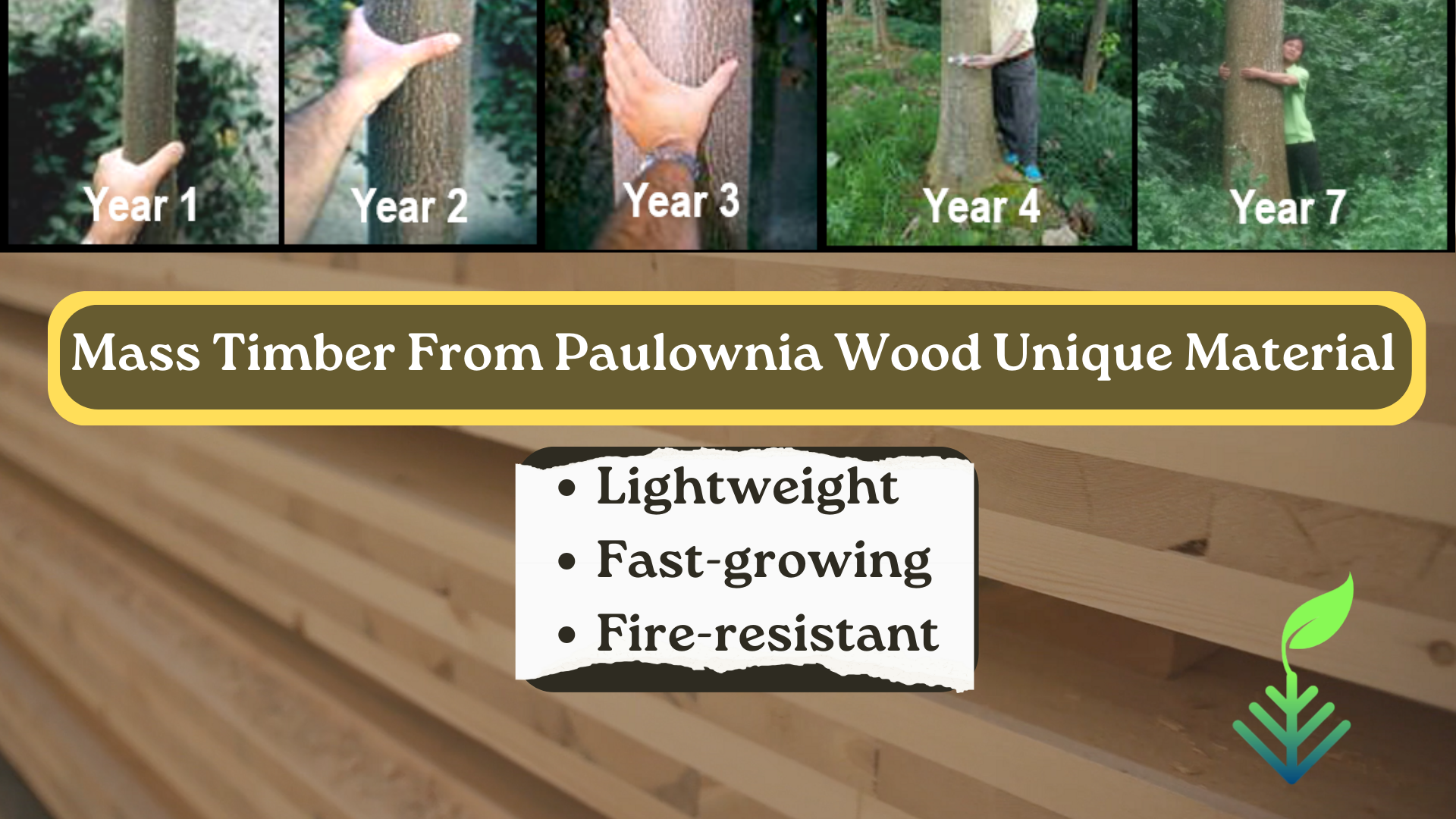
While traditional softwood takes 20-50 years to mature, Paulownia delivers:

  • Harvestable timber in 5-7 years
  • 15-30 feet of growth in first season
  • Coppicing ability: Regrows from cut stumps without replanting
  • Multiple harvests from single planting

This means American landowners could establish domestic lumber supply chains in less than a decade—not the generations required for traditional forestry.

Geographic Flexibility

Unlike softwood forests concentrated in the Pacific Northwest and Southeast, Paulownia thrives across diverse American landscapes:

  • Semi-arid regions previously unsuitable for timber
  • Degraded agricultural land generating new rural income
  • Marginal soils where food crops struggle
  • Urban periphery for distributed lumber production

USA Paulownia Lumber now has “Class A” ASTM E84 Flame Spread Rating.

Download: Flame-Retardancy-of-Paulownia-Wood-and-Its-Mechanism.pdf

A Class A ASTM E84 flame spread rating for Paulownia lumber is highly significant for its advancement in the U.S. structural lumber and interior building materials market. Here’s why:

Economic Impact: Beyond Lumber

For Rural America:

  • Farmers diversify income with fast-growing timber crops
  • Abandoned farmland becomes productive again
  • Local sawmills process regional Paulownia supply
  • Carbon credit revenue provides additional income streams

For Builders:

  • Reduced transportation costs from distributed production
  • Price stability through domestic supply chains
  • Superior performance characteristics reduce callbacks
  • Lightweight properties decrease labor costs

For Homeowners:

  • Lower construction costs through domestic supply
  • Superior insulation reduces energy bills
  • Fire-resistant properties may lower insurance premiums
  • Sustainable building materials increase property values

The Construction Applications Revolution

Mass Timber Potential

While Paulownia isn’t suitable for primary load-bearing applications, its unique properties make it ideal for paulownia mass timber applications:

Sandwich Construction:

  • Paulownia core with hardwood exterior
  • Maintains strength while reducing weight
  • Significant material cost savings
  • Enhanced insulation properties

Engineered Wood Products:

  • Laminated veneer lumber (LVL) applications
  • Cross-laminated timber (CLT) components
  • Glue-laminated beams for specific applications

Specialty Markets

High-Value Applications:

  • Musical instrument construction (proven market)
  • Boat building and marine applications
  • RV and mobile home construction
  • Modular housing components

Addressing the Labor Crisis

The U.S. lumber industry faces severe labor shortages, with employment expected to decline 2-4% by 2033. Paulownia offers solutions:

Mechanized Harvesting:

  • Forage harvesters process 80-100 green tons per hour
  • Reduced dependence on skilled logging crews
  • Safer harvesting operations
  • Lower labor costs per board foot

Distributed Processing:

  • Smaller, regional mills reduce transportation
  • Less specialized labor required
  • Community-based economic development
  • Reduced infrastructure investment

The Regulatory Advantage

While traditional forestry battles the Endangered Species Act and National Environmental Policy Act, Paulownia offers regulatory benefits:

Environmental Positives:

  • Carbon sequestration during growth phase
  • Soil improvement on degraded lands
  • No impact on old-growth forests
  • Biodiversity enhancement when properly managed

Fast Permitting:

  • Agricultural land conversion simpler than forest management
  • No endangered species habitat conflicts
  • Positive environmental impact assessments
  • Community economic development benefits

Economic Modeling: The Numbers Work

Traditional Softwood Economics:

  • 20-50 year investment horizon
  • High land acquisition costs
  • Regulatory compliance expenses
  • Transportation from limited regions

Paulownia Economics:

  • 5-7 year payback period
  • Utilizes lower-cost marginal land
  • Multiple revenue streams (timber, carbon, biomass)
  • Distributed production reduces logistics costs

Market Opportunity: With lumber representing a $60+ billion annual U.S. market, even capturing 10% would create a $6 billion Paulownia industry—enough to meaningfully impact supply and pricing.

Implementation Strategy: A Roadmap Forward

Phase 1: Pilot Projects (Years 1-3)

  • Establish demonstration plantations in key regions
  • Partner with progressive builders for testing
  • Develop processing and grading standards
  • Create supply chain partnerships

Phase 2: Scale-Up (Years 3-7)

  • Expand acreage based on proven demand
  • Build regional processing facilities
  • Establish distribution networks
  • Develop specialized applications

Phase 3: Market Integration (Years 7-15)

  • Achieve meaningful market share in specialty applications
  • Integrate with existing lumber supply chains
  • Export surplus production
  • Establish Paulownia as standard construction material

The Investment Opportunity

For Landowners:

  • Convert marginal land to productive timber assets
  • Generate income while trees mature through carbon credits
  • Benefit from multiple harvest cycles
  • Participate in growing domestic lumber market

For Investors:

  • Early entry into emerging domestic lumber supply
  • ESG-compliant investment with measurable impact
  • Multiple exit strategies through various end markets
  • Hedge against lumber price volatility

For Communities:

  • Rural economic development opportunities
  • Reduced dependence on volatile agricultural markets
  • Local processing jobs
  • Sustainable economic base

Overcoming the Challenges

Market Acceptance:

  • Education about Paulownia’s superior properties
  • Demonstration projects proving performance
  • Building code acceptance and standards development
  • Architect and engineer training programs

Supply Chain Development:

  • Processing equipment adaptation
  • Quality grading systems
  • Distribution network establishment
  • End-user education and support

Scale Requirements:

  • Coordinated planting across multiple landowners
  • Processing facility investment
  • Market development initiatives
  • Policy support for domestic alternatives

The Climate Bonus

While solving America’s lumber crisis, Paulownia delivers massive climate benefits:

  • 80-100 tons CO₂ sequestered per acre in first 5 years
  • Carbon-negative construction materials
  • Reduced transportation emissions from domestic supply
  • Soil improvement on degraded lands

This creates additional revenue through carbon credit markets while addressing climate goals.

The Time Is Now

America’s lumber crisis demands innovative solutions. While politicians debate tariffs and regulations, Paulownia offers a market-based path forward:

Domestic supply security

Superior performance characteristics

Rapid deployment timeline

Rural economic development

Climate benefits

Regulatory advantages

The question isn’t whether Paulownia can help solve America’s lumber crisis—it’s whether we’ll act fast enough to capture the opportunity.

Every month we delay is another month of volatile prices, housing unaffordability, and missed economic development.

The solution is growing. Literally.


Ready to explore Paulownia opportunities for your land, business, or investment portfolio? The domestic lumber revolution starts with the first tree planted.

Contact us to learn how Paulownia can transform your piece of America’s lumber future.

Conclusion

The Paulownia tree, with its FAST growth rate, carbon capture abilities, and adaptability, is a powerful tool in climate change mitigation, biodiversity support, and sustainable forest management. When used appropriately in afforestation and reforestation projects, it holds the potential to restore ecosystems, combat deforestation, and provide long-term environmental and economic benefits.

Contact Us

BioEconomy Solutions is a Carbon Dioxide Removal (CDR) Project Developer. Talk to us about our TREE PLANTING strategies with Paulownia trees.

We’re happy to organize a time to speak with you about our paulownia trees and lumber we have for sale. Please book your preferred time to speak directly.

Here’s a link to my online calendar/schedule:

www.bioeconomysolutions.com/bookcall

BioEconomy Solutions

mail@BioEconomySolutions.com

Office: 843.305.4777

Visit us at: https://bioeconomysolutions.com/paulownia-carbon-credits/ Let’s chat about paulownia tree solutions for sustainable Forest carbon credits projects.

LIKE|SHARE|COMMENT

Enjoy this article? You may also enjoy “Carbon Developers Choose Paulownia Trees” https://www.linkedin.com/pulse/carbon-developers-choose-paulownia-trees-victor-garlington-imh4e/

Subscribe to our newsletter

Subscribe to our newsletter

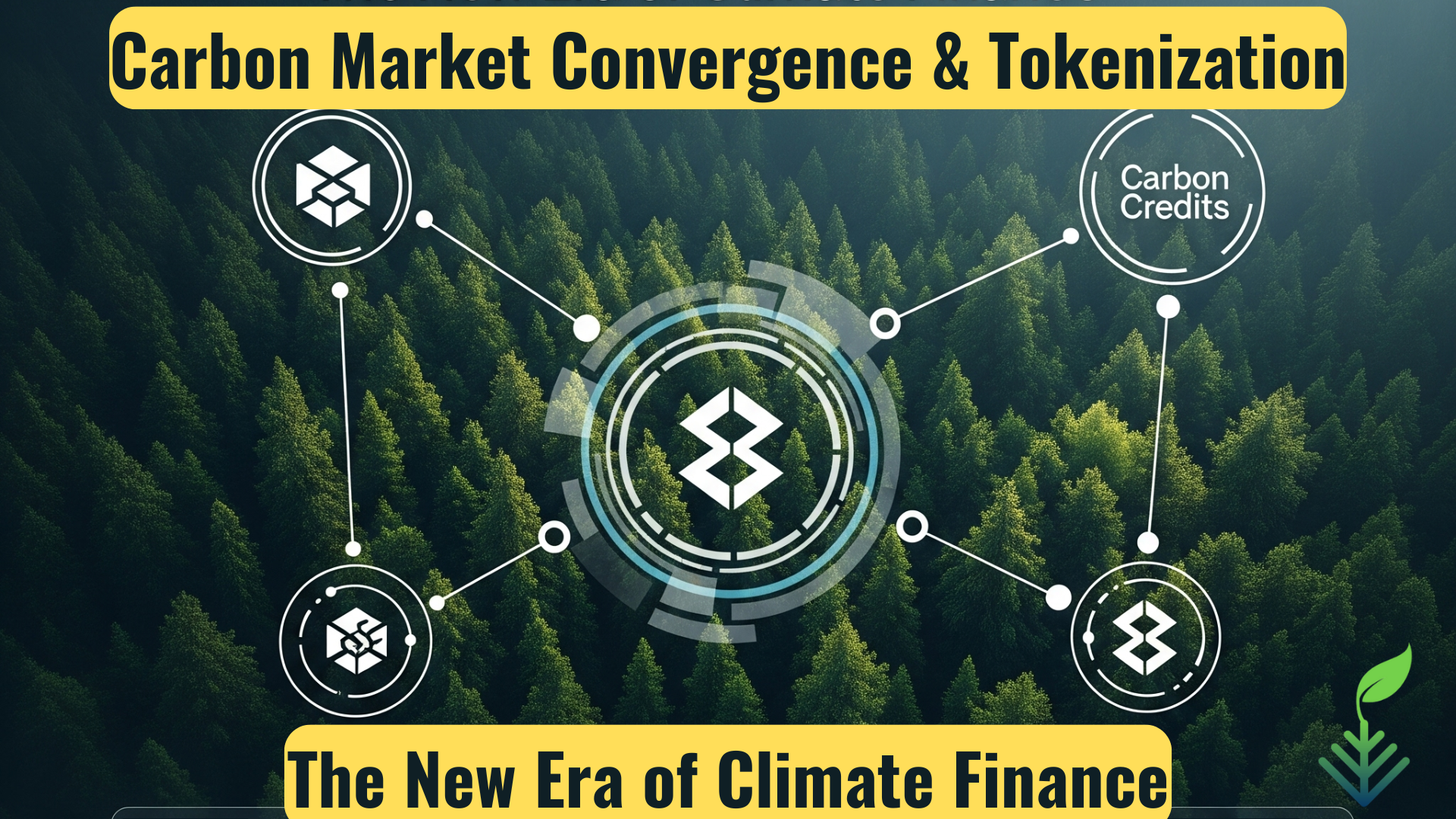
The world accelerates toward a low-carbon economy, two powerful financial innovations are converging: carbon markets and tokenization. What was once considered a fringe overlap between environmentalism and crypto is now emerging as a serious frontier for climate action and sustainable finance.

Why This Convergence Matters
Carbon credits have long been viewed as a crucial tool for offsetting emissions and achieving net-zero goals. Yet the traditional carbon market infrastructure has faced consistent challenges: lack of transparency, inefficiency, and concerns about credit legitimacy.

Enter Cryptocurrency
Tokenization, powered by blockchain technology, introduces a radical new layer of transparency, efficiency, and accessibility to carbon markets. By converting carbon credits into digital tokens, the process of buying, selling, and retiring credits becomes faster, cheaper, and more traceable.

✅ Transparency & Trust: Blockchain Solves Legacy Problems

One of the biggest criticisms of voluntary carbon markets (VCMs) has been the difficulty in verifying the origin, legitimacy, and retirement of carbon credits. Double-counting and greenwashing have eroded trust among investors and stakeholders.

Blockchain’s immutable, decentralized ledger offers a solution. By tokenizing carbon credits, each unit can be traced from issuance to retirement in real time. Platforms like Toucan Protocol, KlimaDAO, and EcoRegistry are leading this transformation, bringing visibility and accountability to what was once an opaque system.


✅ Efficiency & Liquidity: Smart Contracts Meet Climate Action

Carbon trading has traditionally been encumbered by high administrative costs, long settlement times, and limited market access. Through tokenization, smart contracts automate and streamline the process, enabling:

  • Instant settlements
  • Fractional ownership of carbon assets
  • Lower transaction fees
  • Greater liquidity in secondary markets

This not only reduces friction for large players but also makes the market accessible to individuals, small businesses, and decentralized autonomous organizations (DAOs).

✅ New Technologies and Platforms Are Emerging

The digital infrastructure around tokenized carbon is rapidly evolving. According to Carbonmark and others, we’re seeing the emergence of platforms that bridge traditional registries with programmable finance.

Notable initiatives include:

  • Xpansiv – a marketplace for on-chain carbon
  • ICR (Integrated Carbon Registry) – focusing on digitized MRV systems
  • Tether – helping integrate blockchain with existing carbon credit standards

These tools are helping carbon markets evolve from analog to digital—bringing them in line with 21st-century capital markets.


✅ Rising ESG Demand and Climate Consciousness

As climate change intensifies, the global appetite for ESG-compliant assets and sustainable investment vehicles is growing. Tokenized carbon credits offer a new channel for retail and institutional investors alike to align financial portfolios with climate goals.

This convergence also democratizes climate action. Instead of being limited to governments and large corporations, individuals and startups can now engage in carbon offsetting with low entry barriers and real-time verification.

Challenges on the Road Ahead

Despite the enormous potential, the convergence of carbon and token markets isn’t without its hurdles:

  • Regulatory Uncertainty: Legal frameworks for both carbon credits and blockchain assets are still evolving. This creates risk for token issuers and investors alike.
  • Credit Quality and Verification: Not all carbon credits are created equal. Ensuring the integrity and additionality of tokenized credits is vital to avoid greenwashing.
  • Technical Integration: Bridging legacy carbon registries with blockchain systems is complex, and interoperability between platforms remains a major issue.
  • Market Acceptance: For large-scale adoption, traditional investors and corporations need to see clear, credible benefits from tokenization—beyond hype.

ESG Investment Trend

  • The trend toward Environmental, Social, and Governance (ESG) investing is real and growing.
  • Tokenization helps democratize access, which is key to bringing in individuals, SMEs, and impact investors into a market previously dominated by large corporates.

The Path Forward

While still in its early days, the convergence of tokenized finance and environmental markets is one of the most promising developments in climate tech. It holds the potential to:

  • Unlock new capital for nature-based solutions
  • Bring carbon offsetting to a global, decentralized audience
  • Ensure trust, traceability, and liquidity in climate finance

If executed responsibly—with the right safeguards, standards, and collaboration—it can become a cornerstone of the global decarbonization strategy.

This is more than a financial innovation. It’s the infrastructure for a more transparent, inclusive, and impactful carbon economy.

Conclusion

The Paulownia tree, with its FAST growth rate, carbon capture abilities, and adaptability, is a powerful tool in climate change mitigation, biodiversity support, and sustainable forest management. When used appropriately in afforestation and reforestation projects, it holds the potential to restore ecosystems, combat deforestation, and provide long-term environmental and economic benefits.

Contact Us

BioEconomy Solutions is a Carbon Dioxide Removal (CDR) Project Developer. Talk to us about our TREE PLANTING strategies with Paulownia trees.

We’re happy to organize a time to speak with you about our paulownia trees and lumber we have for sale. Please book your preferred time to speak directly.

Here’s a link to my online calendar/schedule:

www.bioeconomysolutions.com/bookcall

BioEconomy Solutions

mail@BioEconomySolutions.com

Office: 843.305.4777

Visit us at: https://bioeconomysolutions.com/paulownia-carbon-credits/ Let’s chat about paulownia tree solutions for sustainable Forest carbon credits projects.

LIKE|SHARE|COMMENT

Enjoy this article? You may also enjoy “Carbon Developers Choose Paulownia Trees” https://www.linkedin.com/pulse/carbon-developers-choose-paulownia-trees-victor-garlington-imh4e/

Get a FREE copy of Paulownia Carbon Report

Get a FREE copy of Paulownia Carbon Report


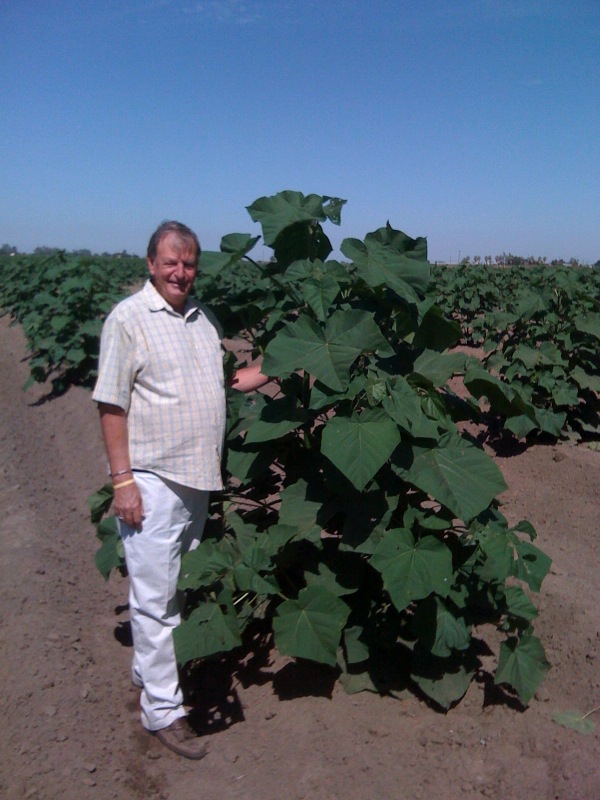
🍃 In Fresno’s sun, where orchards sleep,

A man once sowed a dream so deep.

Dr. Ray Allen, humble and wise,

☄️ Looked not just down — but to the skies.

With roots that whisper to the ground,

🌎 He found a tree not often found.

🍀 Not native, no — but nature-blessed,

🌼 A royal bloom, unlike the rest.

🌲 Three trees were blended, branch by leaf,

Through Stanford’s quiet, green belief.

🌱 A sterile seed, so it won’t roam —

Yet gives the earth a living home.

🐾 Its pods don’t spread in wild decree,

It honors rules of each state tree.

🐻 Even in California’s care,

It grows with grace — and leaves none bare.

🌬 The soil it heals, the sky it clears,

It answers prayers of future years.

And though the world has much to learn,

🌈 These trees give more than they could earn.

I walk like Muir among their shade,

And marvel at the life he made.

🌸Dr. Allen, like Appleseed,

Planted more than just a seed.

🌷 So raise your eyes and watch them grow,

From Fresno’s fields to winds that blow.

🔥 Thank Bio Economy for the flame

They keep alive — in Ray’s great name.

🍃 Let this tree’s truth at last be known:


The Empress stands where hope is grown.

An ode to a friend & Mentor -Dr. Ray Allen Inventor of the MegaFlora Paulownia Tree! 🌲

-Michael McCauley @ Neo Forest


♻️ Repost this to help your network

👉 Follow BioEconomy Solutions for more

🌍 Let’s build the carbon-negative future—one Paulownia tree at a time.

👉 Book a call: https://bioeconomysolutions.com/bookcall

👉 Get a FREE copy of Paulownia Carbon Report: https://bioeconomysolutions.com/carbonreport

👉 What Is Paulownia? https://bioeconomysolutions.com/what-is-paulownia-wood/

Paulownia lumber just leveled up with the introduction of its Class A ASTM E84 Flame Spread Rating—a significant milestone that opens the door for its wider use in fire-resistant, sustainable construction.

Why Is This Important?

Here’s how this new rating ties into the bigger picture of reducing embodied carbon emissions while providing safe, eco-friendly alternatives to traditional building materials.


1. 🔥 Class A Flame Spread Rating: A Major Safety Upgrade

  • Fire-Resistant and Safe: The Class A flame spread rating from ASTM E84 places Paulownia lumber among the most fire-resistant materials available on the market. This rating indicates that the wood exhibits minimal flame spread and smoke development during fire testing—key safety considerations for buildings, especially in commercial or high-density residential spaces.

  • Safer High-Rise and Commercial Builds: With this fire safety certification, Paulownia wood is now a viable candidate for high-rise buildings, commercial spaces, and other fire-sensitive areas. In a post-Grenfell world, fire safety is a critical concern, and this certification makes Paulownia lumber a strong alternative to more traditional, carbon-intensive materials like steel and concrete, without compromising safety.


2. 🌱 Lower Embodied Carbon, Higher Safety Standards

  • Carbon-Friendly, Flame-Smart: Paulownia is already known for its rapid growth and carbon sequestration, absorbing CO₂ from the atmosphere as it matures. Now, with the Class A flame spread rating, it offers the best of both worlds: a low-carbon footprint and enhanced fire safety. This makes it an even more compelling choice for sustainable construction.

  • Carbon Savings with Safety: By using Paulownia lumber, builders can lower the embodied carbon emissions of their projects while adhering to safety regulations that are becoming stricter in fire-prone regions. It’s not just about carbon credits anymore—it’s about eco-friendly, fire-resistant materials that meet the highest safety standards.


3. 💡 Increasing Demand for Low-Carbon, Fire-Safe Alternatives

  • A Solution for “Buy Clean” Policies: With more and more cities and governments enforcing “buy clean” policies—which prioritize the use of low-carbon, environmentally friendly materials in public procurement—Paulownia lumber’s new flame rating positions it as a top-tier choice for government projects, school buildings, hospitals, and other public structures.

  • Enhanced Market Appeal: This development will attract builders and developers looking to meet green building certification standards (e.g., LEED, WELL), especially when combined with its rapid growth and carbon sequestration. With an increased demand for sustainable and fire-safe building materials, Paulownia’s Class A rating gives it a major competitive edge.


4. 🛠 A Game-Changer for Mass Timber and Sustainable Structures

  • Mass Timber with Safety and Sustainability: Paulownia’s strength-to-weight ratio, coupled with its fire-resistant properties, makes it an ideal choice for mass timber construction. Whether in glulam beams, cross-laminated timber (CLT), or timber-frame construction, the Class A flame rating adds an extra layer of confidence in projects where fire safety is a priority.

  • Sustainability Meets Structural Integrity: Builders can now use Paulownia mass timber in large structural components of buildings without compromising on safety. This allows for the reduction of steel and concrete—the most carbon-intensive materials—while ensuring that buildings are safe, durable, and compliant with fire safety standards.


5. 🌍 Paulownia Lumber: A Catalyst for Carbon Markets & Financial Incentives

  • Carbon Credits for Low-Carbon Builds: As Paulownia trees sequester significant amounts of CO₂, landowners and developers involved in Paulownia plantations can earn carbon credits for the environmental benefits of the wood. This makes the transition to sustainable, low-carbon materials more financially appealing, with the added incentive of earning revenue from carbon markets.

  • Class A + Carbon Credits = Double Benefit: Now, with Paulownia lumber’s Class A flame spread rating, builders can tap into both safety and carbon reduction benefits. They can reduce embodied carbon in their buildings, earn carbon credits, and enhance the financial returns of their projects while contributing to sustainability goals.


6. 🏗 Impact on the U.S. Construction Industry

  • Boosting Local Timber Economies: As the demand for fire-safe, sustainable materials increases, Paulownia lumber can become a key driver of economic growth in timber-producing regions of the U.S. This creates new opportunities for local farmers and foresters, boosting job creation in sustainable timber production and carbon management.

  • Alignment with U.S. Green Building Initiatives: The Class A flame rating aligns perfectly with the U.S. Green Building Council’s (USGBC) goals of promoting safe, low-carbon materials in construction. Paulownia lumber now has the necessary credentials to participate in green certifications, federal procurement, and net-zero initiatives across the country.


7. 📊 Setting the Stage for Future Innovation in Sustainable Building

  • Incentivizing R&D in Fire-Resistant, Low-Carbon Materials: As fire-resistant Paulownia lumber becomes more widely accepted, it will likely spark additional research and development into even more advanced low-carbon and fire-resistant building materials. This could lead to the creation of new construction systems that use even less carbon-intensive material without compromising safety.

  • Attracting Investment: The combination of sustainability, fire resistance, and carbon credits makes Paulownia lumber an attractive investment opportunity for venture capitalists and sustainability-focused funds. As demand for eco-friendly and safe materials rises, Paulownia lumber is positioned to be a key player in the construction sector’s green revolution.


Conclusion: Paulownia Lumber’s Class A Rating Is a Game-Changer for Sustainable Construction

With the new Class A ASTM E84 Flame Spread Rating, Paulownia lumber has cemented its role as a fire-safe, low-carbon building material for the future. Builders and developers now have a safer, eco-friendly alternative to traditional construction materials like steel and concrete—allowing them to meet green building certifications, reduce carbon emissions, and increase fire safety.

As the construction industry pushes toward net-zero emissions and carbon-neutral goals, Paulownia lumber offers a powerful solution that meets both environmental and safety standards—making it a game changer for sustainable construction and a low-carbon economy.


Bottom Line

A Class A ASTM E84 rating positions Paulownia as a safe, sustainable, and high-performance alternative in interior and potentially structural applications in the U.S. market. This could accelerate its adoption in architectural design, commercial construction, and green building sectors, provided it clears structural grading and durability hurdles.

Download: Flame-Retardancy-of-Paulownia-Wood-and-Its-Mechanism.pdf

🌿Where To Buy USA Paulownia Lumber?

Need paulownia for your next project?

Where to buy paulownia? We’re harvesting our mature U.S. South Carolina Paulownia Timber and have millions of board foot available. We can mill lumber for your business needs. Contact Us for detailsOffice: 843.305.4777 | Email: mail@bioeconomysolutions.com Here’s a link to our online calendar, schedule a conference call with us:

https://info586.youcanbook.me

USA Paulownia Wood Lumber For Sale – Need paulownia wood lumber for your next project? https://bioeconomysolutions.com/paulownia-lumber/

You will discover that paulownia wood is the “Light Strong Alternative Wood” used in many processes to obtain many types of products.

Weather you are a hobbyist or full time manufacturing company, paulownia wood grown in South Carolina USA may be a new expression of your talent.

We sell Custom Paulownia boards: rough sawn or planed, we offer various sizes and thicknesses. Our Paulownia boards are processed using sustainable Paulownia hardwood grown right here in South Carolina USA.

👉 If you’re interested in paulownia, want to grow or currently growing, Subscribe to our newsletter: https://bioeconomysolutions.com/carbonreport

LIKE|SHARE|COMMENT

If you enjoyed this article, you may also like “Do Wood Carvers Use Paulownia Wood?”

Join Our News Letter

Subscribe Right Here

Get a FREE copy of Paulownia Carbon Report

Get a FREE copy of Paulownia Carbon Report

U.S. Paulownia Hardwood Lumber

Paulownia USA Hardwood Lumber has officially achieved a “Class A” ASTM E84 Flame Spread Rating.

USA Paulownia Lumber now has “Class A” ASTM E84 Flame Spread Rating.

Download: Flame-Retardancy-of-Paulownia-Wood-and-Its-Mechanism.pdf

A Class A ASTM E84 flame spread rating for Paulownia lumber is highly significant for its advancement in the U.S. structural lumber and interior building materials market. Here’s why:


1. Compliance with Building Codes

  • Many U.S. building codes (e.g., International Building Code, NFPA standards) require interior wall and ceiling finishes to meet Class A or Class B flame spread ratings in commercial and residential structures.

  • Class A (0–25 FSI) allows Paulownia to be used in interior applications such as wall panels, ceilings, trim, and even in fire-sensitive areas, without requiring additional treatments.

  • This certification can reduce or eliminate the need for costly fire-retardant coatings or treatments, which are often necessary for traditional softwoods.


2. Competitive Positioning Against Other Woods

  • Most common U.S. lumber species like pine, fir, and spruce generally have Class C ratings (FSI 76–200) unless treated.

  • Paulownia achieving Class A naturally or with minimal treatment positions it as a premium, safer alternative for interior applications.

  • It offers an edge in markets that prioritize fire safety + sustainability, such as commercial buildings, schools, and multi-family housing.


3. Increased Acceptance in LEED and Green Building Markets

  • Paulownia is fast-growing, lightweight, and renewable, making it attractive for sustainable construction.

  • When combined with a Class A rating, it appeals to architects and developers aiming for LEED certification or other green building standards, as it reduces reliance on chemical fire retardants.


4. Potential for Structural Applications

  • While ASTM E84 addresses surface burning characteristics, structural use is governed by strength grading and code approvals (e.g., ASTM D245, D2555).

  • If Paulownia meets strength, dimensional stability, and durability requirements, its Class A rating could help it break into:

    • Glue-laminated beams

    • CLT (Cross-Laminated Timber) panels

    • Hybrid structural systems

  • Fire safety is a major barrier to wood in large-scale construction, so Paulownia’s rating provides a marketing advantage in mass timber projects.


5. Market Expansion Opportunities

  • Interior design: Wall panels, acoustic panels, cabinetry, decorative beams.

  • Public spaces: Hotels, offices, educational facilities where fire safety regulations are strict.

  • Prefab and modular construction: Class A rating simplifies compliance for off-site fabrication.

Challenges to Overcome

  • Need for code listing and ICC-ES approval for structural applications.

  • Market education about Paulownia’s properties (lightweight but strong enough | decay resistance).

  • Supply chain scaling to ensure availability and competitive pricing versus domestic species.


Bottom Line

A Class A ASTM E84 rating positions Paulownia as a safe, sustainable, and high-performance alternative in interior and potentially structural applications in the U.S. market. This could accelerate its adoption in architectural design, commercial construction, and green building sectors, provided it clears structural grading and durability hurdles.

Download: Flame-Retardancy-of-Paulownia-Wood-and-Its-Mechanism.pdf

🌿Where To Buy USA Paulownia Lumber?

Need paulownia for your next project?

Where to buy paulownia? We’re harvesting our mature U.S. South Carolina Paulownia Timber and have millions of board foot available. We can mill lumber for your business needs. Contact Us for detailsOffice: 843.305.4777 | Email: mail@bioeconomysolutions.com Here’s a link to our online calendar, schedule a conference call with us:

https://info586.youcanbook.me

USA Paulownia Wood Lumber For Sale – Need paulownia wood lumber for your next project? https://bioeconomysolutions.com/paulownia-lumber/

You will discover that paulownia wood is the “Light Strong Alternative Wood” used in many processes to obtain many types of products.

Weather you are a hobbyist or full time manufacturing company, paulownia wood grown in South Carolina USA may be a new expression of your talent.

We sell Custom Paulownia boards: rough sawn or planed, we offer various sizes and thicknesses. Our Paulownia boards are processed using sustainable Paulownia hardwood grown right here in South Carolina USA.

👉 If you’re interested in paulownia, want to grow or currently growing, Subscribe to our newsletter: https://bioeconomysolutions.com/carbonreport

LIKE|SHARE|COMMENT

If you enjoyed this article, you may also like “Do Wood Carvers Use Paulownia Wood?”

Join Our News Letter

Subscribe Right Here