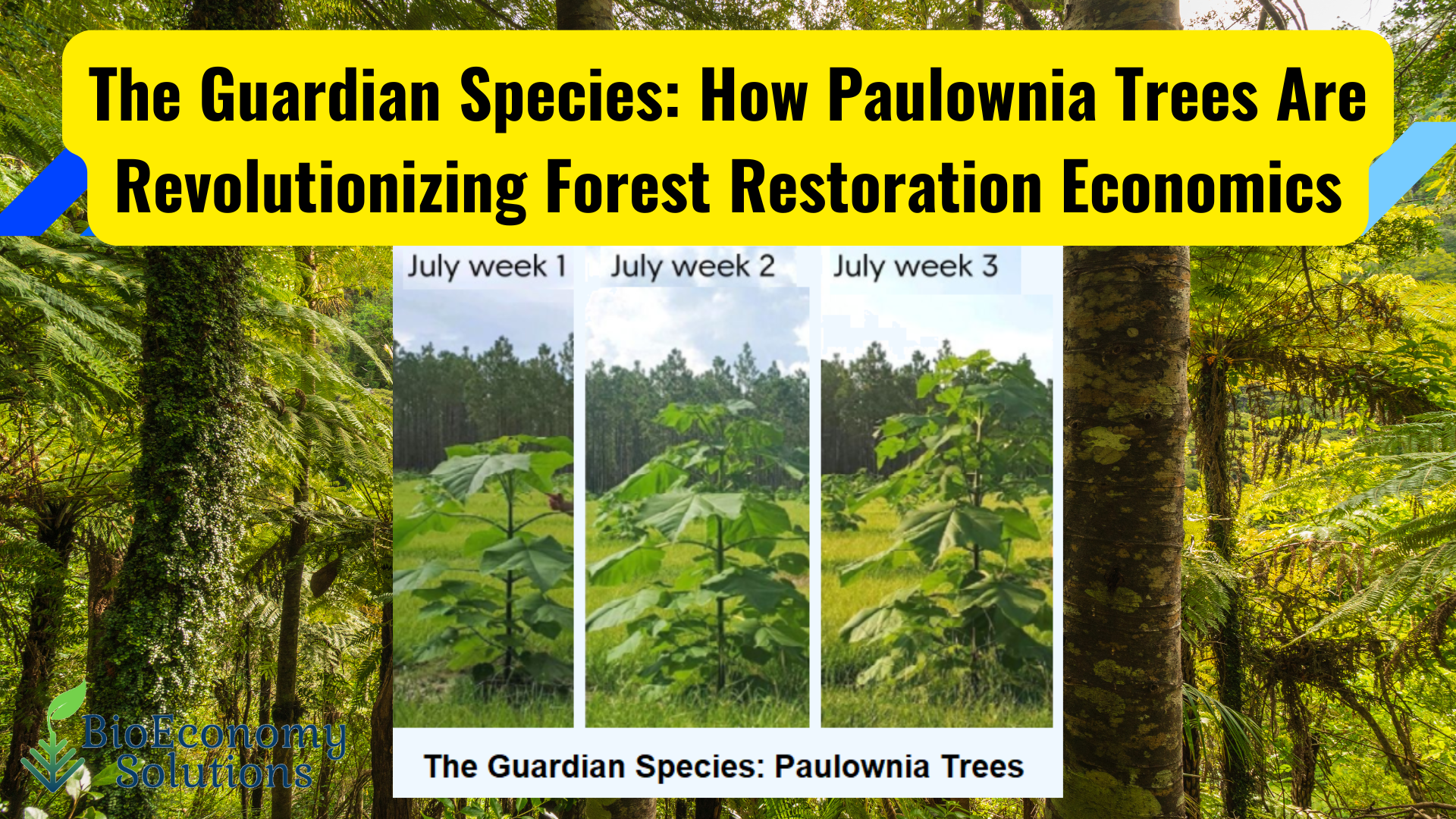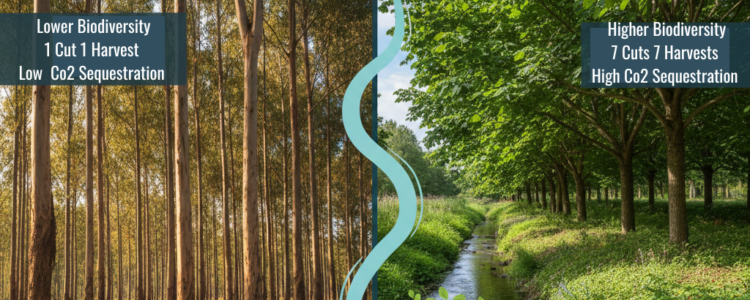
Paulownia Secret Weapon Against Eucalyptus Legacy of Depletion

The $2 Trillion Tree Battle: Eucalyptus vs. Paulownia—Which One is Actually Restoring Our Planet?


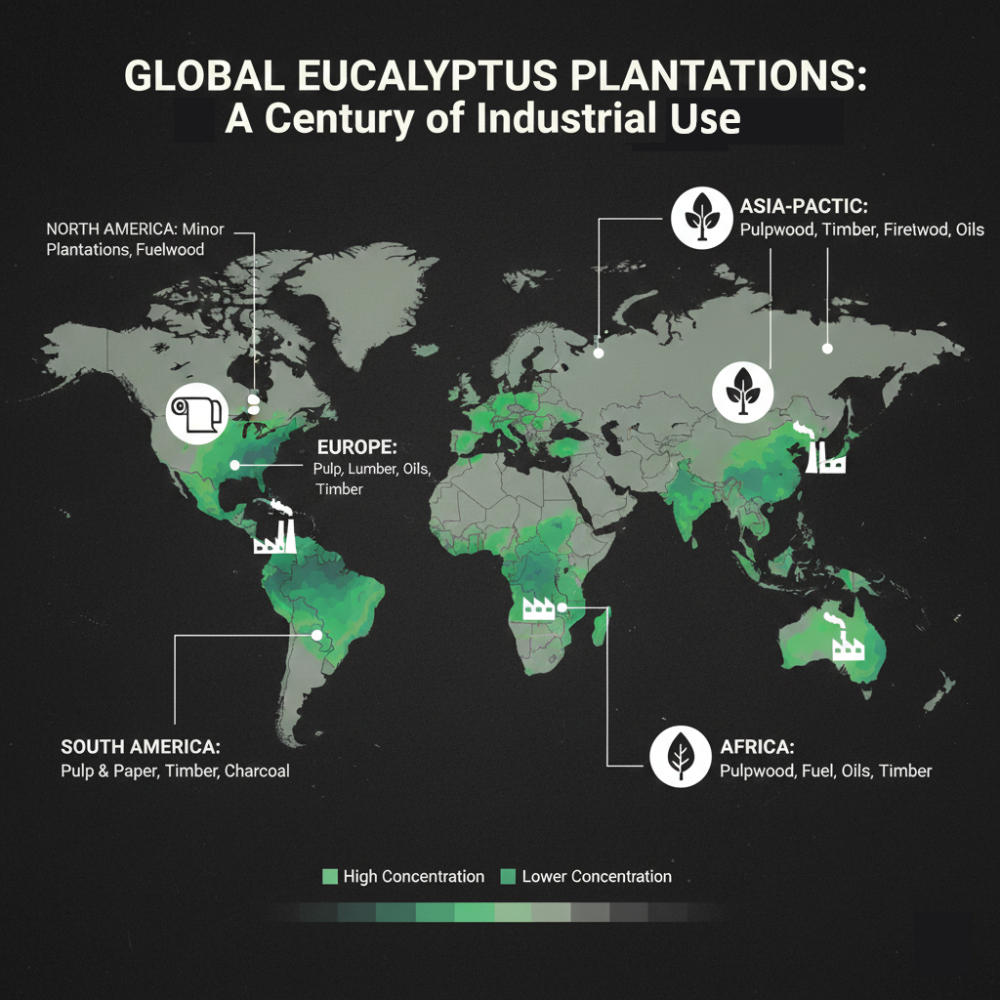
Eucalyptus Tree Around The World

What if I told you that the tree planted across around the world to “solve” deforestation is actually causing it?

Large industries, primarily the pulp and paper and timber industries, have planted extensive eucalyptus plantations around the world. These plantations are concentrated in regions where the fast-growing trees can be used as a renewable resource.

The main geographies and industries involved are:

South America

This region is a global leader in eucalyptus plantations, mostly for the pulp industry.

  • Brazil: The world’s largest producer of eucalyptus, with millions of hectares of plantations. Major corporations drive the industry, primarily for the production and export of pulp used in paper products. The timber industry also uses the wood for charcoal and solid wood products.
  • Argentina, Chile, and Uruguay: These countries also have significant eucalyptus plantations, with the pulp industry being the main driver in Uruguay and Argentina, and the timber industry also being significant.

Asia-Pacific

This region has seen rapid expansion in eucalyptus planting, with a significant share of the world’s total.

  • China: China has developed large areas of eucalyptus plantations for timber production, pulp and paper, and as a source of industrial oils.
  • India: Plantations are extensive in India, contributing to both the pulp and paper industry and local uses like firewood.
  • Indonesia: Eucalyptus is a key raw material for the pulp and paper production in this country.

Europe

Eucalyptus is a key industrial resource in parts of Europe, particularly the Iberian Peninsula.

  • Portugal and Spain: Large areas are dedicated to growing eucalyptus for pulp production, as well as for lumber, veneer, and eucalyptus oil extraction.

Africa

The tree has been widely introduced and used for various industrial purposes.

  • South Africa and Eswatini: Eucalyptus is grown extensively for pulpwood, poles, fuel, and the extraction of essential oils.
  • Ethiopia: Historically, it was used to meet a high demand for firewood and construction timber.

North America

While less dominant than other regions, some areas have industrial plantations.

  • United States (primarily California and Hawaii): Historically introduced for potential timber and railroad ties, commercial planting today is minor compared to global leaders, with some areas studied for pulpwood or industrial fuelwood.
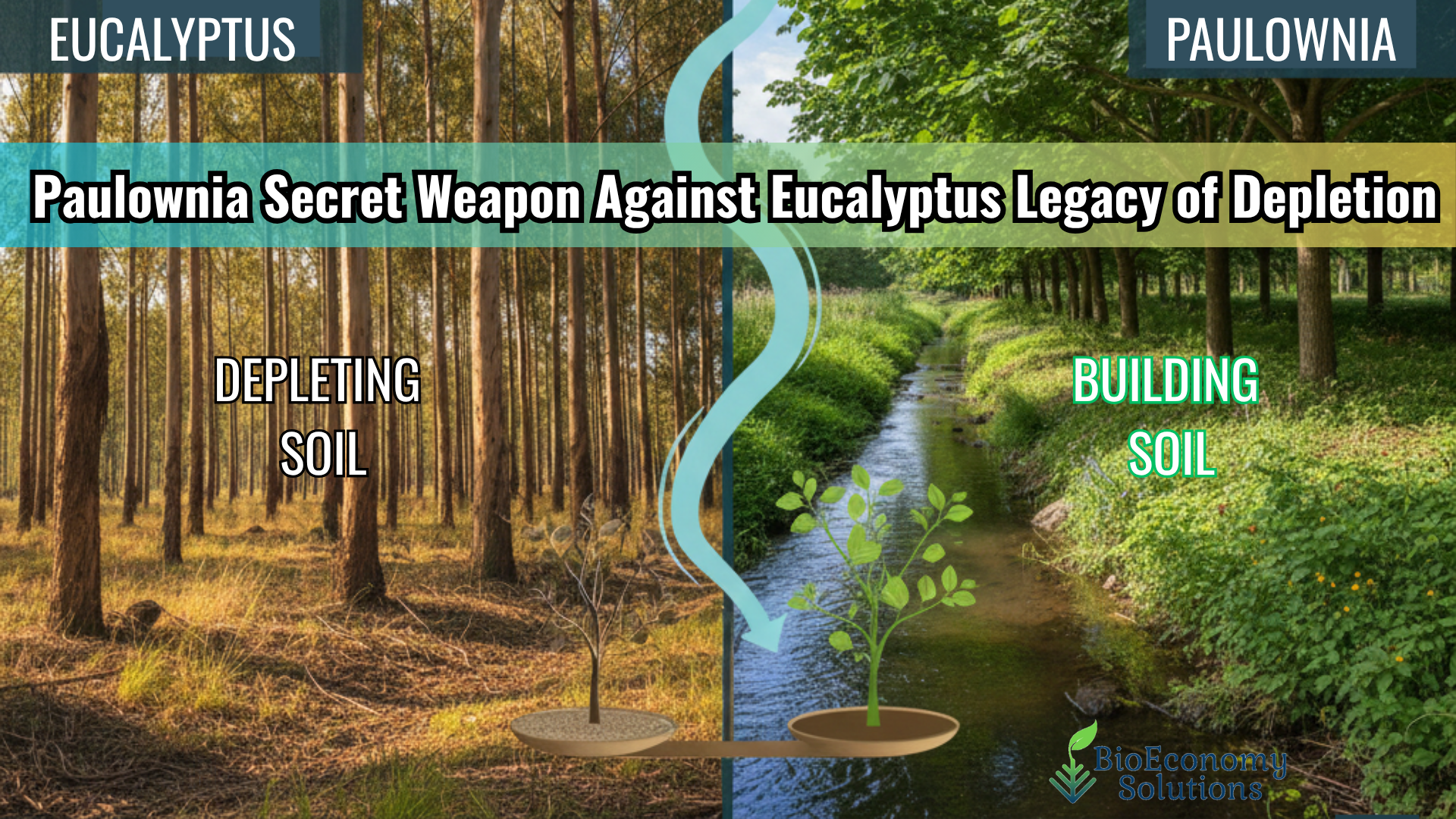
Paulownia Secret Weapon Against Eucalyptus Legacy of Depletion

The Global Map

The Background

In Africa referred to as The $792 Million Mistake: Why Africa’s Big Industry Planted the Wrong Tree.

For over 150 years, eucalyptus has been promoted as the miracle tree—fast-growing, drought-resistant, perfect for timber and fuel.

Governments planted it. NGOs funded it. Farmers adopted it.

The Wood Value Comparison: Eucalyptus vs. Paulownia
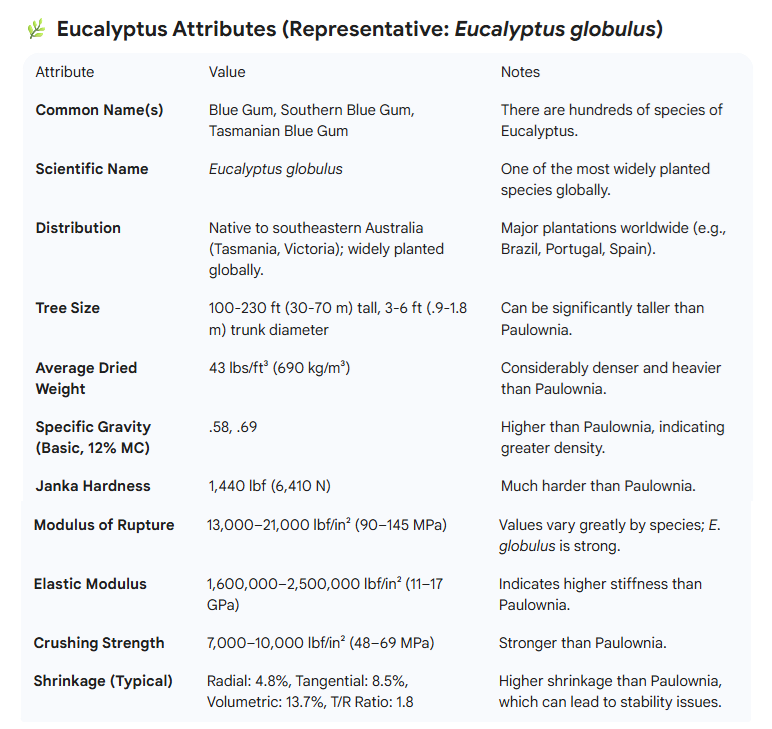
Eucalyptus Wood Value – BY THE NUMBERS
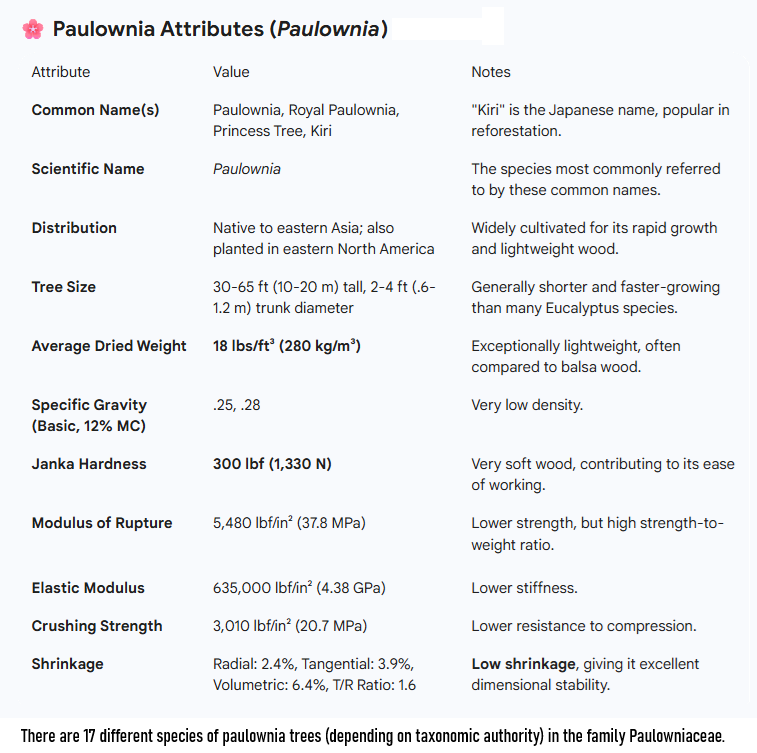
Paulownia vs Eucalyptus

By the numbers Paulownia vs Eucalyptus

What They Did NOT Know?

But here’s what nobody told them:

❎ Eucalyptus trees drink 20-40 liters of water per day.

❎ They release chemicals that kill surrounding crops.

❎ They turn soil hydrophobic (water-repelling).

Meanwhile, there’s another tree—one that grows even faster, uses 90% less water, actually improves soil health, and could save the Big Industry $660 million annually Zimbabwe.

But almost nobody knows about it.

Let me show you the data.


After 40+ years of forestry research, partnerships with CREA Italy and the Chinese Academy of Forestry, and analyzing deforestation patterns across Zimbabwe, Malawi, Tanzania, and beyond, we’ve uncovered a fundamental mistake in how Africa approaches fast-growing trees.

This isn’t about vilifying eucalyptus in its native Australia—it’s about understanding why a tree that works in one ecosystem becomes destructive in another, and why there’s a scientifically superior alternative that’s been hiding in plain sight for 1,000 years.


The Tale of Two Trees: Eucalyptus vs. Paulownia

How Eucalyptus Became Africa’s “Go-To” Tree (And Why That Was a Mistake)

The History:

  • 1850s-1900s: Eucalyptus introduced globally from Australia after Captain Cook’s expeditions
  • Promoted for: Fast timber, fuel, swamp drainage, malaria control, windbreaks
  • California Gold Rush: Planted for railroad ties (wood proved too difficult to work)
  • Portugal (late 1800s): Planted to reforest stripped land—became most common tree
  • Africa (1900s-present): Widely adopted for commercial timber and fuel

The Promise:

✅ Fast growth (8-10 years to maturity)

✅ Drought-resistant

✅ High timber yield

✅ Medicinal properties (eucalyptus oil)

The Reality:

Water depletion:20-40 liters per day per tree

Allelopathy:Releases chemicals that kill surrounding plants

Soil degradation:Waxy leaves create hydrophobic soil

Nutrient depletion:Strips nitrogen, phosphorus, potassium

Fire risk:Oil-rich leaves are highly flammable

Biodiversity loss: Fewer bird species, reduced native habitat


The Tobacco Industry’s Eucalyptus Addiction

The Scale of the Problem:

Zimbabwe’s tobacco industry (Africa’s largest, 4th globally):

  • Production: 352.7 million kg (2025 record)
  • Revenue: $1.2+ billion
  • Farmers: 130,000+ households
  • Wood consumption (conventional barns): 9 kg wood per 1 kg tobacco
  • Total wood needed: 3.17 billion kg annually
  • Annual cost: $792.5 million (at $0.25/kg)

The Environmental Catastrophe:

  • 🔴 Deforestation rate: 262,349 hectares per year ⬅️📢📢📢
  • 🔴 Between 2000-2010: 300,000+ trees destroyed
  • 🔴 Forest cover: Down to 30-35%
  • 🔴 Projection: Accessible forests depleted within 10-15 years

The Vicious Cycle:

  1. Tobacco industry needs massive wood supply for curing
  2. Eucalyptus planted as “fast solution”
  3. Eucalyptus depletes water, kills crops, degrades soil
  4. Farmers cut more native forest for wood
  5. Deforestation accelerates, water scarcity worsens
  6. Repeat (NOT SUSTAINABLE) 🔴❌❌❌🚫🚫🚫🚫

Enter Paulownia: The 1,000-Year-Old Solution

The History:

  • Origin: South Asia, cultivated for 1,000+ years
  • Traditional uses: Timber, medicine, soil restoration
  • Modern applications: Discovered by Western science in recent decades
  • Global presence: Successfully grown in 60+ countries

Why It Was Overlooked:

  • Eucalyptus had first-mover advantage (150+ years of promotion)
  • Colonial-era forestry focused on familiar species
  • Lack of commercial nurseries and seedling availability
  • Limited research funding compared to eucalyptus
  • No powerful industry lobby promoting it

Here Is Side-by-Side Comparison: Eucalyptus vs. Paulownia
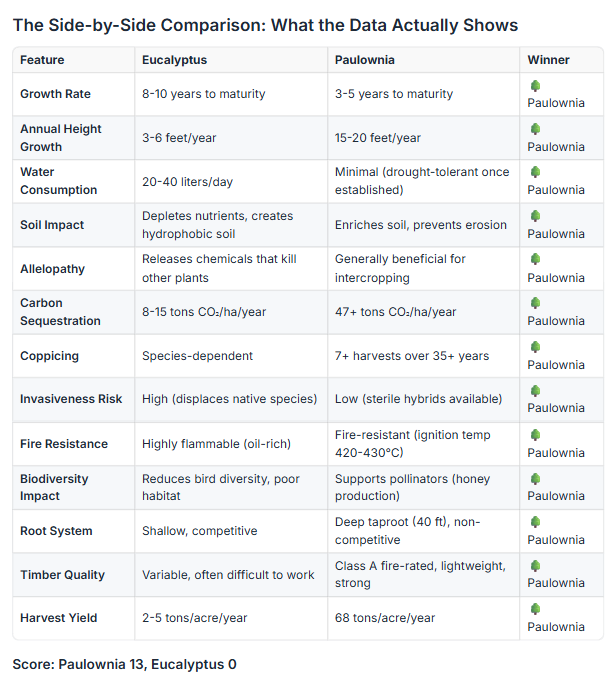
The Real-World Impact: What Eucalyptus Has Done to Africa

Case Study #1: Zimbabwe

The Firewood Crisis:

  • 98% of rural people rely on firewood
  • 11 million tons needed annually (cooking, heating, tobacco curing)
  • Villagers now travel “very long distances” for wood
  • Mountains “running out of firewood”
  • Illegal wood poaching driven by 90%+ unemployment
  • Fines ($200-5,000) can’t stop survival-driven cutting

The Agricultural Impact:

  • Rice fields near eucalyptus suffer water shortages
  • Crop yields decrease due to allelopathic effects
  • Soil nutrients stripped by rapid eucalyptus growth
  • Groundwater tables dropping, springs drying up

Case Study #2: Hawaii

Eucalyptus as Invasive Species:

  • Introduced late 1800s for timber and windbreaks
  • Now highly invasive, outcompeting native flora
  • Allelopathy creates barren zones around trees
  • Increased wildfire risk (oil-rich leaves)
  • Hydrophobic soil causes flash floods and erosion
  • Displaces native Ohia trees, harming native birds

Case Study #3: Nepal

The Eucalyptus Boom Became an Ecological Cautionary Tale:

  • Rapid expansion for timber and fuel
  • Severe water depletion in communities
  • Soil degradation and reduced agricultural productivity
  • Growing movement to replace with native species

The Paulownia Alternative: What the Science Shows

Water Efficiency

Eucalyptus:

  • 20-40 liters per day per tree
  • Deep roots access and deplete groundwater
  • Lowers water table, dries springs and streams

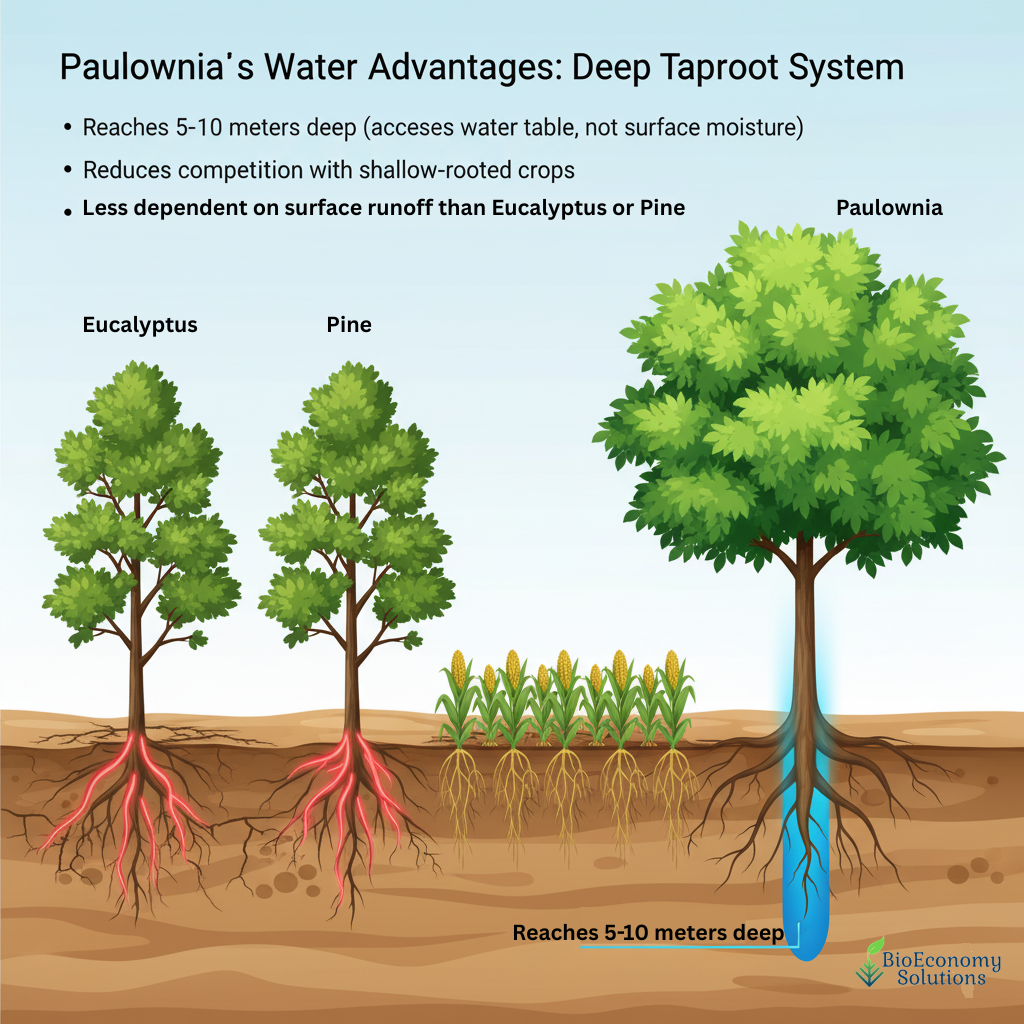
Paulownia:

  • Minimal water once established (2 years)
  • Deep taproot (40 ft) accesses water without depleting surface sources
  • Doesn’t compete with crops for water
  • Suitable for water-scarce regions

Impact: Paulownia uses 90%+ less water than eucalyptus
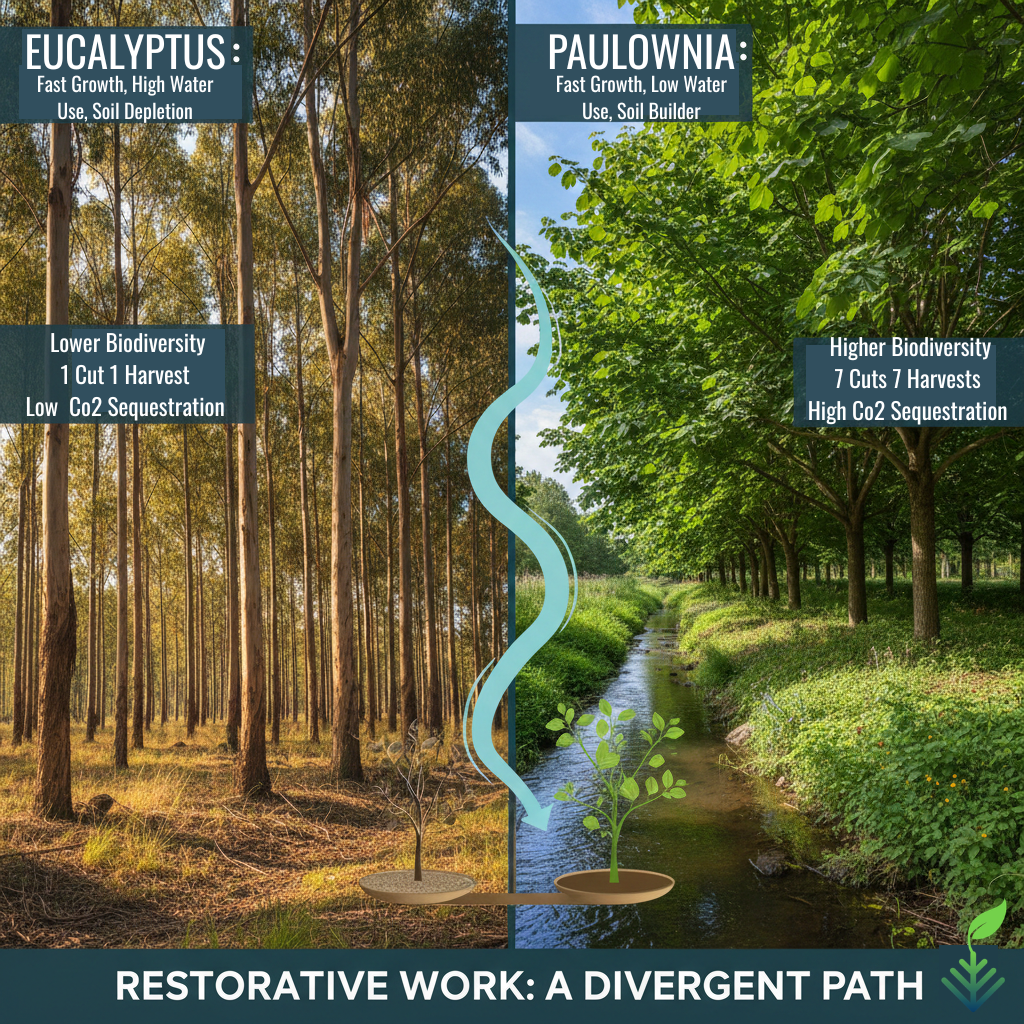
Paulownia vs Eucalyptus 🌳 | Why Paulownia is the Better Eco-Friendly Tree


Paulownia vs Eucalyptus | Why Paulownia is the Better Eco-Friendly Tree

Soil Health

Eucalyptus:

  • Depletes nitrogen, phosphorus, potassium
  • Waxy leaves decompose slowly, create hydrophobic soil
  • Hinders nutrient cycling and microbial activity
  • Contributes to soil erosion

Paulownia:

  • Deep roots stabilize soil, prevent erosion
  • Leaf litter enriches soil with organic matter
  • Improves soil structure and water retention
  • Used for phytoremediation (cleans polluted soil)
  • Fixes nitrogen through root associations

Impact: Paulownia regenerates soil; eucalyptus degrades it


Carbon Sequestration

Eucalyptus:

  • 8-15 tons CO₂ per hectare per year
  • Single harvest, then replant required

Paulownia:

  • 47+ tons CO₂ per hectare per year (optimal conditions)
  • 117.1 Mg CO₂eq per hectare (10-year rotation)
  • Coppices 7+ times (no replanting needed)
  • 35+ year productive life

Impact: Paulownia sequesters 3-6x more carbon than eucalyptus


Economic Value

Eucalyptus (Tobacco Industry):

  • 9 kg wood per 1 kg tobacco (conventional barns)
  • 3.17 billion kg wood needed annually
  • Cost: $792.5 million per year
  • Unsustainable deforestation to meet demand

Paulownia (Tobacco Industry):

  • 1.5 kg wood per 1 kg tobacco (rocket barns)
  • 529 million kg wood needed annually
  • Cost: $132.25 million per year
  • Savings: $660.25 million annually
  • Wood reduction: 83%

Additional Paulownia Revenue:

  • Carbon credits: $62.8-156M annually
  • Biochar: $61-103M annually
  • Honey: $3,000-5,000 per hectare
  • Timber: Premium pricing for Class A lumber

Impact: Paulownia saves $660M+ annually while generating $124-259M in additional revenue
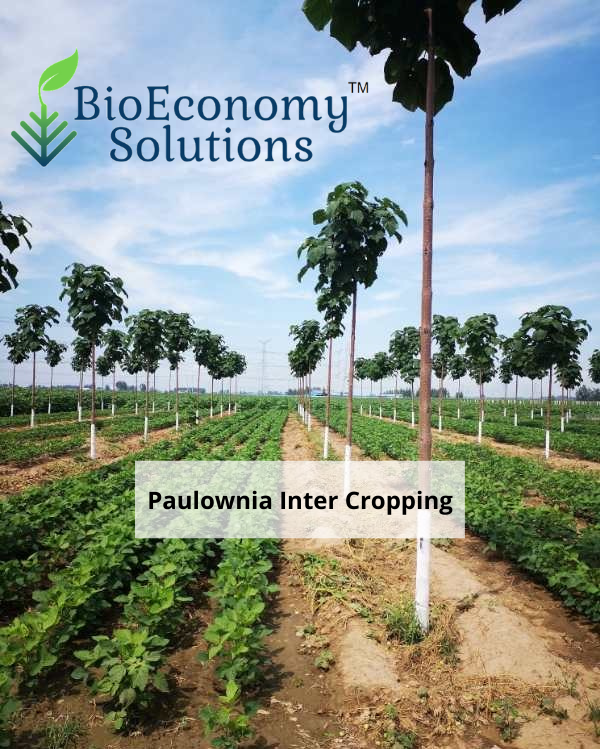
Inner cropping Paulownia

Inner cropping Paulownia

The Numbers Don’t Lie: Why Paulownia is the Superior Choice

For the Tobacco Industry:

Current State (Eucalyptus/Mixed Wood):

  • $792.5M annual wood cost
  • 3.17 billion kg wood consumption
  • 262,349 hectares deforestation per year
  • Forests depleted in 10-15 years
  • Water scarcity worsening
  • Soil degradation accelerating

Future State (Paulownia + Rocket Barns):

  • $132.25M annual wood cost (83% reduction)
  • 529 million kg wood consumption
  • Zero native forest deforestation
  • 7,779 acres paulownia plantations (sustainable supply)
  • $660M saved annually
  • $124-259M additional revenue (carbon + biochar)
  • Net-zero operations in 5-10 years

For Farmers:

Eucalyptus Model:

  • 8-10 years to first harvest
  • Single harvest, then replant
  • Depletes soil nutrients
  • Competes with crops for water
  • Reduces adjacent crop yields
  • Single revenue stream (timber)

Paulownia Model:

  • 3-5 years to first harvest
  • 7+ harvests over 35 years (coppicing)
  • Enriches soil health
  • Deep roots don’t compete with crops
  • Can intercrop with tobacco/food crops
  • Multiple revenue streams: Biomass sales ($40-60/ton) Carbon credits ($8-20/tree/year) Honey production ($3,000-5,000/hectare) Premium timber (furniture, construction)

For the Environment:

Eucalyptus Impact: ❌ 20-40 liters water per day per tree ❌ Groundwater depletion ❌ Soil degradation and hydrophobicity ❌ Reduced biodiversity (fewer birds, insects) ❌ Increased wildfire risk ❌ Allelopathic effects on native plants ❌ 8-15 tons CO₂/ha/year sequestration

Paulownia Impact: ✅ Minimal water consumption ✅ Water table stabilization ✅ Soil enrichment and erosion prevention ✅ Enhanced biodiversity (pollinator support) ✅ Fire-resistant (420-430°C ignition temp) ✅ Compatible with intercropping ✅ 47+ tons CO₂/ha/year sequestration


Why Hasn’t This Happened Already?

The Eucalyptus Entrenchment:

  1. First-Mover Advantage: 150+ years of promotion and planting
  2. Established Supply Chains: Nurseries, markets, processing infrastructure
  3. Institutional Inertia: Government forestry departments trained in eucalyptus
  4. Lack of Awareness: Limited research funding for paulownia alternatives
  5. Seedling Availability: Few commercial paulownia nurseries in Africa
  6. Industry Lobbying: Eucalyptus pulp/paper industry has powerful advocates

The Paulownia Opportunity:

  1. Proven Science: 40+ years of research, successful in 60+ countries
  2. Economic Case: $660M+ annual savings for tobacco industry alone
  3. Climate Urgency: Net-zero commitments require rapid solutions
  4. Technology Ready: Rocket barns + paulownia = 83% wood reduction
  5. Scalable Model: Replicable across Africa and beyond
  6. Multi-Stakeholder Support: Tobacco companies, governments, farmers, investors all benefit

The Path Forward: Replacing Eucalyptus with Paulownia

Phase 1: Pilot Projects (Years 1-2)

  • Convert 500 rocket barns in Zimbabwe
  • Establish 500-acre paulownia plantation
  • Train 1,000 farmers on paulownia cultivation
  • Demonstrate wood savings and carbon sequestration
  • Validate economic model

Phase 2: Scale-Up (Years 2-5)

  • Expand to 7,779 acres (Zimbabwe’s full biomass need)
  • Establish processing infrastructure
  • Train 20,000+ farmers
  • Achieve 50% tobacco curing from paulownia
  • Launch carbon credit sales

Phase 3: Continental Expansion (Years 5-10)

  • Replicate across 6 African countries
  • 25,000+ acres paulownia plantations
  • 100,000+ farmers participating
  • $9-11B wood cost savings (Africa-wide)
  • Net-zero tobacco operations continent-wide
The $792 Million Question: How Long Will We Keep Making the Same Mistake?

For 150 years, we’ve planted eucalyptus as the “fast solution” to timber and fuel needs.

For 150 years, we’ve watched it deplete water, degrade soil, and accelerate deforestation.

Meanwhile, paulownia—a tree that grows faster, uses less water, improves soil, and generates multiple revenue streams—has been waiting in the wings.

The data is clear. The science is proven. The economics are compelling.

The only question is: Who will lead the transition?


If you’re in the BIG industry, forestry, sustainable agriculture, or climate investing:

📥 DM “PAULOWNIA” for the full comparison report and implementation guide

📞 Book a discovery call: bioeconomysolutions.com/bookcall

📊 Download the case study: “How Paulownia Can Save Zimbabwe’s Tobacco Industry $660M Annually”

🎥 Watch the video: Why Paulownia is the Better Eco-Friendly Tree

📥 DM “TRANSCRIPT” for the full English transcription of this video


The forests are calling. The data is clear. The solution is growing.

Let’s plant the right tree this time. 🌳


#Eucalyptus #Paulownia #Deforestation #SustainableForestry #TobaccoIndustry #Africa #Zimbabwe #GuardianSpecies #Reforestation #ClimateAction #RegenerativeAgriculture #WaterConservation


About BioEconomy Solutions:

BioEconomy Solutions (BES) is pioneering the transition from destructive eucalyptus monocultures to regenerative paulownia plantations through The G.U.A.R.D.I.A.N. Framework™. With 40+ years of paulownia research and partnerships across three continents, BES is working with Africa’s tobacco industry to eliminate deforestation while saving $660M+ annually and achieving net-zero operations.

Contact:


Sources: [1] https://onlinelibrary.wiley.com/doi/10.1155/tswj/1780293 [2] https://www.sciencedirect.com/science/article/pii/S0378112725004694 [3] https://news.mongabay.com/2017/08/indigenous-farmers-fight-eucalyptus-damage-to-water-source-in-ecuador/ [4] https://news.mongabay.com/2025/02/in-nepal-a-eucalyptus-boom-became-an-ecological-cautionary-tale/ [5] https://www.youtube.com/watch?v=8DDrLCh3A1U

Download Free Paulownia Carbon Sequestration Guide

Download Your FREE COPY of The G.U.A.R.D.I.A.N. Framework™ E-BOOK - 58pages

The G.U.A.R.D.I.A.N. Framework™ E-BOOK – 58pages

 

Why America IS NOT Planting Paulownia Trees

Grows 20 Feet a Year. Fire-Resistant. Harvest-Ready in 5. Why America Calls It a Weed.

By Victor Garlington | BioEconomy Solutions
There is a tree growing near you “The Little Known Hardwood” you have never heard of.

Why America IS NOT Planting Paulownia Trees

This is the “TRUE STORY” of Paulownia. And it is one of the most important stories in American agriculture, forestry, and climate action that almost nobody is telling correctly.

It grows 20 feet in a single year. It will not catch fire until it hits 788°F — nearly twice the ignition point of any hardwood at your local lumber yard. It reaches full harvest size in 5 years while oak takes 50. It regrows from its own stump after every harvest, indefinitely, without replanting.

For over 3,000 years it was the wood of emperors. Its flower is the official seal of the Japanese Prime Minister. It appears on Japanese passports and on the 500 yen coin in circulation right now.

In America?

We spray it with herbicide and call it a weed.

Japanese timber executives flew small planes over the eastern United States in the 1970s — searching roadside ditches, railroad embankments, and forgotten margins of the American countryside — looking for this tree. When they found it, they paid up to $20,000 for a single log.

For timber, Americans were actively poisoning it.

This is the “TRUE STORY” of Paulownia. And it is one of the most important stories in American agriculture, forestry, and climate action that almost nobody is telling correctly.

By the time you finish reading this, you will understand why other countries are building billion-dollar industries around a tree that America labeled a weed — and why the opportunity hiding in that mislabeling is larger than most people realize.

PART ONE: The Imperial Tree — 3,000 Years of Documented Excellence

To understand why Paulownia matters today, you need to understand where it came from.

Not from a laboratory. Not from a modern breeding program. Not from a government research initiative.

From 3,000 years of human civilization selecting, cultivating, and refining the most useful tree on Earth.

The Han Dynasty, 200 BC:

An imperial decree orders the planting of a specific tree around government buildings and the estates of the noble class. The tree is called Paulownia. Its flower is chosen as the crest of imperial administration itself — a symbol of authority, permanence, and excellence.

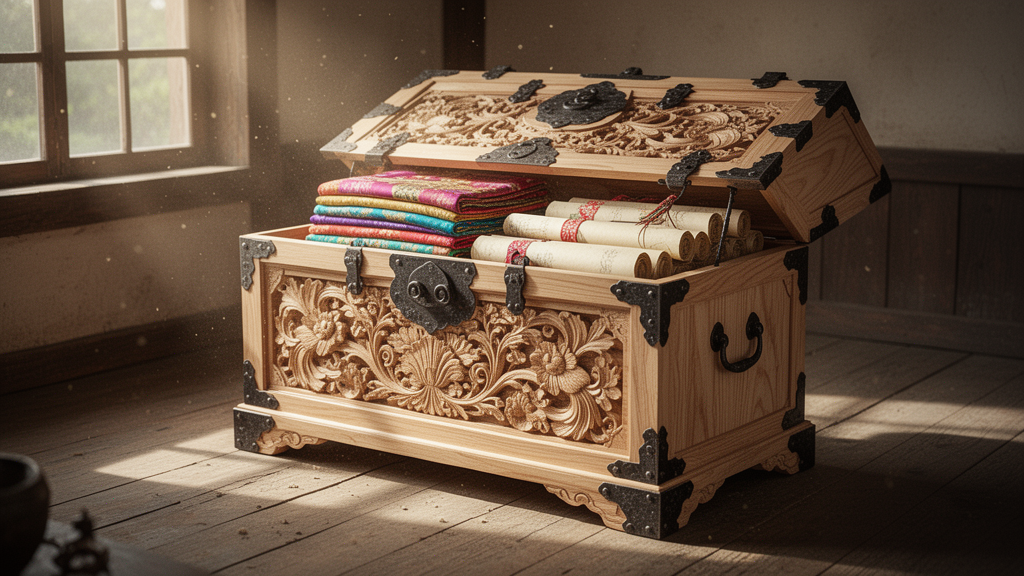
When a daughter is born to a wealthy family, three Paulownia trees are planted in her honor. When she reaches the age of marriage, the trees are felled and carved into her dowry chest — furniture built to preserve silk and parchment for centuries. The finest furniture in all of China is made this way.

This is not folklore. This is documented history spanning more than two millennia.

Japan’s Sacred Adoption:

By 794 AD, during the Heian period, Paulownia became the wood of the imperial palace itself. The Japanese name for it is Kiri. The Paulownia flower crest — the Kirimmon — becomes the personal seal of the emperor before the chrysanthemum is adopted.

Feudal warlords fight wars for the right to display it.

Toyotomi Hideyoshi, who unified Japan in the 1580s, carries it as his own family emblem — granted directly by the emperor as the highest honor available.

Today, this same flower appears on:

  • The official seal of the Japanese Prime Minister
  • Japanese passports and visas
  • The 500 yen coin in circulation right now

A tree with the highest strength-to-weight ratio of any wood on Earth became the symbol of sovereign power in the most wood-conscious civilization in human history.

That is not a coincidence. That is 3,000 years of evidence.


PART TWO: The Science Behind the Reverence

The emperors were not wrong. The science confirms everything they knew intuitively.

Growth Rate:

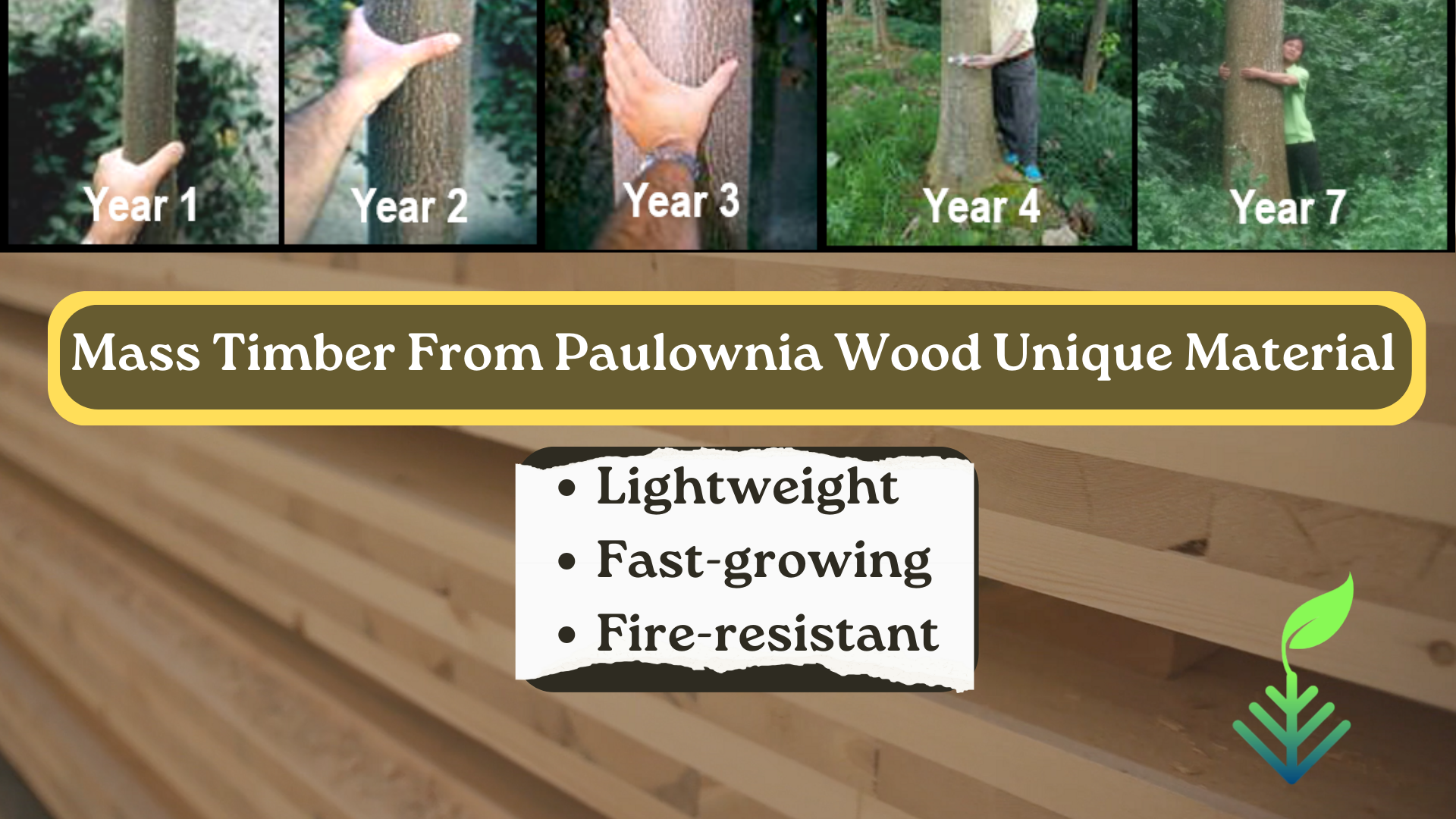
In its first year, a young Paulownia can grow 20 feet tall. Not inches. Feet.

By year 5 to 10, it reaches full harvest size. An oak requires 40 years. A walnut requires 60 years. Paulownia resets that math equation entirely.

You plant it today. You harvest it. Not your grandchildren. You.

The Phoenix Tree Advantage:

When the trunk is cut, the root system does not die. Within weeks, new shoots emerge from the same stump. Americans call this trait coppicing, the Japanese call it the Phoenix tree because it cannot be killed. It regenerates indefinitely from the same root — requiring no replanting, no new purchase, no seed company.


Plant once. Harvest up to seven times from the same root system over 35 years.

Engineering Properties That Defy Expectation:

The wood Paulownia produces is something engineers struggle to believe when they first encounter the data:

  • Weight: One-third the weight of oak — lighter than most softwoods
  • Strength: Highest strength-to-weight ratio of any known wood species — confirmed by Dr. R.C. Tang at Auburn University
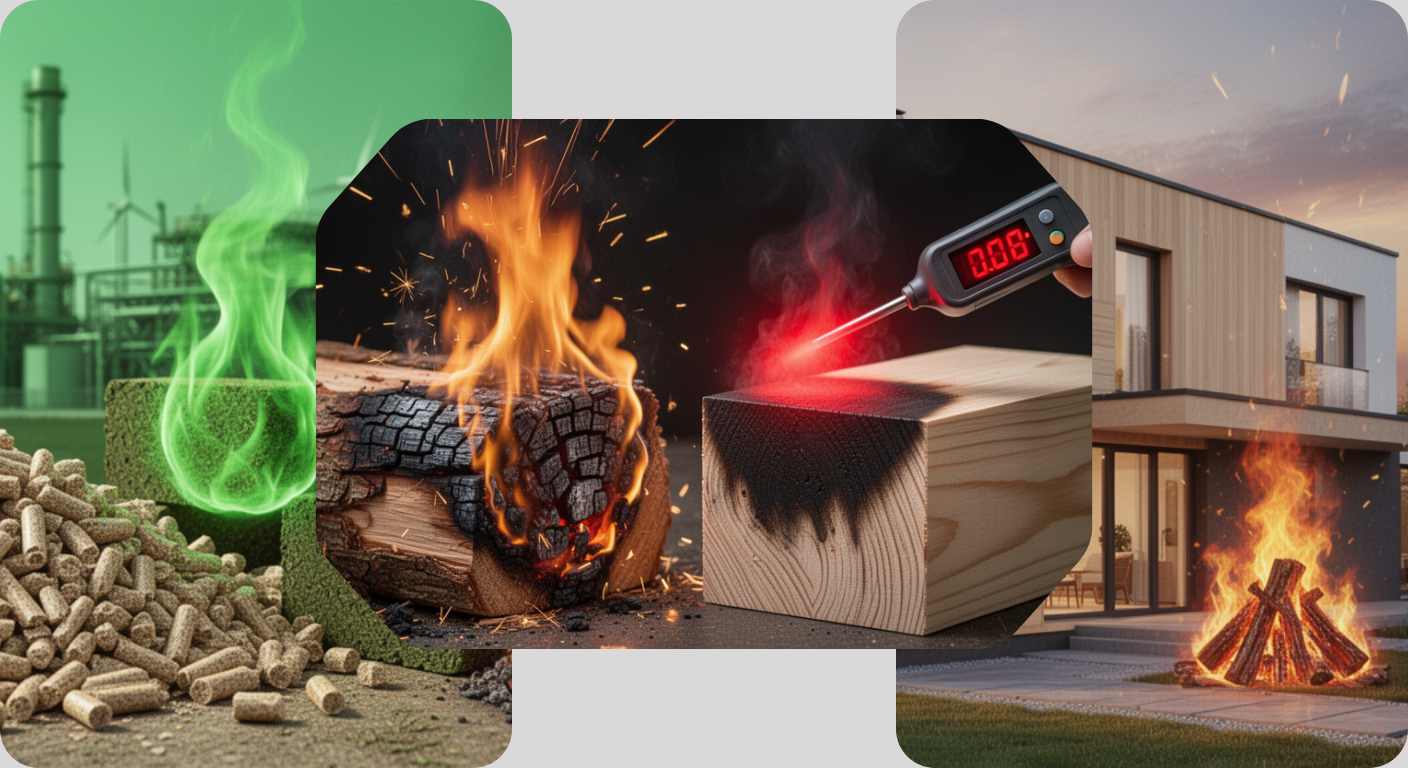
  • Fire resistance: Does not ignite until 788°F — nearly twice the 430°F ignition point of average hardwood. Documented by researchers Lee and Oda in a 2007 peer-reviewed study published in the Journal of Wood Science
  • Class A fire rating: The highest classification for building materials. No chemicals
  • Stability: Does not warp, crack, or split with humidity changes
  • Drying time: Air-dried in 60 days compared to years required for dense hardwoods
  • Durability: Naturally rot-resistant and naturally insect-resistant

The Tree That Shouldn’t Exist

In 2007, researchers at Kanazawa University in Japan measured something that should have changed American forestry forever.

A wood that auto-ignites at 420°C.

Standard lumber? 220-360°C.

In July 2025, this same wood earned a Class A fire rating—the highest classification for building materials. No chemicals. No retardant coating. Just wood.

>>> One of only four untreated woods in recorded history to achieve this. <<<

But in the United States—where we spend $394-893 billion annually on wildfire damage—this tree is classified as invasive in over a dozen states.

This is not marketing copy. Every one of these properties is documented in peer-reviewed scientific literature.

The Climate Superpower:

A 2024 review published in Frontiers in Environmental Science confirmed that Paulownia sequesters up to twice the carbon dioxide of other tree species in the same period.

One acre of mature Paulownia plantation absorbs what 19 cars emit in a year.

While the global timber industry clear-cuts old-growth forests and chips them into particle board, the one tree that could replace them in under a decade sits in American road cuts being sprayed with herbicide.


PART THREE: The $20,000 Log Mystery

Here is where the story becomes extraordinary.

In the 1970s, Japanese timber executives began flying small planes low over the eastern United States. They were not sightseeing. They were searching the roadside ditches, the railroad embankments, and the forgotten margins of the American countryside.

They were looking for wild Paulownia.

China had cultivated Paulownia for 3,000 years — but plantation-grown Chinese timber carried wide, loose growth rings from trees grown in open conditions with abundant resources. The wild American specimens, growing slowly over decades in crowded forests competing for light and water, had developed something extraordinary: tight, fine grain that the Japanese prized above all others.

It was ideal for making the Koto — the traditional 13-string instrument — and the Tansu — the ceremonial dowry chest.

They began purchasing with a ferocity that shocked domestic dealers.

The Poaching Crisis:

A 1993 Baltimore Sun investigation documented log poaching rings operating across Virginia, Maryland, and Tennessee. Sheriff’s deputies were ambushed in the woods. Suspects were caught with chainsaws, covered in sawdust. Investigators matched cut stumps to seized logs to secure convictions.

A single fine-grain log was fetching $3,000.

For a tree Americans had been calling a weed.

The University of Kentucky and University of Tennessee Extension Services took notice. In 1991, they helped form the American Paulownia Association — a coalition of growers, lumber dealers, and researchers. The potential was undeniable: a domestic hardwood that required no decades of waiting, grew on marginal land, rebuilt depleted soil, and commanded prices double that of walnut.

Plantations began forming across the Southeast. Early promotional material called Paulownia “the tree of the future.”

That future lasted exactly eight years.


PART FOUR: How America Got It Wrong — And What It Cost Us

In February 1999, President Bill Clinton signed Executive Order 13,112, creating the National Invasive Species Council.

The order was designed for genuinely destructive species — plants and animals that cause measurable ecological harm when introduced to new environments.

What it actually created was a mechanism.

Environmental advocacy groups with close financial ties to the American Forest and Paper Association moved within months to target Paulownia as a non-native invasive. The American Paulownia Association newsletter documented the process in plain language as recently as 2016 — writing that the invasive label was achieved after direct pressure from interested environmentalists, several national and state parks, and the Department of Agriculture.

Twelve states banned it.

The Critical Mislabeling:

The invasive label was applied to one species — Paulownia tomentosa. But in the public mind, it contaminated the entire genus — including Paulownia elongata and Paulownia fortunei, which are not on any invasive list anywhere in the world. Not in China. Not in the European Union. Not in Latin America, where Paulownia plantations operate commercially without restriction.

There are at least 17 distinct species of Paulownia. Only one — tomentosa — has been associated with invasive behavior in certain disturbed environments. The other 16 species, and the numerous commercial sterile hybrids developed over the past three decades, carry none of the invasive characteristics that justified the original concern.

The Science That Was Ignored:

A 2015 study published in Plants People Planet followed three Paulownia species in unmanaged southern Appalachian forests for nine years. The combined survival rate was 27.3%. The trees died without human intervention. They require full sun and sterile disturbed soil to germinate. They do not colonize established forests.

And then there is this: A paleontologist named Charles Smiley was excavating fossil beds in southern Washington and northern Oregon when he found ancient leaf fossils nearly identical to Paulownia tomentosa. The tree was growing on this continent millions of years before any European drew a map of it.

Calling it non-native was, at minimum, a disputed science.

The Real Motive:

The American Forest and Paper Association represents an industry built on 40-year rotation cycles, government-subsidized logging roads, and a captive domestic market that has no competitive alternative.

A tree that reaches harvest size in 5 years, requires no chemical inputs, regenerates from its own stump, and sells at premium prices is not a problem for homeowners.

It is a structural threat to that business model.

The invasive label cost them nothing to obtain. It shut down plantation development, drove buyers to other species, and allowed the steady export of raw Paulownia logs to Japan to continue uninterrupted — while domestic commercial cultivation stopped entirely.

Today, the Wood Database — the definitive reference for American lumber professionals — carries a single commercial note on Paulownia: “Seldom offered for sale in the United States, though it is actually grown on plantations and exported to Japan, where demand for the wood is much higher.” <This Whole Narrative Is False”>

America grows it. America ships it across the Pacific. America then buys the finished products back again at a significant markup.

See for yourself. Here is a challenge to you, the reader. Google the following: “What paulownia products from China and Japan show up in American stores in 2026?


In 2026, Paulownia products from China and Japan in American stores primarily consist of lightweight kitchenware, specialized storage solutions, and high-end musical instrument components. While China remains the world’s largest producer, accounting for over 70% of global production, Japan is known for its high-craftsmanship “Kiri” wood applications. 

Key Product Categories in US Stores (2026) 

  • Kitchenware and Home Goods
  • Steamers:  
  • Storage Boxes (Kiribako):
  • Tansu Chests: 
  • Ready-to-Assemble (RTA) Furniture:  
  • Wall Cladding and Panels:  
  • Instrument Components: 
  • Electric Guitar Bodies: 
  • Sports Equipment: Paulownia wood cores are a key component in imported snowboards, kiteboards, and surfboards because they offer strength without excessive weight.

President Carter Understood:

Former President Jimmy Carter — a Georgia farmer and woodworker — spent his later years actively promoting Paulownia elongata as a sustainable American crop. He grew it on his own property. He told anyone in Washington who would listen that planting Paulownia was both a climate solution and an economic opportunity that American farmers were being systematically blocked from accessing.

No one listened.

PART FIVE: What the World Built While America Looked Away

While America was spraying herbicide on Paulownia growing in its ditches, the rest of the world was building industries around it.

The Global Reality in 2026:

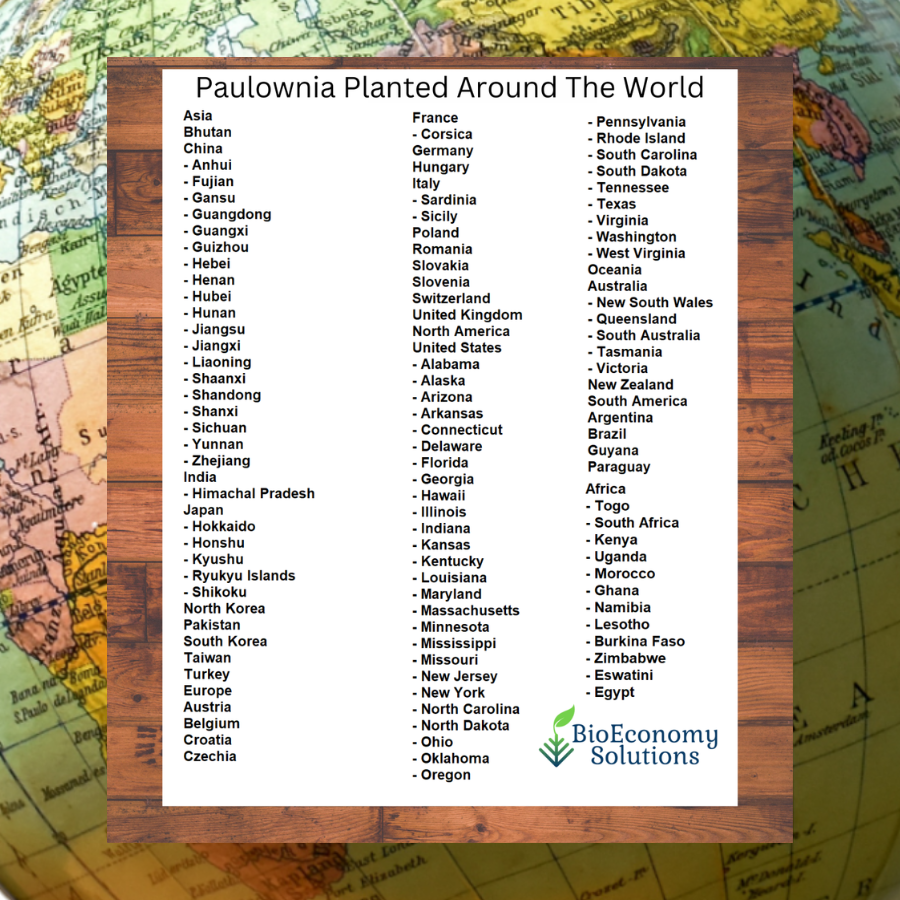
Paulownia is now planted commercially in more than 60 countries. China has millions of acres in active production. Spain operates large-scale Paulownia plantations for biomass and timber. Australia has established commercial operations. Brazil is scaling rapidly. South Korea, Vietnam, India, and dozens of other nations have active Paulownia industries.

Dr. Ray Allen’s initial U.S.-based work eventually led to the creation of the MegaFlora hybrid Paulownia — and as of 2021, over 17 million MegaFlora trees have been planted by his Chinese team in seven different provinces and 17 different locations, from the coast to the border of the Gobi Desert, north to Mongolia, and south to Vietnam.

None of these countries have experienced the ecological catastrophe that the invasive label implied.

Paulownia Trees In 60 Countries

Paulownia Around The World In 60 Countries

The Applications the World Discovered:

While America was debating whether to allow Paulownia to exist, the rest of the world was discovering what it could do:

Construction and Building Materials:
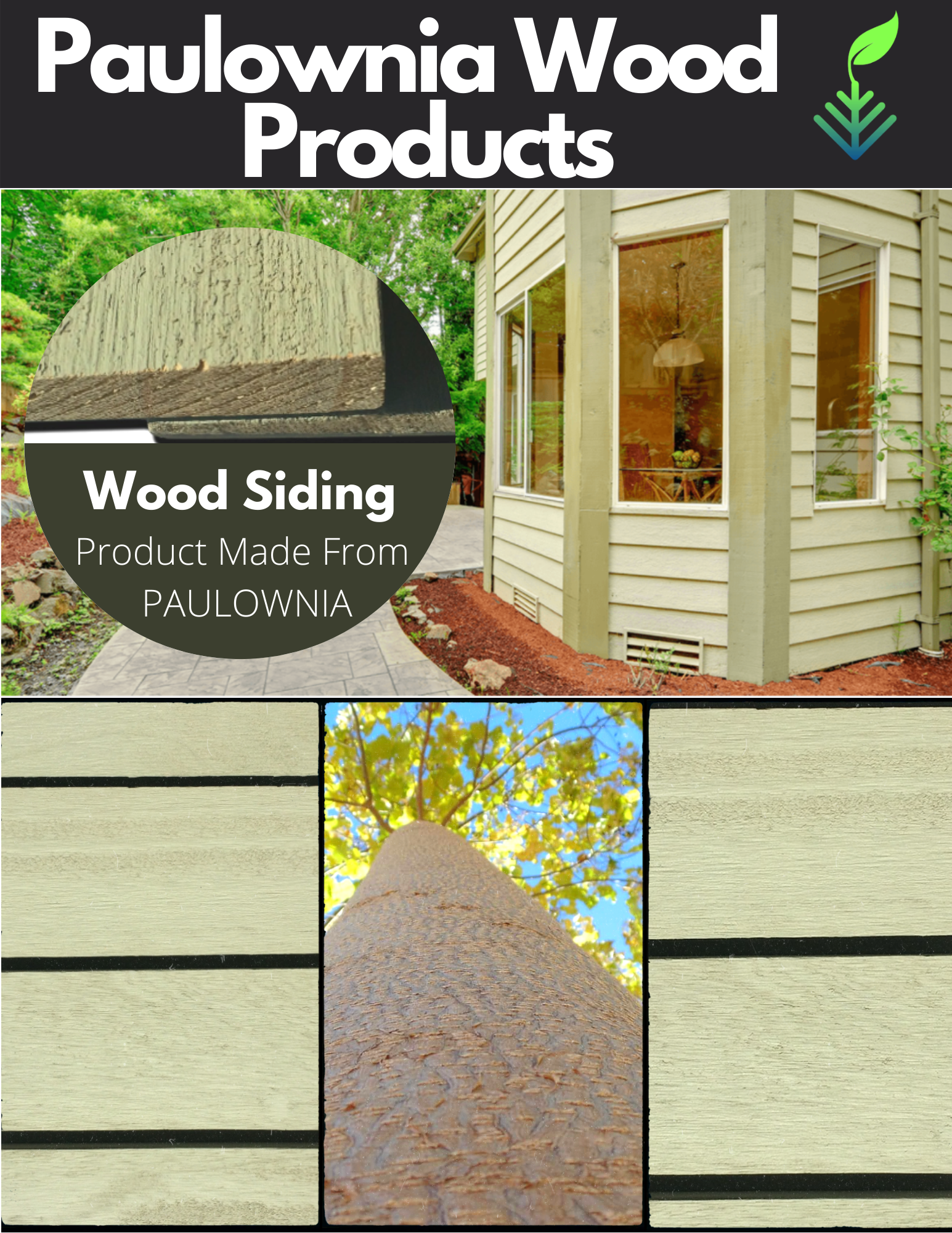
Paulownia siding, exterior cladding, interior paneling, and furniture-grade wood are now standard products in Asian and European markets. Its fire resistance — that 788°F ignition point — makes it particularly valuable for building materials in fire-prone regions. Its dimensional stability means it does not warp or crack with seasonal humidity changes, making it ideal for flooring, cabinetry, and trim.

Musical Instruments:
Paulownia’s tonal qualities — its resonance, its lightness, its stability — make it the preferred wood for guitar soundboards, ukulele bodies, and traditional Japanese instruments. Luthiers who discover Paulownia rarely go back to other species.

Water Sports Equipment:
The combination of lightness, buoyancy, and water resistance makes Paulownia the material of choice for high-performance surfboards and paddleboards. Its strength-to-weight ratio exceeds aluminum — meaning a Paulownia surfboard can be both lighter and stronger than its conventional alternatives.

Carbon Sequestration and Credits:
The carbon credit market has discovered what emperors knew 3,000 years ago. Paulownia sequesters carbon at a rate that no other commercially viable tree species can match. Up to 100 tons of CO₂ per acre per year. Seven harvest cycles from the same root system. Biochar conversion that stores carbon for over 1,000 years.

The math is extraordinary: one well-managed Paulownia plantation, properly coppiced and converted to biochar, is the carbon sequestration equivalent of seven traditional forests — from the same land, over the same time period.

Desertification Control:
Paulownia has been successfully established in semi-arid and arid environments across Australia, Egypt, the Gobi Desert region, Sub-Saharan Africa, and the American Southwest. Its deep taproot can access groundwater at depths of up to 5 meters. Its large leaves — up to 12 inches wide — create significant transpiration that raises local humidity and can, at sufficient scale, influence rainfall patterns.

Animal Feed and Agroforestry:
Paulownia leaves contain 16% protein — comparable to alfalfa — making them a valuable livestock fodder. In Asia, goats, cattle, and sheep graze directly from Paulownia trees planted within their enclosures. Each tree produces up to 80 kg of dry leaves annually. The combination of timber, carbon credits, biomass, and animal fodder from a single plantation creates a diversified revenue model that conventional monoculture farming cannot match.

PART SIX: The Opportunity Hiding in Plain Sight

Here is what all of this means for the present moment.

The regulatory landscape is shifting. Climate goals are creating demand that did not exist a decade ago. The supply shortage created by decades of suppression has produced premium pricing for anyone who moves early. And the science — the peer-reviewed, independently verified, institutionally supported science — is increasingly on the side of rational Paulownia policy.

For Landowners:

Paulownia elongata, Paulownia fortunei, and the numerous commercial hybrids developed over the past three decades can be planted legally in most American states. You do not need 40 years. You need 5 to 10.

A single root cutting — available for a few dollars from specialty nurseries — establishes a tree that reaches harvest size within your own lifetime. Plant it once. The stump sends up new growth after each harvest without replanting. That root lives indefinitely, giving you timber on a cycle no oak plantation can match.

But here is the most important advice any Paulownia grower can receive:

Solve for Y before you plant.

X represents your land and your growing capacity. Y represents your return — your customers, your markets, your revenue strategy. Until you solve for Y, you should not purchase Paulownia saplings. Hope is not a strategy. Your land and your finances deserve the extra effort of understanding your market before you plant your first tree.

The seven revenue streams available from a well-managed Paulownia operation — carbon credits, timber, soil remediation, biochar, animal feed, pharmaceutical applications from the flowers, and ecosystem services — mean that the landowner who understands all seven is operating a fundamentally different business than the one who only knows about one.

For Investors:

Investors, lenders, and offtake partners do not fund interesting biology. They fund verified, certified, documented supply chains. The Paulownia industry has spent decades building that certification infrastructure — and the investors who understand it are the ones who will capture the value that the suppression campaign inadvertently created.

Contact us about our BES Infrastructure Architecture, our system functions as a carbon refinery network.

The supply shortage is real. The demand is growing. The pricing premium for certified, verified Paulownia products — carbon credits, biomass feedstock, timber — reflects a market that has more buyers than sellers. That is not a problem for the industry. That is an opportunity for early movers.

For Green Fuel Developers:

Feedstock security is becoming the key bankability factor for green FUEL projects. Without predictable biomass supply, even well-designed projects struggle to attract project finance. We provide the certified (UCLM Gold Standard) feedstock needed to de-risk green methanol refineries.

BES carbon orchards solve this problem. Dedicated plantations — not waste streams, not spot market purchases — provide the supply security that lenders require for Final Investment Decision. UCLM Gold Standard certified Paulownia biomass is the feedstock that turns a theoretical green fuel project into a bankable one.

For Corporate Sustainability Officers:

The carbon credit market is bifurcating. Understanding your Scope 1, 2, and 3 classifications used to categorize the greenhouse gas (GHG) emissions your organization produces, based on source and the level of control the company has over them is part of your job function. 

Developed by the Greenhouse Gas Protocol, these categories provide a standardized way for businesses to measure, report, and manage their total carbon footprint.

A common shorthand for remembering these categories is “Burn, Buy, Beyond”:

Scope 1 (Burn): Direct emissions from sources the company owns or controls.

Scope 2 (Buy): Indirect emissions from the energy a company purchases.

Scope 3 (Beyond): All other indirect emissions occurring in the company’s entire value chain.

ESG Gold Standard: BES Allows your organization report “Reduces Emissions” in their Scope 1 & Scope 3.


Three thousand years of documented human knowledge pointed to this tree.

The seal of the Japanese government still bears its flower. The dowry chests that preserved silk and parchment for centuries were carved from its wood. The 500 yen coin in your pocket — if you have ever visited Japan — carries its image.

We called it a weed.

But here is the thing about weeds: they are just plants that someone decided were inconvenient.

Paulownia was inconvenient for an industry built on 40-year rotation cycles. It was inconvenient for a regulatory system that could not distinguish between one problematic species and an entire genus of extraordinary trees. It was inconvenient for a timber market that had no competitive alternative and no interest in finding one.

But inconvenient for an industry “IS NOT” the same as wrong for the world.

The Japanese knew what they were looking at in the 1970s. They flew over in small planes. They paid $20,000 per log. They sent buyers who camped in rural Maryland and Tennessee just to secure access to timber that Americans were actively poisoning.

The world’s fastest-growing hardwood. The wood that does not burn. The tree that grows back from its own stump. The carbon capture machine that sequesters twice what any other species can manage. 

The tree that former President Carter grew on his own land and told Washington was the answer to both climate change and rural economic decline.

We called it a weed.

It is not too late to change that.

The Paulownia industry is growing — in America and around the world. Growers, researchers, developers, investors, and carbon credit buyers are building the ecosystem that turns this extraordinary tree into the economic and environmental force it has always had the potential to be.

Every landowner who plants a certified Paulownia plantation expands the supply chain. Every investor who funds a Paulownia carbon project deepens the market. Every corporate buyer who purchases a Paulownia carbon credit validates the entire ecosystem. Every researcher who publishes data on Paulownia performance adds to the scientific foundation that makes all of our projects more credible.

In the Paulownia world, one success is all of our success.

The revolution is not coming.

It is already growing — in the ditch beside your road.

Get a FREE copy of Paulownia Carbon Report

Get a FREE copy of Paulownia Carbon Report

Are you ready to explore what Paulownia can do for your land, your portfolio, or your climate strategy?

📞 Book a strategy call: BioEconomySolutions.com/bookcall
📧 Email: mail@bioeconomysolutions.com
📱 Office: 843.305.4777

Drop a comment below — did this change how you think about the opportunities hiding in plain sight around you?

Share this with someone who needs to know about the tree America forgot. The “Little Known Hardwood”.

Victor Garlington is the Co-founder of BioEconomy Solutions and the architect of the G.U.A.R.D.I.A.N. Framework™. BES builds carbon asset infrastructure for institutional investors, delivering industrial biogenic carbon infrastructure through certified carbon orchard forestry, Closed-Cycle Greenhouse technology, and blockchain-verified carbon credit systems.

#Paulownia #Bioeconomy #CarbonCapture #GreenMethanol #SAF #SustainableAviationFuel #CarbonCredits #ESG #CDR #ClimateAction #Louisiana #Forestry #Biochar #RenewableEnergy #Sustainability #CircularEconomy #NatureBasedSolutions #Timber #Agroforestry #ProjectFinance


Paulownia For Sale

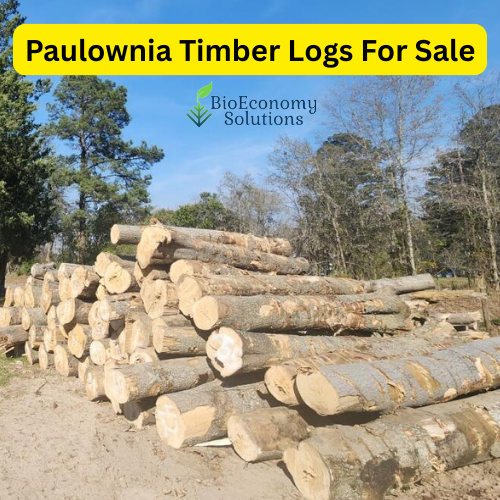
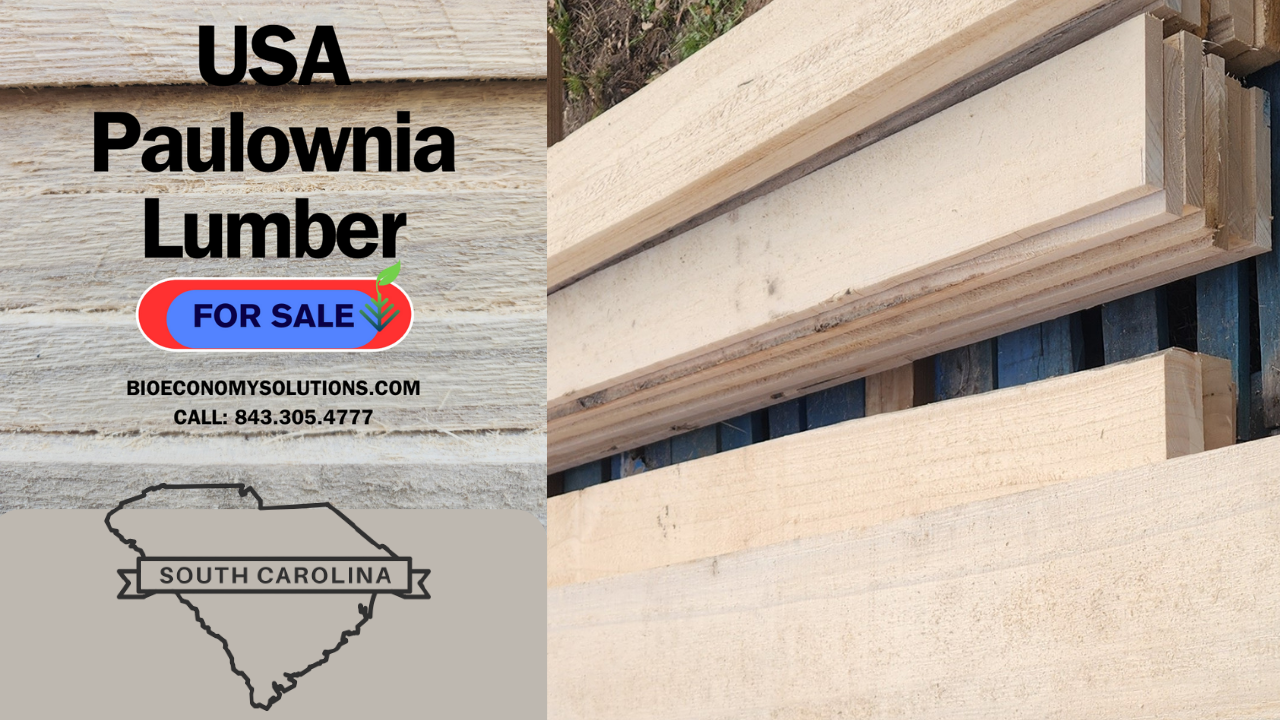
Click here for more information on USA Paulownia Lumber & Timber grown in South Carolina.

Paulownia Timber Logs For Sale

Paulownia Timber Logs For Sale

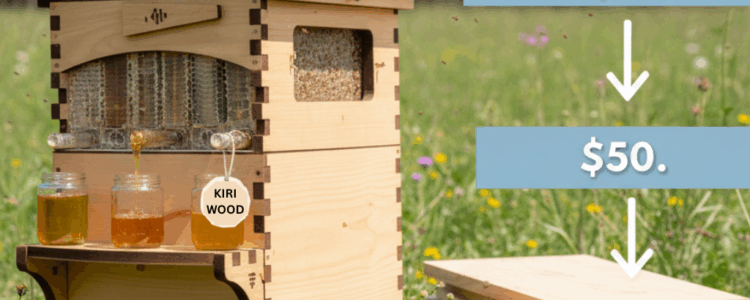
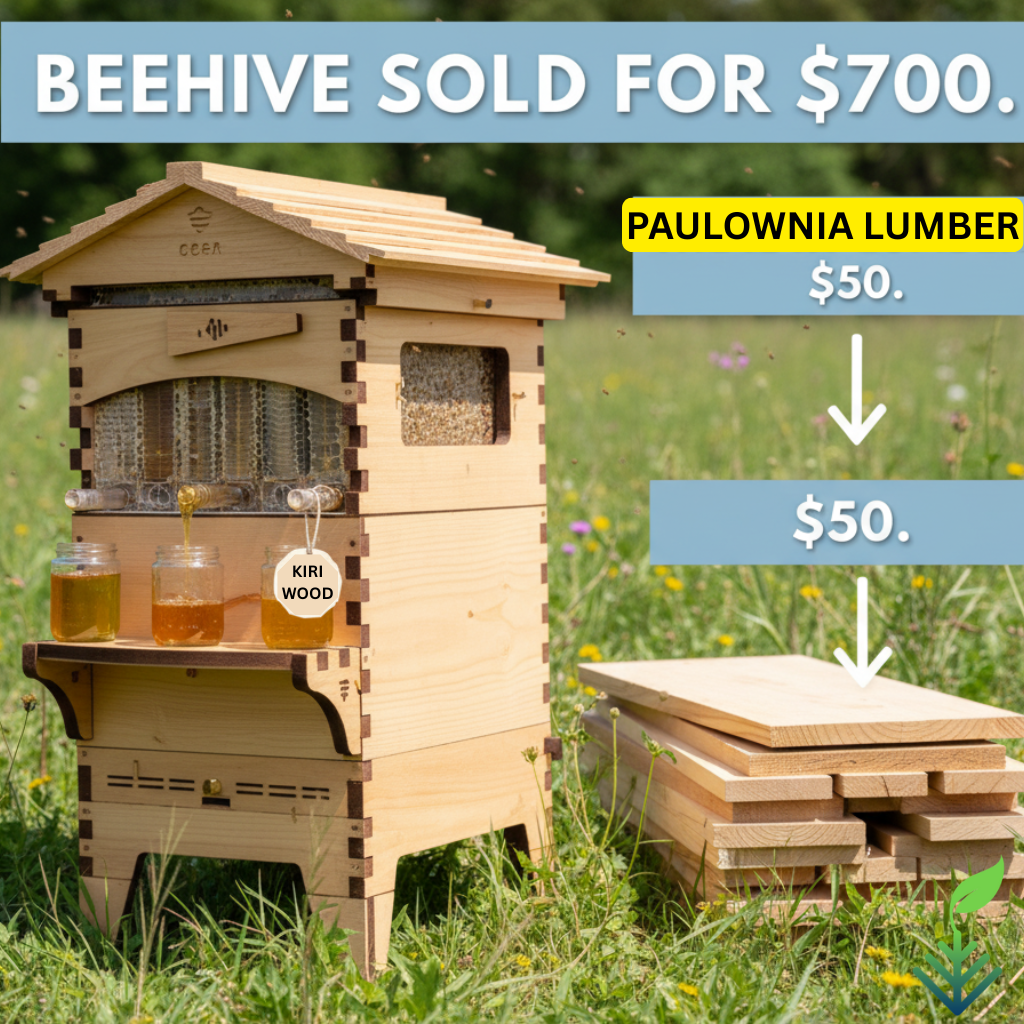
🐝 A beehive made from Paulownia just sold for $700. The raw lumber? $50.
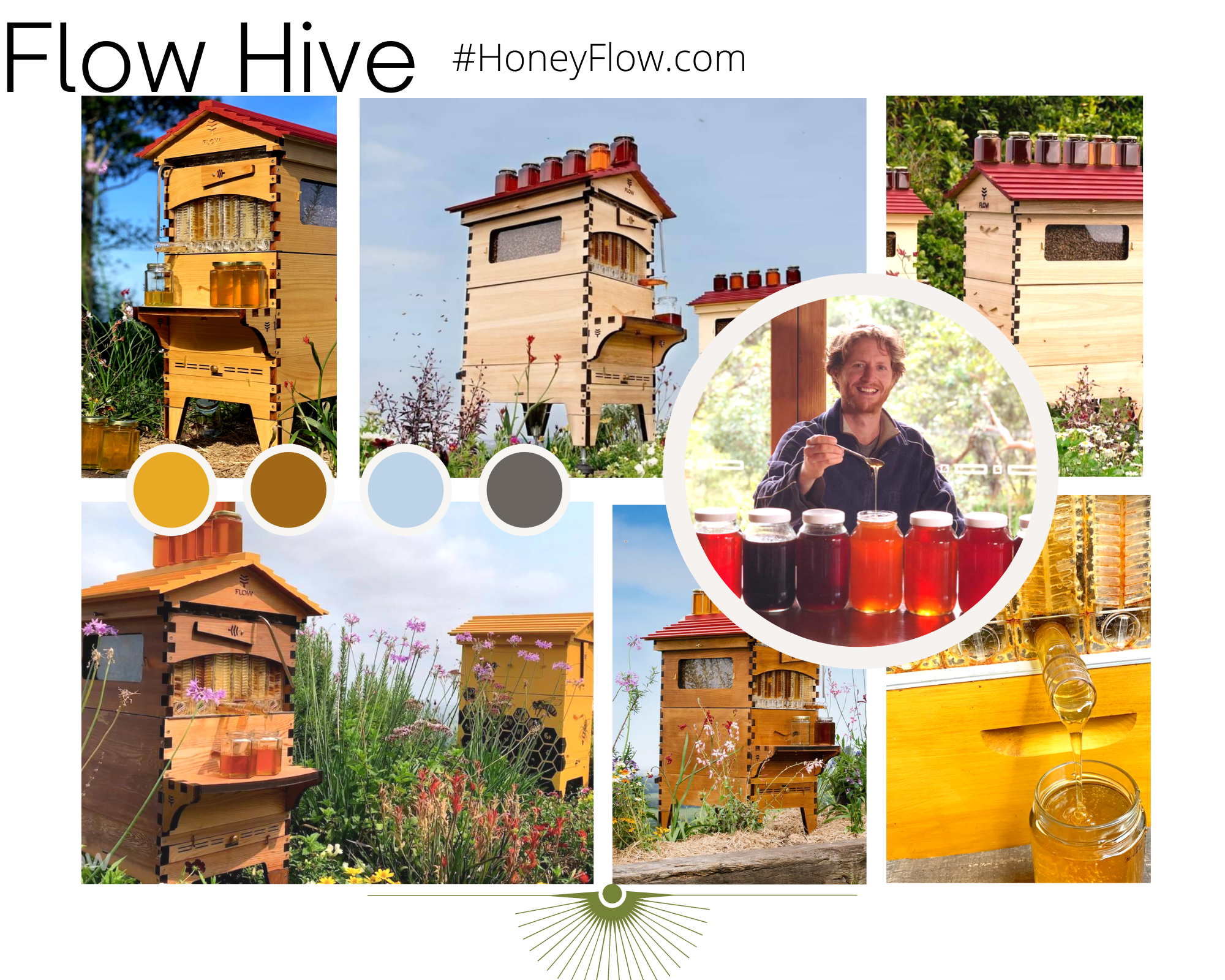

That’s a 14x value multiplier—and it shows why we’ve been thinking about Paulownia timber all wrong.

Most forestry projects focus on commodity lumber: Grow trees, cut logs, sell by the ton. Race to the bottom on price.

But Paulownia isn’t a commodity. It’s a specialty material.


Case Study: Flow Hive 2

Flow Hive—the innovative beehive that lets you harvest honey without disturbing bees—just launched their Paulownia edition.

Why Paulownia?

✅ Super lightweight (280 kg/m³) – beekeepers can move hives easily
✅ Durable outdoors – withstands weather without rot
✅ Precision workable – laser cuts cleanly for complex designs
✅ Thermal insulation – regulates hive temperature naturally
✅ Sustainability story – FSC-certified, 5-7 year harvest vs. 50-100 for hardwoods

The result: Premium beehives selling for $500-700+ to eco-conscious beekeepers worldwide.

The math that changes everything:

Commodity Approach:
→ Harvest Paulownia timber
→ Sell as raw lumber: $2,000-5,000/hectare
→ One-time revenue

Value-Added Approach:
→ Harvest same timber
→ Process into beehives (or furniture, instruments, specialty products)
→ Revenue: $10,000-30,000/hectare
→ 5-10x multiplier

Plus: Premium brand positioning, sustainability marketing, customer loyalty.

This is the circular economy model BES has been building:

Not just “plant trees and sell logs.”

But: Raw Lumber → Process → Brand → Premium Markets

Other high-value Paulownia applications:

🎸 Musical instruments (guitars, mandolins) – $500-3,000 each
🪑 Lightweight furniture – 30-50% premium over standard wood
🏗️ Mass timber construction – Class A fire-rated, architectural spec
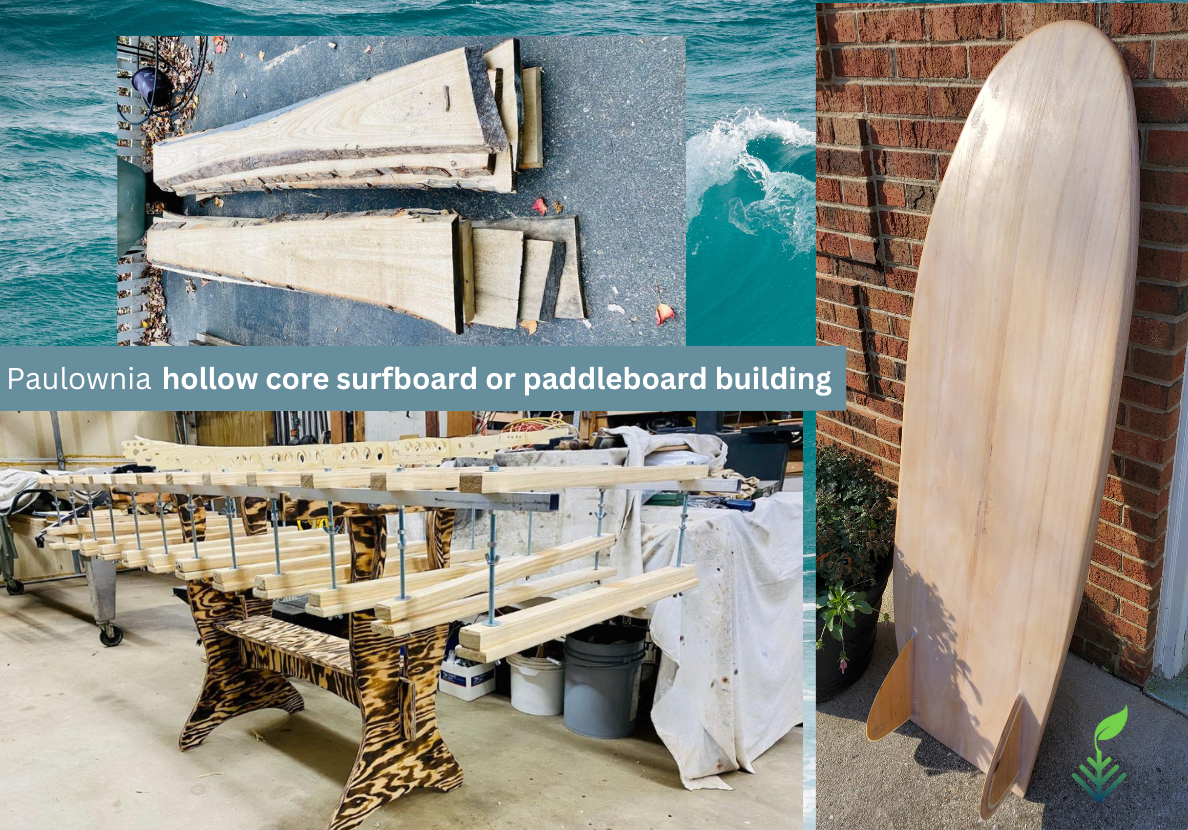
🛶 Surfboards/boats – strength-to-weight ratio unmatched
🎨 Specialty packaging – luxury goods, wine boxes

Each application commands 5-20x raw lumber prices.

The lesson for forestry investors:

Stop competing on volume. Start competing on value.

Paulownia’s rapid growth (5-7 years) + lightweight properties + sustainability story = premium positioning in niche markets.

Flow Hive proves it works:

Crowdfunded millions
Global customer base
Premium pricing sustained
Sustainability as selling point

And here’s the bonus: Beehives support pollinator populations. So you’re selling timber AND biodiversity impact.

My question for timber investors:

Why are you selling raw logs at $50 when finished products command $700?

The future of Paulownia isn’t commodity forestry. It’s specialty manufacturing.

Working in sustainable products or timber value chains?

Let’s discuss premium market opportunities for Paulownia.

♻️ Repost if you believe forestry should be about value, not just volume.

👉 Learn More About: “Benefits Paulownia Lumber” Here: https://bioeconomysolutions.com/paulownia-lumber/

👉 This Is How We Grow Paulownia: https://bioeconomy-solutions.kit.com/products/paulownia-growers-manual-bio-econom

👉 Book a call: https://bioeconomysolutions.com/bookcall

👉 Get a FREE copy of Paulownia Carbon Report: https://bioeconomysolutions.com/carbonreport

#Paulownia #CircularEconomy #SustainableTimber #ValueAdded #Beekeeping #SpecialtyProducts #Forestry Create a viral email from this limit to 500 characters. Use the Kasey Brown Framework.

Paulownia 42.86% Lighter Than Swamp Ash

Paulownia wood is approximately 45% to 55% lighter than swamp ash by weight. Some sources even suggest the difference can be as high as 60% depending on the specific samples.

Pictured above: The paulownia board is larger than the swamp ash board. This Paulownia Sample Proved 42.86% Lighter Than Swamp Ash.

This percentage is derived from the average dried weights (densities) of the two woods:

Paulownia wood has an average dried weight of around 18 lbs/ft³ (280 kg/m³).
Swamp ash has an average dried weight of approximately 32 to 33 lbs/ft³ (510 to 530 kg/m³), though some sources list it as high as 42 lbs/ft³.

Guitar Builders In The Know

Here’s what boutique builders and kit makers already know:

🎸 G&L Guitarsuses Paulownia for special lightweight runs of their ASAT and Legacy models.

🎸 Reverend Guitarshas featured Paulownia in limited editions, praising its resonance and comfort.

🛠️ Warmoth and Guitar Fetish (GFS)offer Paulownia bodies for Strat and Tele-style kits—perfect for DIY builders who want featherweight guitars.

🪚 Custom luthiers are fielding more requests for Paulownia than ever, especially for players with shoulder or back issues.

Why The Switch?

  • Extreme Lightness: Paulownia is as light as balsa, making it the go-to for anyone who plays long gigs or wants a travel-friendly axe.
  • Surprising Resonance: Despite its low density, Paulownia delivers a clear, articulate tone—especially when paired with quality hardware.
  • Sustainability & Cost: Grows fast, replenishes quickly, and is far more affordable than traditional tone woods.

Paulownia is now used by major, globally recognized manufacturers like Fender for specific models aimed at achieving extreme lightness (e.g., the Brad Paisley Road Worn Telecaster).

The use of Paulownia is currently most common among:

  1. Major manufacturers for specialized, lightweight, or signature models.
  2. High-end boutique builders.
  3. Aftermarket/DIY body suppliers.

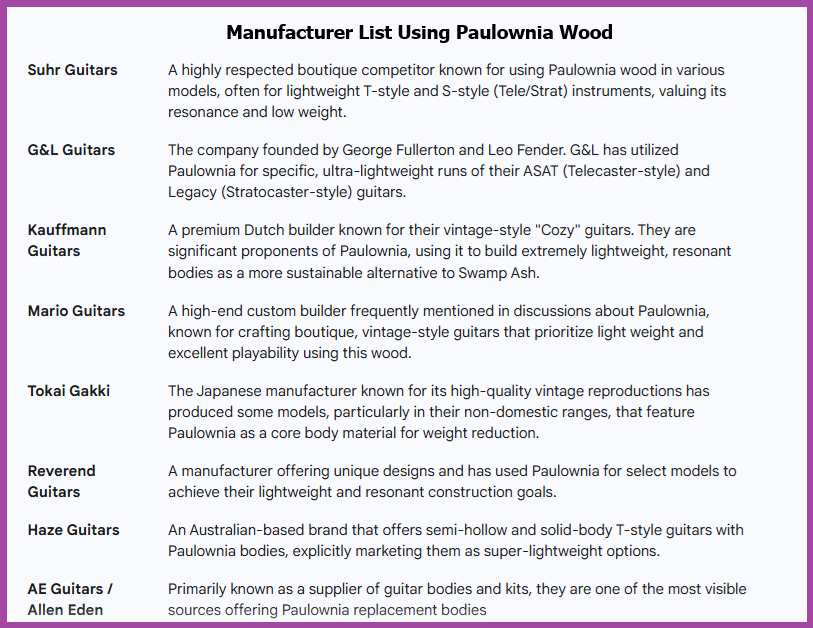
Based on industry research and known models, here is a list of Fender’s competitors and other prominent brands known to produce guitars with Paulownia cores or bodies.

Guitar Manufacturer BIG Names Using Paulownia

Suhr Guitars
G&L Guitars
Kauffmann Guitars
Mario Guitars
Tokai Gakki
Reverend Guitars
Haze Guitars
AE Guitars / Allen Eden
Fender Guitars

Did We Miss ANY? Comment below to add your suggested guitar manufacturers using paulownia wood lightweight materials.

Making The Change
If you’re tired of heavy guitars weighing you down, it’s time to try what the pros are already using.

Whether you’re a boutique builder, a custom shop, or a DIY enthusiast, Paulownia is the material that’s changing the game for lightweight, sustainable, and great-sounding guitars.

Curious about how Paulownia could work for your next build? Drop a comment or DM for supplier info, and real-world feedback to make the switch.

CONTACT US
Contact BioEconomy Solutions paulownia lumber specialists to discuss specifications, availability, and applications for your next project.

Where To Buy Paulownia? Paulownia Wood For Sale – QUESTIONS?

Visit our web page. https://bioeconomysolutions.com/paulownia-lumber/

We’re happy to organize a time to speak with you about our paulownia trees and lumber we have for sale. Please book your preferred time to speak directly.

Here’s a link to my online calendar/schedule:

www.bioeconomysolutions.com/bookcall

BioEconomy Solutions

mail@BioEconomySolutions.com

Office: 843.305.4777

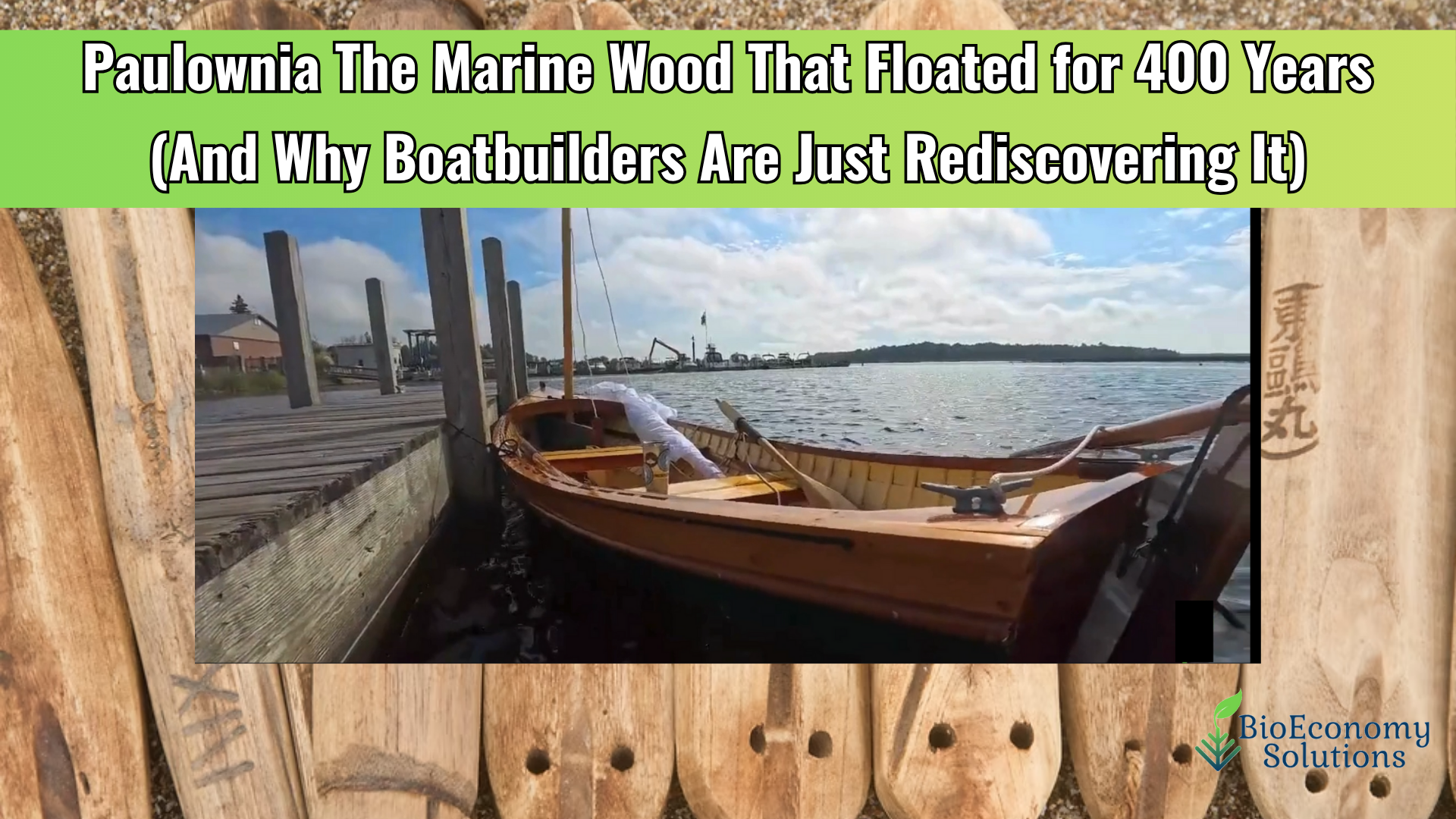
Paulownia wood has been hiding in plain sight for centuries.

Now marine craftsmen are realizing what 16th-century fishermen already knew.

While modern boatbuilders struggle with scarce cedar and expensive mahogany, there’s a wood that naturally resists water, rot, and decay—and it’s been proven in marine applications for over 400 years.

The question isn’t whether Paulownia works in marine environments.

The question is: why did we forget about it?

Watch Video: https://youtu.be/LZKKHAFN8mg?si=GEWcXuH7UJc_QQyy

The Marine Industry’s Hidden Crisis

Walk into any boatyard today and you’ll hear the same complaints:

“Western red cedar is unobtanium.” “Mahogany costs $16+ per board foot—when you can find it.” “We’re shipping wood from Africa and the Philippines.”

Meanwhile, the marine environment demands perfection:

  • Constant wet/dry cycles that split most woods
  • Salt water that accelerates decay
  • UV exposure that degrades materials
  • Weight considerations for performance

Traditional solutions are failing:

  • Cedar: Increasingly scarce, expensive
  • Teak: Overharvested, sustainability concerns
  • Mahogany: Limited supply, import dependent
  • Cypress: Heavy, prone to movement

But there’s a wood that solves all these problems.


The Forgotten Marine Champion

Paulownia’s natural marine advantages:

Water Resistance That Actually Works

Unlike woods that absorb water and swell, Paulownia’s cellular structure naturally repels moisture. This isn’t a treatment—it’s built into the wood’s biology.

Real-world proof: Boats built with Paulownia planking sat wet for a month with no buckling, splitting, or movement. Traditional cypress boats would have warped beyond repair.

Rot and Decay Resistance

Paulownia contains natural compounds that resist fungal attack and bacterial decay. In marine environments where rot destroys most woods within years, Paulownia maintains structural integrity.

Historical evidence: 16th-century Paulownia fishing buoys still exist as antique collectibles—400+ years later.

Paulownias use as a wood for fishing floats and small buoys is more of a modern phenomenon, capitalizing on its superior buoyancy and water resistance, often as a sustainable and lightweight alternative to materials like cedar, balsa, or non-biodegradable plastics. Its role is particularly prominent today in the production of hand-crafted or high-end fishing bobbers and drift floats.

The Weight Advantage

Paulownia boats: 165-170 pounds Cypress boats: 200+ pounds

That’s 35+ pounds saved on a 14-foot boat. For larger vessels, the weight savings become exponential—improving fuel efficiency, handling, and performance.


Modern Marine Applications

Hull Planking: The Foundation

Paulownia excels in hull construction because it:

  • Maintains dimensional stability through wet/dry cycles
  • Resists the crushing forces of wave impact
  • Provides natural buoyancy enhancement
  • Eliminates the buckling that plagues traditional planking

Master boatbuilder Eric’s testimony: “There’s no buckling or movement in the planking… That’s bad for a boat, and we can’t have that.”

Surfboards and Paddleboards: Performance Plus

The surfing industry discovered Paulownia’s advantages:

Buoyancy Benefits:

  • Natural flotation superior to synthetic cores
  • Lightweight reduces fatigue during long sessions
  • Water resistance prevents waterlogging

Performance Advantages:

  • Excellent strength-to-weight ratio
  • Natural flex characteristics
  • Sustainable alternative to foam cores

Durability Factor:

  • Resists dings and pressure damage
  • Self-healing properties from minor impacts
  • Long-term structural integrity

Decking and Fittings: Beauty Meets Function

Paulownia’s aesthetic appeal combines with practical benefits:

Visual Appeal:

  • Light, attractive grain patterns
  • Takes stain and finish beautifully
  • Maintains appearance in UV exposure

Functional Benefits:

  • Non-slip surface when properly finished
  • Comfortable underfoot (doesn’t get burning hot)
  • Easy to work with standard tools
  • Excellent screw and fastener holding

The Science Behind the Performance

Cellular Structure Advantage

Paulownia’s unique cellular composition creates:

  • Natural water repellency without chemical treatment
  • Dimensional stability through moisture changes
  • Impact resistance from flexible cell walls
  • Thermal insulation properties

Natural Preservatives

The wood contains compounds that:

  • Inhibit fungal growth
  • Resist bacterial decay
  • Repel marine borers
  • Maintain structural integrity underwater

Density Sweet Spot

At 0.28-0.30 specific gravity, Paulownia hits the perfect balance:

  • Light enough for easy handling
  • Dense enough for structural strength
  • Optimal buoyancy characteristics
  • Superior strength-to-weight ratio

Why the Marine Industry Forgot

The same reason hemp disappeared: Sometimes proven technologies get lost in the shuffle of industrial change.

What happened:

  • Colonial expansion shifted to local woods
  • Industrial revolution favored mass production
  • Synthetic materials promised “better living through chemistry”
  • Traditional knowledge wasn’t systematically preserved

The result: Centuries of proven marine performance forgotten.


The Sustainability Advantage

While traditional marine woods face scarcity:

Paulownia offers abundance:

  • Plantation-grown in 5-7 years vs. decades for hardwoods
  • Coppices from stumps—no replanting required
  • Grows on marginal land—doesn’t compete with food production
  • Carbon sequestration during growth phase

Environmental benefits:

  • No old-growth forest destruction
  • Reduced transportation emissions (local production)
  • Biodegradable end-of-life (unlike fiberglass)
  • Soil improvement during cultivation

Real-World Performance Data

Marine Trades Institute Testing:

  • Paulownia planks showed minimal dimensional change
  • Superior stability compared to traditional species
  • No fastener stress from wood movement
  • Maintained water-tight integrity

Commercial Applications:

  • Surfboard manufacturers reporting excellent durability
  • Paddleboard builders citing weight and performance advantages
  • Small craft builders achieving superior strength-to-weight ratios

Historical Validation:

  • 400-year-old buoys prove long-term marine durability
  • Traditional fishing applications across multiple cultures
  • Proven performance in harsh saltwater environments

The Modern Renaissance

Smart marine manufacturers are taking notice:

Surfboard Industry Leading

  • Premium boards featuring Paulownia cores
  • Marketing sustainability alongside performance
  • Customer education about natural materials

Small Craft Builders

  • Testing Paulownia for traditional construction methods
  • Documenting performance advantages
  • Training next generation on sustainable materials

Yacht Industry Interest

  • Exploring applications for luxury craft
  • Investigating weight savings for performance boats
  • Evaluating sustainability credentials for eco-conscious buyers

Implementation Considerations

For Boatbuilders:

  • Source properly dried lumber (12% moisture content)
  • Use appropriate fasteners for lightweight wood
  • Consider hybrid construction (Paulownia with traditional reinforcement)
  • Document performance for future reference

For Manufacturers:

  • Establish reliable supply chains
  • Develop processing specifications
  • Create quality standards
  • Educate customers on benefits

For Buyers:

  • Understand maintenance requirements
  • Appreciate long-term durability benefits
  • Consider total cost of ownership
  • Support sustainable material choices

The Future of Marine Paulownia

Emerging applications:

  • Composite cores for advanced construction
  • Engineered lumber for larger vessels
  • Specialty applications (masts, spars, interior components)
  • Hybrid construction combining traditional and modern techniques

Market drivers:

  • Sustainability requirements
  • Traditional wood scarcity
  • Performance advantages
  • Cost considerations

Innovation opportunities:

  • Advanced processing techniques
  • Engineered products development
  • Hybrid material systems
  • Specialized marine treatments

The Bottom Line

Paulownia isn’t a new marine material—it’s a rediscovered one.

For 400 years, it proved itself in the harshest marine environments. Modern testing confirms what ancient craftsmen knew: this wood naturally excels in water.

The advantages are clear:

  • Natural water, rot, and decay resistance
  • Superior strength-to-weight ratio
  • Dimensional stability in marine conditions
  • Sustainable production and supply
  • Proven long-term durability

The question for marine professionals:

Will you be an early adopter of this rediscovered solution, or will you wait until everyone else figures it out?

The master boatbuilders are already placing their orders.

The surfboard industry is embracing the performance advantages.

The historical evidence speaks for itself.


Sometimes the best innovations are actually rediscoveries.

Paulownia wood: 400 years of marine performance, waiting for its modern renaissance.


Ready to explore Paulownia for your marine applications? The wood that floated for centuries is available today—with modern processing and sustainable supply chains.

CONTACT US

Contact BioEconomy Solutions lumber specialists to discuss specifications, availability, and applications for your next project.

Where To Buy Paulownia? Paulownia Wood For Sale – QUESTIONS?

Visit our web page. https://bioeconomysolutions.com/paulownia-lumber/

We’re happy to organize a time to speak with you about our paulownia trees and lumber we have for sale. Please book your preferred time to speak directly.

Here’s a link to my online calendar/schedule:

www.bioeconomysolutions.com/bookcall

BioEconomy Solutions

mail@BioEconomySolutions.com

Office: 843.305.4777


Most boatbuilders have never heard of the wood that built 16th-century fishing buoys.

But one master craftsman just proved it outperforms everything we use today.

Eric has 43 years of boatbuilding experience. He’s trained hundreds of students at Marine Trades Institute. He’s worked with every wood species you can imagine.

But when a student asked him about Paulownia wood, he’d never heard of it.

That conversation changed everything.


The Crisis Hiding in Plain Sight

The marine industry faces a quiet emergency:

Traditional woods are disappearing:

  • Western red cedar: $16+ per board foot (when available)
  • His lead instructor calls it “unobtanium” – you just can’t get it
  • White oak: Limited supply, slow growth
  • Mahogany: Increasingly scarce, shipped from Africa/Philippines

The workforce is aging:

  • 5 boatbuilders retire for every 2 entering the trade
  • World Trade Organization declared wooden boat builders “endangered” in England
  • Not from lack of work – lack of skilled craftsmen

Meanwhile, fiberglass pollution is killing marine life:

  • Scientists found fiberglass strands in oyster beds
  • Microplastics contaminating entire food chains
  • “We can’t even find a control group anymore”

The Forgotten Solution

Eric decided to test this mystery wood his student mentioned.

What he discovered shocked him:

The Stability Test

He marked a 7-11/16″ wide Paulownia plank at 72% moisture content.

Two months later:

  • Dried to 12% moisture
  • Lost only 3/32″ in width
  • Comparison: White oak shrinks 1/4″ on a 12″ board

“That’s significant in that it’s such a small amount.”

The Marine Performance Test

Eric built boats using Paulownia planking.

The boats sat wet for a month – rain, lake water, everything.

Traditional cypress boats: Planks buckle, split, stress the fasteners Paulownia boats: No movement, no buckling, no splitting

“There’s no buckling or movement in the planking… we don’t want that. We can’t have that. That’s bad for a boat.”

The Weight Advantage

  • Cypress boats: 200 pounds
  • Paulownia boats: 165-170 pounds
  • 35-pound weight savings on 14.5-foot boats

The Historical Revelation

Then Eric learned something that changed his perspective entirely:

Paulownia buoys from the 1600s still exist.

Fishermen used Paulownia for marine floats 400 years ago. These antique buoys are now collector’s items.

“This buggers the real question here… what the hell happened? How did this stuff get forgotten about?”

The answer: Like hemp, proven technologies sometimes disappear from collective memory – only to be “rediscovered” centuries later.


Why This Matters Beyond Boats

Eric’s discovery reveals something bigger:

The Sustainability Factor:

  • Plantation-grown (no old-growth forests cut)
  • Regrows from stumps in 90 days
  • Reaches 13 feet in first season after cutting
  • Carbon sequestration while producing materials

The Performance Factor:

  • Lighter than traditional woods
  • Superior dimensional stability
  • Natural rot resistance
  • Proven 400-year marine heritage

The Economic Factor:

  • Consistent supply vs. scarce traditional woods
  • Predictable pricing vs. “call for availability”
  • Multiple revenue streams from same trees

The Resistance to Change

When Eric contacted high-end boatbuilders about Paulownia:

“I’ve been in the boat business for three generations. I’ve never heard of this thing… my daddy’s daddy’s daddy has done it this way, and by god, I’m gonna do it this way.”

Sound familiar?

Every industry has this challenge. The best solutions often hide behind unfamiliarity and tradition.

Marine Technical Institute (MTI) Paulownia Sailing Skiff Build 1 of 3

What Eric’s Teaching the Next Generation

At Marine Trades Institute, Eric now includes Paulownia in his curriculum:

“If you can build a boat, you can do damn near anything.”

His students are learning:

  • Traditional craftsmanship with modern materials
  • Sustainability without compromising performance
  • How to question assumptions and test alternatives
  • The importance of environmental responsibility

His mission: Pass proven techniques to the next generation before knowledge disappears.


The Bigger Lesson

Eric’s story isn’t just about wood or boats.

It’s about:

  • How proven solutions get forgotten
  • Why expertise matters in evaluating new materials
  • The importance of testing assumptions
  • How sustainability and performance can align

His advice to other industries: “Don’t be entrenched. This isn’t about converting you. It’s about offering you options.”


The Future Eric’s Building

Eric plans to:

  • Continue long-term durability testing
  • Share results with Traditional Small Craft Association
  • Train more students on sustainable materials
  • Document findings for future generations

His goal: Ensure valuable knowledge doesn’t disappear again.


What This Means for You

Whether you’re in construction, manufacturing, or any industry using materials:

Ask yourself:

  • What “traditional” materials are becoming scarce or expensive?
  • What proven alternatives might exist that you’ve never heard of?
  • How could testing new materials improve your products and sustainability?

Eric’s example shows: Sometimes the best innovations are actually rediscoveries of forgotten wisdom.


The master craftsman who “never heard of” Paulownia is now planning his next order.

His students are building boats that outperform traditional materials.

And a 400-year-old marine solution is getting a second chance.

Sometimes the future is found by looking at the past with fresh eyes.


What “forgotten” solutions might be hiding in your industry?

The next breakthrough might be something that worked centuries ago – waiting to be rediscovered.

View the “Entire” Live Interview

Paulownia Boatbuilder Live Interview | Interviewing a Master Builder on His 1st Paulownia Projects

Where To Buy Paulownia? Paulownia Wood For Sale – QUESTIONS?
Visit our web page. https://bioeconomysolutions.com/paulownia-lumber/

We’re happy to organize a time to speak with you about our paulownia trees and lumber we have for sale. Please book your preferred time to speak directly.

Here’s a link to my online calendar/schedule:

www.bioeconomysolutions.com/bookcall

BioEconomy Solutions

mail@BioEconomySolutions.com

Office: 843.305.4777

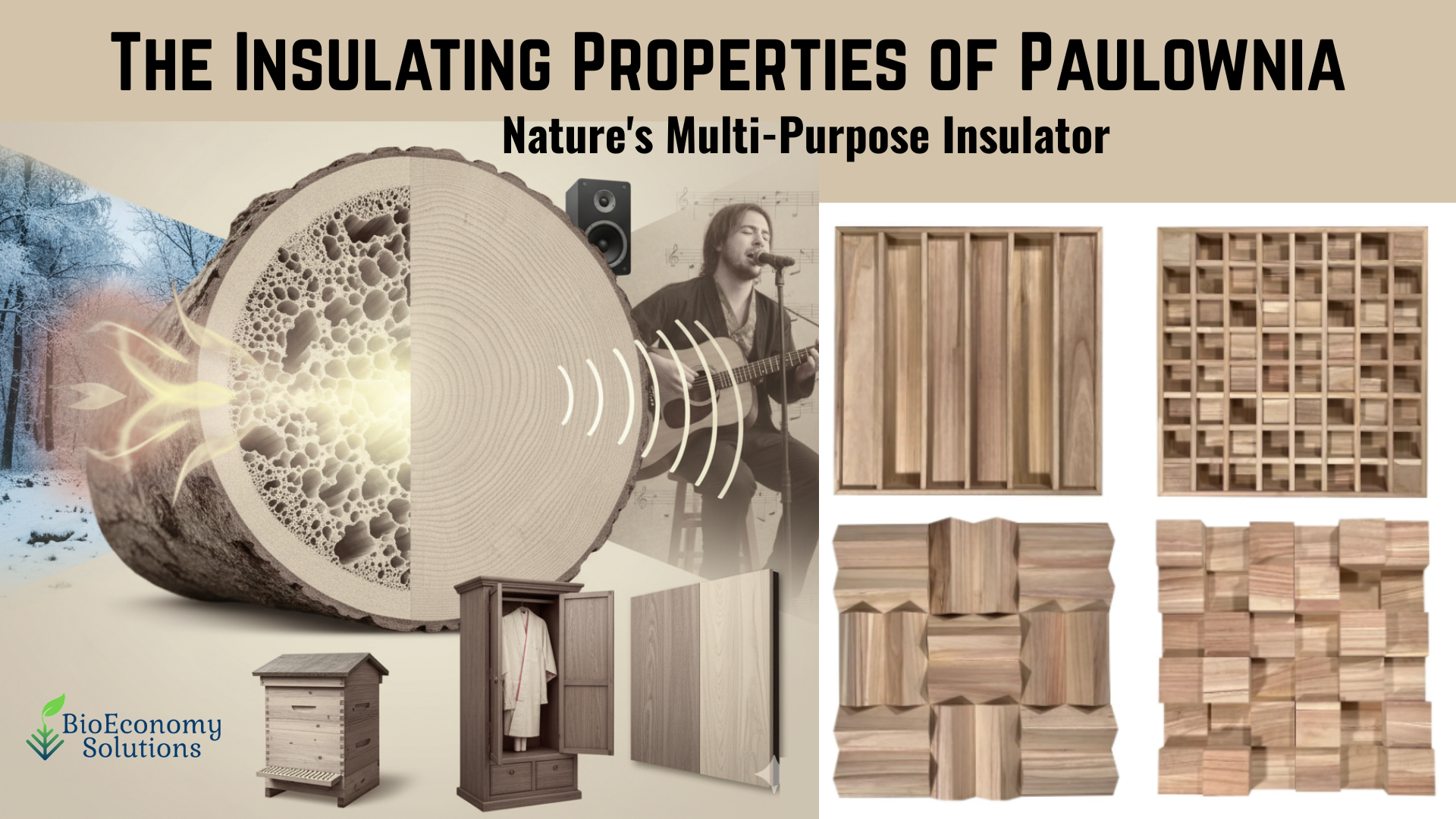
Paulownia wood possesses exceptional insulating properties that make it valuable across multiple applications. Here’s a comprehensive breakdown:

Thermal Insulation Properties

Low Thermal Conductivity

  • Paulownia has one of the lowest thermal conductivity values among all wood species
  • This means it effectively resists heat flow, keeping interiors warm in winter and cool in summer
  • The thermal conductivity becomes even lower after thermal modification (heat treatment)
  • Performance is comparable to standard thermal insulation materials

Structural Basis for Insulation

  • Low Density: One of the lightest woods available (30% lighter than most hardwoods)
  • Honeycomb Cellular Structure: Highly porous internal structure traps air – nature’s best insulator
  • Hollow Center: The characteristic “water highway” creates additional air pockets for insulation

Fire Resistance & Safety

Superior Fire Performance

  • Auto-ignition temperature: ~400°C (752°F) vs. ~220°C (428°F) for common hardwoods
  • Class A Fire Rating: Achieved ASTM E84 flame spread rating (as noted in knowledge base)
  • Self-Protecting Mechanism: When heated, it carbonizes easily, creating a char layer that insulates and protects the wood underneath

Why It Matters

  • Significantly safer for construction applications
  • Reduces fire insurance costs
  • Meets strict building codes without chemical treatments

Acoustic Insulation

Sound-Deadening Properties

  • Light weight combined with porous structure creates excellent sound absorption
  • Natural acoustic dampening without additional materials
  • Reduces noise transmission between spaces

Applications

  • Musical instruments (traditional use for centuries)
  • Recording studios and concert halls
  • Residential sound insulation
  • Commercial acoustic panels

Practical Applications of Paulownia’s Insulating Properties

Construction & Building

  • Wall panels: Natural insulation reduces HVAC costs
  • Roofing materials: Lightweight with thermal protection
  • Interior cladding: Temperature regulation without bulk
  • Mass timber construction: Insulating structural elements

Specialized Uses

  • Saunas: Heat resistance + insulation + moisture tolerance
  • Cold storage: Natural thermal barrier
  • Shipping containers: Temperature-controlled transport
  • Aerospace: Lightweight insulation for aircraft interiors

Traditional Applications

  • Japanese construction: Used for centuries in fire-resistant buildings
  • Furniture: Naturally insulating storage chests and wardrobes
  • Musical instruments: Acoustic properties enhance sound quality

Comparative Advantages

vs. Traditional Insulation Materials:

  • Renewable and sustainable (5-year harvest cycles)
  • No chemical treatments required
  • Structural strength + insulation in one material
  • Natural fire resistance without additives

vs. Other Woods:

  • 2x better thermal performance than most hardwoods
  • Significantly lighter weight
  • Superior fire resistance
  • Better acoustic properties

Economic Benefits

Energy Efficiency

  • Reduces heating and cooling costs
  • Meets green building standards naturally
  • Lower HVAC system requirements

Construction Advantages

  • Lighter weight reduces structural load requirements
  • Faster installation due to workability
  • Multi-functional (structural + insulating)
  • Reduced need for additional insulation materials

Scientific Backing

The insulating properties are well-documented and stem from:

  1. Physical structure: Honeycomb cellular matrix traps air
  2. Low density: Less material = more air pockets
  3. Thermal modification potential: Heat treatment enhances properties
  4. Natural composition: No synthetic additives needed

Future Applications

Given these properties, Paulownia is positioned for:

  • Passive house construction: Ultra-efficient building standards
  • Sustainable architecture: Green building certifications
  • Industrial insulation: High-temperature applications
  • Acoustic engineering: Specialized sound control

The combination of thermal, fire, and acoustic insulation properties makes Paulownia unique among natural materials – offering multiple performance benefits in a single, sustainable, fast-growing resource.


Where To Buy USA Paulownia Lumber?

Need paulownia for your next project?

Where to buy paulownia? We’re harvesting our mature U.S. South Carolina Paulownia Timber and have millions of board foot available. We can mill lumber for your business needs. Contact Us for details. Office: 843.305.4777 | Email: mail@bioeconomysolutions.com Here’s a link to our online calendar, schedule a conference call with us:

www.bioeconomysolutions.com/bookcall

USA Paulownia Wood Lumber For Sale – Need paulownia wood lumber for your next project? https://bioeconomysolutions.com/paulownia-lumber/

You will discover that paulownia wood is the “Light Strong Alternative Wood” used in many processes to obtain many types of products.

Weather you are a hobbyist or full time manufacturing company, paulownia wood grown in South Carolina USA may be a new expression of your talent.

We sell Custom Paulownia boards: rough sawn or planed, we offer various sizes and thicknesses. Our Paulownia boards are processed using sustainable Paulownia hardwood grown right here in South Carolina USA.

If you’re interested in paulownia, want to grow or currently growing, Subscribe to our newsletter: https://bioeconomysolutions.com/carbonreport

LIKE|SHARE|COMMENT

If you enjoyed this article, you may also like “Do Wood Carvers Use Paulownia Wood?

STOP 🛑

You’ve been lied to about Paulownia trees.

For decades, one Google search result has cost investors millions in missed opportunities. Type “Paulownia” and the first thing you see: “INVASIVE SPECIES.”

That lie just died.

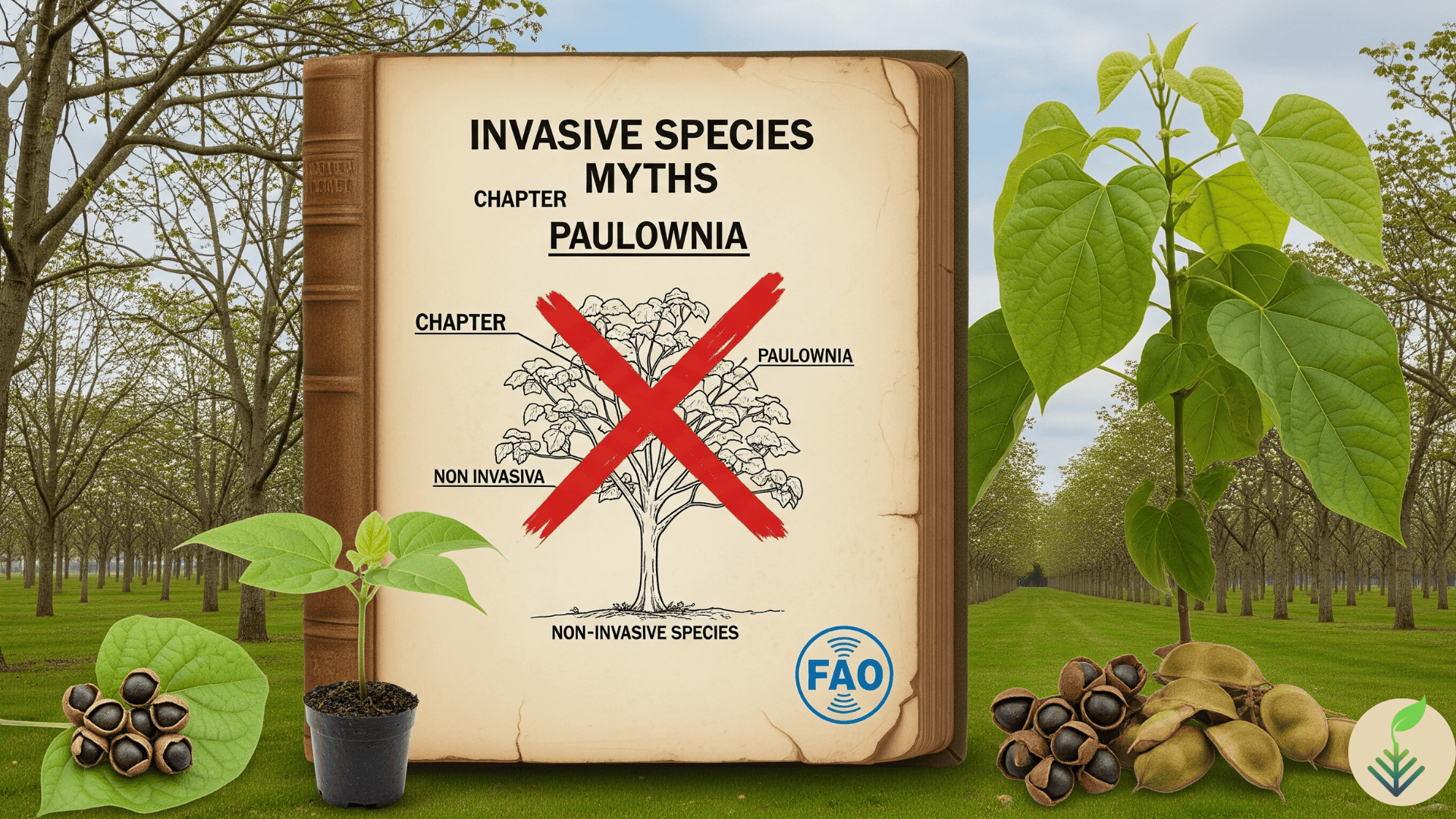
The UN’s Food and Agriculture Organization—the world’s leading forestry authority—released their 27th Session, October 2024 report on fast-growing trees.

Paulownia got the official green light

WHY? 📖

Here’s the truth that changes everything:

The Scientific Validation

Dr. Nicola La Porta of FEM conducted definitive studies: Even in naturalization conditions, Paulownia tomentosa cannot permanently colonize environments. Only transitory colonization occurs—then it disappears.

Translation: The invasive species fear was based on incomplete science.

The Commercial Proof

Wonder K Green has planted 1,200 hectares since 2013 across Central and Southern Italy using Cotevisa 2 clone (P. elongata x P. fortunei hybrid).

FAO’s assessment: “Technical reports indicate good performance.”

Real-world result: Zero invasive incidents. Zero ecological disruption. Just rapid growth and economic returns.

The Industry Recognition

PEFC Italia initiated certification for Paulownia plantations and wood—the same standards used for sustainable forestry worldwide.

What this means: Paulownia is now recognized as a legitimate forestry species, not an ecological threat.

The Competitive Landscape

While the FAO report shows other species struggling:

Eucalyptus: Disease outbreaks (Teratosphaeria gauchensis) and variable productivity (6-16 m³/ha/year)

Douglas Fir: Limited to specific mountain regions, requires 40+ years to mature

Poplar: Increasing pest pressure from climate change, woolly aphid resistance issues

Paulownia emerges as the viable alternative with unique advantages the FAO couldn’t ignore.

The Research Momentum

Institutional backing is accelerating:

  • Veneto Agricoltura comparative studies at demonstration farms
  • Collaboration with Chinese Academy of Forestry (CAF)
  • CNR IBAF research partnerships
  • Multiple Italian regions reporting success

The Market Timing

The FAO report emphasizes “growing international interest in fast-growing species for climate mitigation” and “Bioeconomy Solutions applications including bioenergy and biochemicals.”

Paulownia checks every box:

  • Fastest growth rates (10-15 feet/year)
  • Multiple revenue streams (timber, carbon, biomass, biochar)
  • Thrives on marginal land
  • Proven carbon sequestration (80-100 tons CO₂/acre in 5 years)

SHAPE THE FUTURE 🚀

Why this FAO validation changes everything:

For Investors

The “invasive species” discount just disappeared. Paulownia investments now have UN-level scientific backing.

For Landowners

You can plant Paulownia without regulatory or environmental concerns. The science is settled.

For Carbon Markets

Paulownia-based carbon credits now have institutional credibility that buyers demand.

For the Industry

PEFC certification opens doors to mainstream forestry markets previously closed due to invasive fears.

The Opportunity Window

Here’s what smart money knows:

While competitors avoided Paulownia due to internet myths, early movers captured:

  • Premium land at discount prices
  • First-mover advantage in carbon markets
  • Exclusive partnerships with growers
  • Technology and genetic advantages

The FAO validation just opened the floodgates.

What Happens Next

Phase 1 (Now): Early adopters scale operations while competition is limited

Phase 2 (2025-2026): Mainstream adoption begins as FAO validation spreads

Phase 3 (2027+): Premium land prices, competitive markets, reduced returns for latecomers

The Bottom Line

When the world’s top forestry scientists validate your tree species, everything changes.

The invasive species myth cost investors millions. The FAO validation will make early movers millions.

The question isn’t whether Paulownia will succeed—it’s whether you’ll be early or late.


Ready to explore Paulownia opportunities before the mainstream catches on?

The FAO just gave us the ultimate third-party validation. The window for early-mover advantage is open, but it won’t stay that way.

Download the FAO REPORT


Contact BioEconomy Solutions to learn how FAO validation transforms the Paulownia investment landscape.

The revolution just got official backing. Don’t let this opportunity grow past you.

Want To Grow Paulownia For Your Next Project?


Contact Us for paulownia saplings and planning assistance.

Where To Buy Paulownia? Paulownia Wood For Sale – QUESTIONS?

Learn more about paulownia carbon projects here: https://bioeconomysolutions.com/paulownia-carbon-credits/

We’re happy to organize a time to speak with you about our paulownia trees and lumber we have for sale. Please book your preferred time to speak directly.

Here’s a link to my online calendar/schedule:

www.bioeconomysolutions.com/bookcall

BioEconomy Solutions

mail@BioEconomySolutions.com

Office: 843.305.4777

Download FREE Paulownia Carbon REPORT

Subscribe to our newsletter

Subscribe to our newsletter

The Perfect Storm Hitting American Construction!

Steve Martinez, a Boise contractor, watches lumber prices swing wildly—sometimes increasing tenfold overnight. Canada has historically accounted for a very high percentage of U.S. softwood lumber imports, typically in the 70–85% range. Recent data shows this percentage has shifted. For example, in 2024, Canada accounted for 84.3% of U.S. softwood lumber imports.

The new potential tariffs jumping from 14.5% to 34.5%, America’s construction industry faces an unprecedented crisis which ultimately the end consumer pays the price.

The numbers are staggering: over 100 million American households can’t afford the median $460,000 home price, while builders struggle with fixed contracts and volatile material costs that make up 15-18% of total construction expenses.

But what if there was a domestic solution growing right under our noses?

Enter Paulownia: America’s Untapped Lumber Goldmine

While politicians debate tariffs and regulations, a revolutionary wood species is quietly proving itself across American soil. Paulownia—often called the “aluminum of lumber”—offers properties that could transform the U.S. construction landscape.

The Paulownia Advantage: Superior Performance Metrics

Strength-to-Weight Champion:

  • 30% lighter than traditional hardwoods
  • Twice as strong as balsa wood
  • Highest strength-to-weight ratio of any wood globally
  • Perfect for reducing transportation costs and construction labor

Built-in Durability:

  • Naturally fire-resistant (higher ignition temperature)
  • Termite and rot resistant without chemical treatment
  • Dimensionally stable—resists warping, shrinking, and cracking
  • Ideal for moisture-prone applications like saunas and pool decks

Construction Versatility:

  • Non-load-bearing structural components
  • Interior finishing and trim work
  • Flooring with superior dimensional stability
  • Natural insulation properties
  • Acoustic panels for soundproofing

Paulownia Bearing The Load

Non-load-bearing structural components are elements of a building that do not support the main weight of the structure, such as the roof or floors. Instead, they primarily serve functions like dividing spaces, providing insulation or soundproofing, or acting as decorative finishes. Examples include interior partition walls, drywall, and exterior cladding.

Paulownia Wood and Load-Bearing Applications

Paulownia wood is exceptionally lightweight, often compared to balsa wood, but it has a high strength-to-weight ratio. While it is naturally a non-load-bearing material by itself, its properties can be enhanced through existing engineered wood technologies to make it suitable for some load-bearing applications.

These technologies generally involve processing the wood to create composite materials with improved structural properties:

Laminated Veneer Lumber (LVL): This process involves bonding thin layers (veneers) of wood together with adhesives. By arranging the grain of all veneers parallel to the long direction, LVL creates a strong, stiff, and dimensionally stable product.

Sandwich Panels: Paulownia wood can be used as the lightweight core material in a sandwich panel, with stronger, denser materials like fiberglass, plywood, or other hardwoods bonded to its surfaces. This structure provides high stiffness and strength while keeping the overall product lightweight.

Glued Laminated Timber (Glulam): Similar to LVL, glulam is made by bonding together smaller pieces of wood into larger, more stable members. This process can utilize the lightweight properties of paulownia for the core while potentially using stronger wood or other materials for the outer laminations to increase its load-bearing capacity.

The use of these engineered wood products allows paulownia to be utilized in structural applications where its natural properties alone would be insufficient, leveraging its fast growth and sustainable characteristics for a greener building industry.

Engineered wood technologies, including laminated veneer lumber (LVL) and cross-laminated timber (CLT), are used in modern construction.

How Strong Is Paulownia Wood?

Solving America’s Lumber Supply Chain Crisis

Speed to Market: The Game-Changer

While traditional softwood takes 20-50 years to mature, Paulownia delivers:

  • Harvestable timber in 5-7 years
  • 15-30 feet of growth in first season
  • Coppicing ability: Regrows from cut stumps without replanting
  • Multiple harvests from single planting

This means American landowners could establish domestic lumber supply chains in less than a decade—not the generations required for traditional forestry.

Geographic Flexibility

Unlike softwood forests concentrated in the Pacific Northwest and Southeast, Paulownia thrives across diverse American landscapes:

  • Semi-arid regions previously unsuitable for timber
  • Degraded agricultural land generating new rural income
  • Marginal soils where food crops struggle
  • Urban periphery for distributed lumber production

USA Paulownia Lumber now has “Class A” ASTM E84 Flame Spread Rating.

Download: Flame-Retardancy-of-Paulownia-Wood-and-Its-Mechanism.pdf

A Class A ASTM E84 flame spread rating for Paulownia lumber is highly significant for its advancement in the U.S. structural lumber and interior building materials market. Here’s why:

Economic Impact: Beyond Lumber

For Rural America:

  • Farmers diversify income with fast-growing timber crops
  • Abandoned farmland becomes productive again
  • Local sawmills process regional Paulownia supply
  • Carbon credit revenue provides additional income streams

For Builders:

  • Reduced transportation costs from distributed production
  • Price stability through domestic supply chains
  • Superior performance characteristics reduce callbacks
  • Lightweight properties decrease labor costs

For Homeowners:

  • Lower construction costs through domestic supply
  • Superior insulation reduces energy bills
  • Fire-resistant properties may lower insurance premiums
  • Sustainable building materials increase property values

The Construction Applications Revolution

Mass Timber Potential

While Paulownia isn’t suitable for primary load-bearing applications, its unique properties make it ideal for paulownia mass timber applications:

Sandwich Construction:

  • Paulownia core with hardwood exterior
  • Maintains strength while reducing weight
  • Significant material cost savings
  • Enhanced insulation properties

Engineered Wood Products:

  • Laminated veneer lumber (LVL) applications
  • Cross-laminated timber (CLT) components
  • Glue-laminated beams for specific applications

Specialty Markets

High-Value Applications:

  • Musical instrument construction (proven market)
  • Boat building and marine applications
  • RV and mobile home construction
  • Modular housing components

Addressing the Labor Crisis

The U.S. lumber industry faces severe labor shortages, with employment expected to decline 2-4% by 2033. Paulownia offers solutions:

Mechanized Harvesting:

  • Forage harvesters process 80-100 green tons per hour
  • Reduced dependence on skilled logging crews
  • Safer harvesting operations
  • Lower labor costs per board foot

Distributed Processing:

  • Smaller, regional mills reduce transportation
  • Less specialized labor required
  • Community-based economic development
  • Reduced infrastructure investment

The Regulatory Advantage

While traditional forestry battles the Endangered Species Act and National Environmental Policy Act, Paulownia offers regulatory benefits:

Environmental Positives:

  • Carbon sequestration during growth phase
  • Soil improvement on degraded lands
  • No impact on old-growth forests
  • Biodiversity enhancement when properly managed

Fast Permitting:

  • Agricultural land conversion simpler than forest management
  • No endangered species habitat conflicts
  • Positive environmental impact assessments
  • Community economic development benefits

Economic Modeling: The Numbers Work

Traditional Softwood Economics:

  • 20-50 year investment horizon
  • High land acquisition costs
  • Regulatory compliance expenses
  • Transportation from limited regions

Paulownia Economics:

  • 5-7 year payback period
  • Utilizes lower-cost marginal land
  • Multiple revenue streams (timber, carbon, biomass)
  • Distributed production reduces logistics costs

Market Opportunity: With lumber representing a $60+ billion annual U.S. market, even capturing 10% would create a $6 billion Paulownia industry—enough to meaningfully impact supply and pricing.

Implementation Strategy: A Roadmap Forward

Phase 1: Pilot Projects (Years 1-3)

  • Establish demonstration plantations in key regions
  • Partner with progressive builders for testing
  • Develop processing and grading standards
  • Create supply chain partnerships

Phase 2: Scale-Up (Years 3-7)

  • Expand acreage based on proven demand
  • Build regional processing facilities
  • Establish distribution networks
  • Develop specialized applications

Phase 3: Market Integration (Years 7-15)

  • Achieve meaningful market share in specialty applications
  • Integrate with existing lumber supply chains
  • Export surplus production
  • Establish Paulownia as standard construction material

The Investment Opportunity

For Landowners:

  • Convert marginal land to productive timber assets
  • Generate income while trees mature through carbon credits
  • Benefit from multiple harvest cycles
  • Participate in growing domestic lumber market

For Investors:

  • Early entry into emerging domestic lumber supply
  • ESG-compliant investment with measurable impact
  • Multiple exit strategies through various end markets
  • Hedge against lumber price volatility

For Communities:

  • Rural economic development opportunities
  • Reduced dependence on volatile agricultural markets
  • Local processing jobs
  • Sustainable economic base

Overcoming the Challenges

Market Acceptance:

  • Education about Paulownia’s superior properties
  • Demonstration projects proving performance
  • Building code acceptance and standards development
  • Architect and engineer training programs

Supply Chain Development:

  • Processing equipment adaptation
  • Quality grading systems
  • Distribution network establishment
  • End-user education and support

Scale Requirements:

  • Coordinated planting across multiple landowners
  • Processing facility investment
  • Market development initiatives
  • Policy support for domestic alternatives

The Climate Bonus

While solving America’s lumber crisis, Paulownia delivers massive climate benefits:

  • 80-100 tons CO₂ sequestered per acre in first 5 years
  • Carbon-negative construction materials
  • Reduced transportation emissions from domestic supply
  • Soil improvement on degraded lands

This creates additional revenue through carbon credit markets while addressing climate goals.

The Time Is Now

America’s lumber crisis demands innovative solutions. While politicians debate tariffs and regulations, Paulownia offers a market-based path forward:

Domestic supply security

Superior performance characteristics

Rapid deployment timeline

Rural economic development

Climate benefits

Regulatory advantages

The question isn’t whether Paulownia can help solve America’s lumber crisis—it’s whether we’ll act fast enough to capture the opportunity.

Every month we delay is another month of volatile prices, housing unaffordability, and missed economic development.

The solution is growing. Literally.


Ready to explore Paulownia opportunities for your land, business, or investment portfolio? The domestic lumber revolution starts with the first tree planted.

Contact us to learn how Paulownia can transform your piece of America’s lumber future.

Conclusion

The Paulownia tree, with its FAST growth rate, carbon capture abilities, and adaptability, is a powerful tool in climate change mitigation, biodiversity support, and sustainable forest management. When used appropriately in afforestation and reforestation projects, it holds the potential to restore ecosystems, combat deforestation, and provide long-term environmental and economic benefits.

Contact Us

BioEconomy Solutions is a Carbon Dioxide Removal (CDR) Project Developer. Talk to us about our TREE PLANTING strategies with Paulownia trees.

We’re happy to organize a time to speak with you about our paulownia trees and lumber we have for sale. Please book your preferred time to speak directly.

Here’s a link to my online calendar/schedule:

www.bioeconomysolutions.com/bookcall

BioEconomy Solutions

mail@BioEconomySolutions.com

Office: 843.305.4777

Visit us at: https://bioeconomysolutions.com/paulownia-carbon-credits/ Let’s chat about paulownia tree solutions for sustainable Forest carbon credits projects.

LIKE|SHARE|COMMENT

Enjoy this article? You may also enjoy “Carbon Developers Choose Paulownia Trees” https://www.linkedin.com/pulse/carbon-developers-choose-paulownia-trees-victor-garlington-imh4e/

Subscribe to our newsletter

Subscribe to our newsletter

Paulownia lumber just leveled up with the introduction of its Class A ASTM E84 Flame Spread Rating—a significant milestone that opens the door for its wider use in fire-resistant, sustainable construction.

Why Is This Important?

Here’s how this new rating ties into the bigger picture of reducing embodied carbon emissions while providing safe, eco-friendly alternatives to traditional building materials.


1. 🔥 Class A Flame Spread Rating: A Major Safety Upgrade

  • Fire-Resistant and Safe: The Class A flame spread rating from ASTM E84 places Paulownia lumber among the most fire-resistant materials available on the market. This rating indicates that the wood exhibits minimal flame spread and smoke development during fire testing—key safety considerations for buildings, especially in commercial or high-density residential spaces.

  • Safer High-Rise and Commercial Builds: With this fire safety certification, Paulownia wood is now a viable candidate for high-rise buildings, commercial spaces, and other fire-sensitive areas. In a post-Grenfell world, fire safety is a critical concern, and this certification makes Paulownia lumber a strong alternative to more traditional, carbon-intensive materials like steel and concrete, without compromising safety.


2. 🌱 Lower Embodied Carbon, Higher Safety Standards

  • Carbon-Friendly, Flame-Smart: Paulownia is already known for its rapid growth and carbon sequestration, absorbing CO₂ from the atmosphere as it matures. Now, with the Class A flame spread rating, it offers the best of both worlds: a low-carbon footprint and enhanced fire safety. This makes it an even more compelling choice for sustainable construction.

  • Carbon Savings with Safety: By using Paulownia lumber, builders can lower the embodied carbon emissions of their projects while adhering to safety regulations that are becoming stricter in fire-prone regions. It’s not just about carbon credits anymore—it’s about eco-friendly, fire-resistant materials that meet the highest safety standards.


3. 💡 Increasing Demand for Low-Carbon, Fire-Safe Alternatives

  • A Solution for “Buy Clean” Policies: With more and more cities and governments enforcing “buy clean” policies—which prioritize the use of low-carbon, environmentally friendly materials in public procurement—Paulownia lumber’s new flame rating positions it as a top-tier choice for government projects, school buildings, hospitals, and other public structures.

  • Enhanced Market Appeal: This development will attract builders and developers looking to meet green building certification standards (e.g., LEED, WELL), especially when combined with its rapid growth and carbon sequestration. With an increased demand for sustainable and fire-safe building materials, Paulownia’s Class A rating gives it a major competitive edge.


4. 🛠 A Game-Changer for Mass Timber and Sustainable Structures

  • Mass Timber with Safety and Sustainability: Paulownia’s strength-to-weight ratio, coupled with its fire-resistant properties, makes it an ideal choice for mass timber construction. Whether in glulam beams, cross-laminated timber (CLT), or timber-frame construction, the Class A flame rating adds an extra layer of confidence in projects where fire safety is a priority.

  • Sustainability Meets Structural Integrity: Builders can now use Paulownia mass timber in large structural components of buildings without compromising on safety. This allows for the reduction of steel and concrete—the most carbon-intensive materials—while ensuring that buildings are safe, durable, and compliant with fire safety standards.


5. 🌍 Paulownia Lumber: A Catalyst for Carbon Markets & Financial Incentives

  • Carbon Credits for Low-Carbon Builds: As Paulownia trees sequester significant amounts of CO₂, landowners and developers involved in Paulownia plantations can earn carbon credits for the environmental benefits of the wood. This makes the transition to sustainable, low-carbon materials more financially appealing, with the added incentive of earning revenue from carbon markets.

  • Class A + Carbon Credits = Double Benefit: Now, with Paulownia lumber’s Class A flame spread rating, builders can tap into both safety and carbon reduction benefits. They can reduce embodied carbon in their buildings, earn carbon credits, and enhance the financial returns of their projects while contributing to sustainability goals.


6. 🏗 Impact on the U.S. Construction Industry

  • Boosting Local Timber Economies: As the demand for fire-safe, sustainable materials increases, Paulownia lumber can become a key driver of economic growth in timber-producing regions of the U.S. This creates new opportunities for local farmers and foresters, boosting job creation in sustainable timber production and carbon management.

  • Alignment with U.S. Green Building Initiatives: The Class A flame rating aligns perfectly with the U.S. Green Building Council’s (USGBC) goals of promoting safe, low-carbon materials in construction. Paulownia lumber now has the necessary credentials to participate in green certifications, federal procurement, and net-zero initiatives across the country.


7. 📊 Setting the Stage for Future Innovation in Sustainable Building

  • Incentivizing R&D in Fire-Resistant, Low-Carbon Materials: As fire-resistant Paulownia lumber becomes more widely accepted, it will likely spark additional research and development into even more advanced low-carbon and fire-resistant building materials. This could lead to the creation of new construction systems that use even less carbon-intensive material without compromising safety.

  • Attracting Investment: The combination of sustainability, fire resistance, and carbon credits makes Paulownia lumber an attractive investment opportunity for venture capitalists and sustainability-focused funds. As demand for eco-friendly and safe materials rises, Paulownia lumber is positioned to be a key player in the construction sector’s green revolution.


Conclusion: Paulownia Lumber’s Class A Rating Is a Game-Changer for Sustainable Construction

With the new Class A ASTM E84 Flame Spread Rating, Paulownia lumber has cemented its role as a fire-safe, low-carbon building material for the future. Builders and developers now have a safer, eco-friendly alternative to traditional construction materials like steel and concrete—allowing them to meet green building certifications, reduce carbon emissions, and increase fire safety.

As the construction industry pushes toward net-zero emissions and carbon-neutral goals, Paulownia lumber offers a powerful solution that meets both environmental and safety standards—making it a game changer for sustainable construction and a low-carbon economy.


Bottom Line

A Class A ASTM E84 rating positions Paulownia as a safe, sustainable, and high-performance alternative in interior and potentially structural applications in the U.S. market. This could accelerate its adoption in architectural design, commercial construction, and green building sectors, provided it clears structural grading and durability hurdles.

Download: Flame-Retardancy-of-Paulownia-Wood-and-Its-Mechanism.pdf

🌿Where To Buy USA Paulownia Lumber?

Need paulownia for your next project?

Where to buy paulownia? We’re harvesting our mature U.S. South Carolina Paulownia Timber and have millions of board foot available. We can mill lumber for your business needs. Contact Us for detailsOffice: 843.305.4777 | Email: mail@bioeconomysolutions.com Here’s a link to our online calendar, schedule a conference call with us:

https://info586.youcanbook.me

USA Paulownia Wood Lumber For Sale – Need paulownia wood lumber for your next project? https://bioeconomysolutions.com/paulownia-lumber/

You will discover that paulownia wood is the “Light Strong Alternative Wood” used in many processes to obtain many types of products.

Weather you are a hobbyist or full time manufacturing company, paulownia wood grown in South Carolina USA may be a new expression of your talent.

We sell Custom Paulownia boards: rough sawn or planed, we offer various sizes and thicknesses. Our Paulownia boards are processed using sustainable Paulownia hardwood grown right here in South Carolina USA.

👉 If you’re interested in paulownia, want to grow or currently growing, Subscribe to our newsletter: https://bioeconomysolutions.com/carbonreport

LIKE|SHARE|COMMENT

If you enjoyed this article, you may also like “Do Wood Carvers Use Paulownia Wood?”

Join Our News Letter

Subscribe Right Here

Get a FREE copy of Paulownia Carbon Report

Get a FREE copy of Paulownia Carbon Report

U.S. Paulownia Hardwood Lumber

Paulownia USA Hardwood Lumber has officially achieved a “Class A” ASTM E84 Flame Spread Rating.