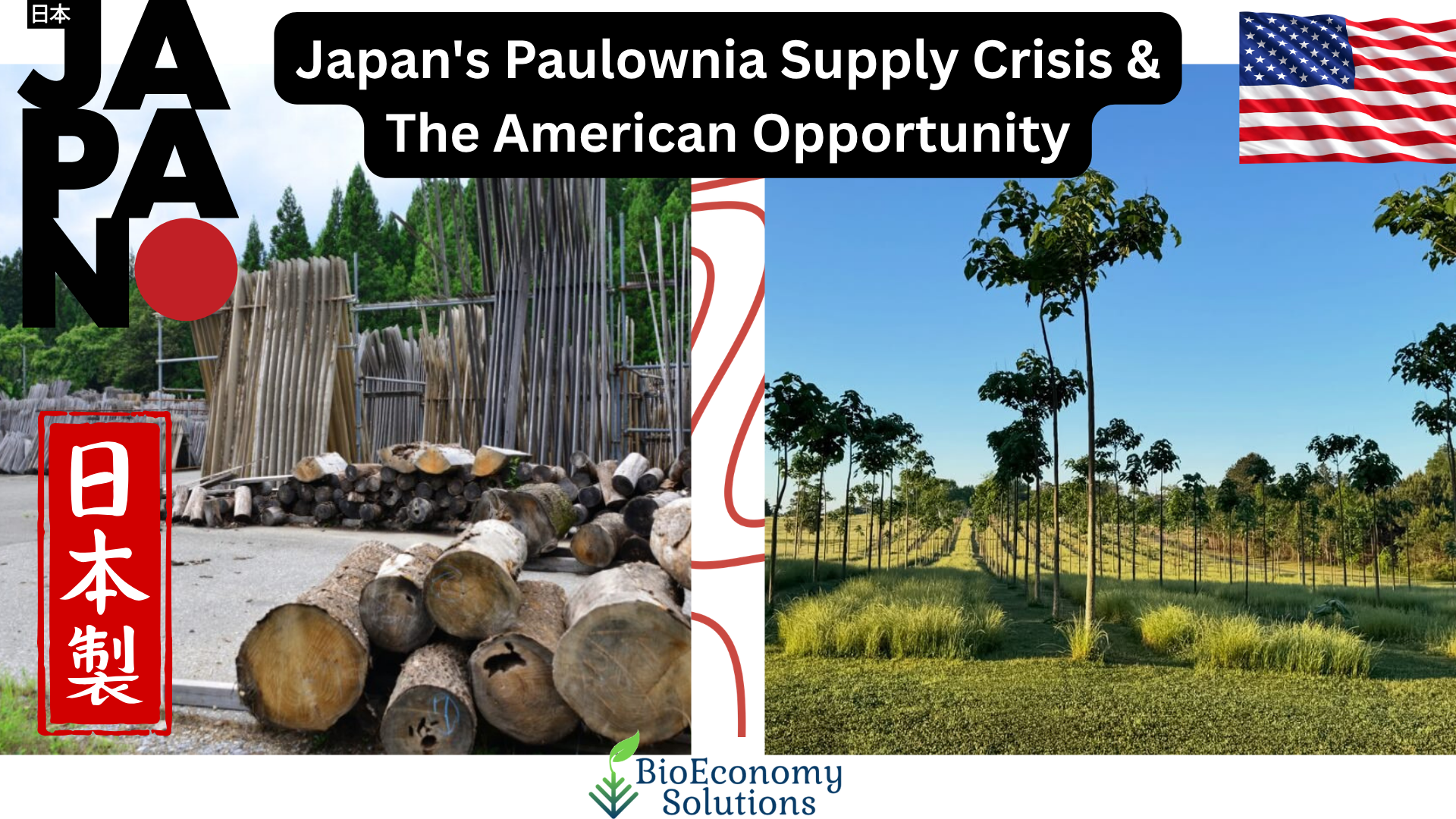
Japan is running out of kiri.

And the calls are coming to South Carolina.

Two Japanese industrial buyers contacted BioEconomy Solutions this month — not through a broker, not through a trade show — directly. Hunting for American paulownia. Willing to talk volume. Willing to talk long-term.

That doesn’t happen by accident.

When one of the world’s most disciplined, quality-obsessed timber markets starts calling a paulownia farm in the American South, something structural has broken in the global supply chain. And the window to position yourself on the right side of that break is closing faster than most people realize.

Here is exactly what is happening — and why it matters to every landowner, carbon developer, and ESG investor paying attention to the bioeconomy right now.

PART A: STAKES — Why Should You Care?

Most people in the American timber and carbon markets have never thought about Japan’s paulownia problem.

That is precisely why this is an opportunity.

Japan is not a casual buyer. When Japanese industrial procurement teams start making direct international calls, it means their domestic supply chain has already failed them. It means their regional brokers have already let them down. It means they are in a structural squeeze — not a seasonal dip — and they need a reliable partner, not a spot-market gamble.

Let’s put the scale of this in context.

Japan has historically imported up to 70% of its paulownia supply. The tree — known in Japan as kiri — is not a commodity wood. It is a cultural and industrial cornerstone. It is used in:

  • Tansu cabinetry — the centuries-old Japanese chest tradition, where paulownia’s natural moisture-regulating properties protect silk kimonos and heirlooms
  • Koto musical instruments — Japan’s national stringed instrument, where the resonance and tonal properties of paulownia are irreplaceable
  • High-tech lightweight laminates — aerospace-adjacent industrial applications where paulownia’s unmatched weight-to-strength ratio and near-zero shrinkage make it the only viable natural material
  • Precision industrial crating and packaging — where its dimensional stability protects sensitive electronics and precision components during export
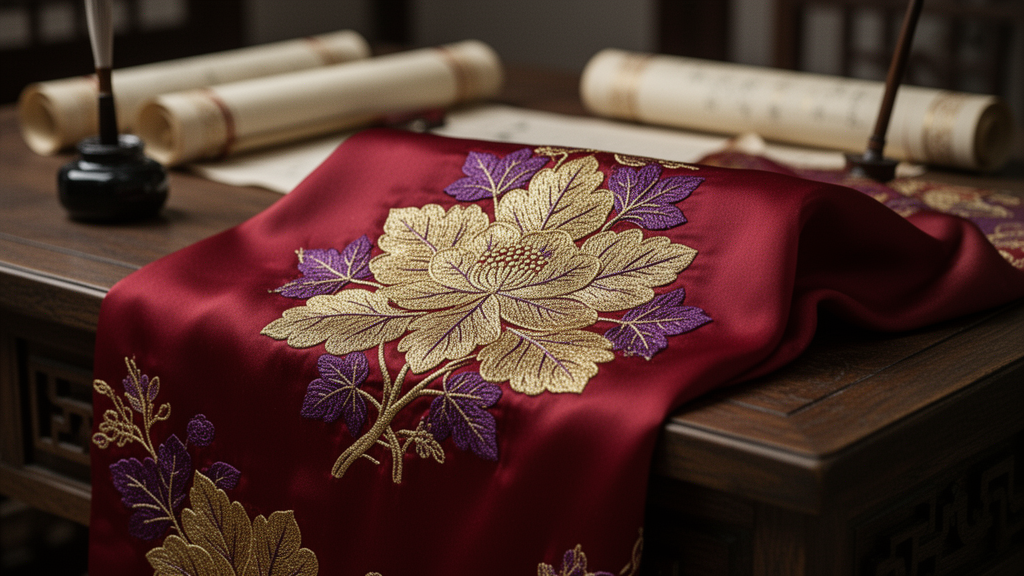
This is not a market that substitutes easily. You cannot swap paulownia for pine and call it done. The physical specifications — bone-dry consistency, tight grain, uniform density, low shrinkage — are non-negotiable for Japanese buyers.

And right now, those specifications are becoming impossible to source at scale.

The cost of inaction for Japanese buyers is not inconvenience. It is production shutdown.

PART B: STORY — What Is Actually Breaking the Supply Chain?

Three forces have converged simultaneously to create this crisis. Understanding all three is critical — because together, they are not a temporary disruption. They are a permanent structural realignment of where paulownia will be grown and traded for the next two decades.

Force #1: The Global Supply Chain Shock

A significant portion of Japan’s imported paulownia has historically originated from or processed through manufacturing hubs in East Asia. That pipeline is fracturing.

Escalated conflicts in the Middle East have caused a massive squeeze on crude oil and petrochemical derivatives — specifically naphtha, the feedstock for styrofoam, plastic foams, and synthetic protective packaging materials. Japanese domestic industries are facing critical shortages of the petroleum-derived packaging and insulation materials they have relied on for decades.

When synthetic packaging spikes in price or faces order suspensions, Japanese industries do not wait. They pivot. They lean back into what they know works — natural wood alternatives for high-end crating, precision packaging, and stable structural components.

Paulownia is at the top of that list.

The demand surge is not coming from one sector. It is coming from electronics manufacturers, precision instrument makers, traditional craft industries, and construction component suppliers — all simultaneously competing for a shrinking pool of available kiri stock.

The ripple effect is real. The demand is not speculative. It is already here.


Force #2: Decades of Domestic Depletion

Japan’s domestic paulownia supply has been in a multi-decade decline. This is not a new problem — but it has now reached a critical threshold.

An aging forestry workforce, land-use shifts toward urban development and rice cultivation, and the collapse of traditional rural forestry management have gutted Japan’s ability to self-supply. What was once a thriving domestic kiri industry has been reduced to a fraction of its former capacity.

For years, Japan compensated by importing from Southeast Asia and regional East Asian suppliers. That pipeline is now tightening too — rising production costs, inconsistent quality control, and geopolitical friction are making those traditional sources unreliable.

Japanese buyers are not looking for a short-term fix. They are looking for a long-term supply chain partner — one with the land, the infrastructure, the climate, and the operational discipline to deliver consistent, scalable, specification-grade paulownia year after year.

The United States — specifically the American South — is one of the very few places on Earth that can credibly offer all of that.

BioEconomy Solutions’ hybrid paulownia program in South Carolina produces non-invasive, non-GMO, seed-sterile clones specifically engineered for tight grain, uniform density, and the kind of dimensional stability that Japanese buyers require. These are not wild-harvested trees. These are purpose-grown, specification-matched feedstocks — the American equivalent of Japan’s Reference Wood standard.
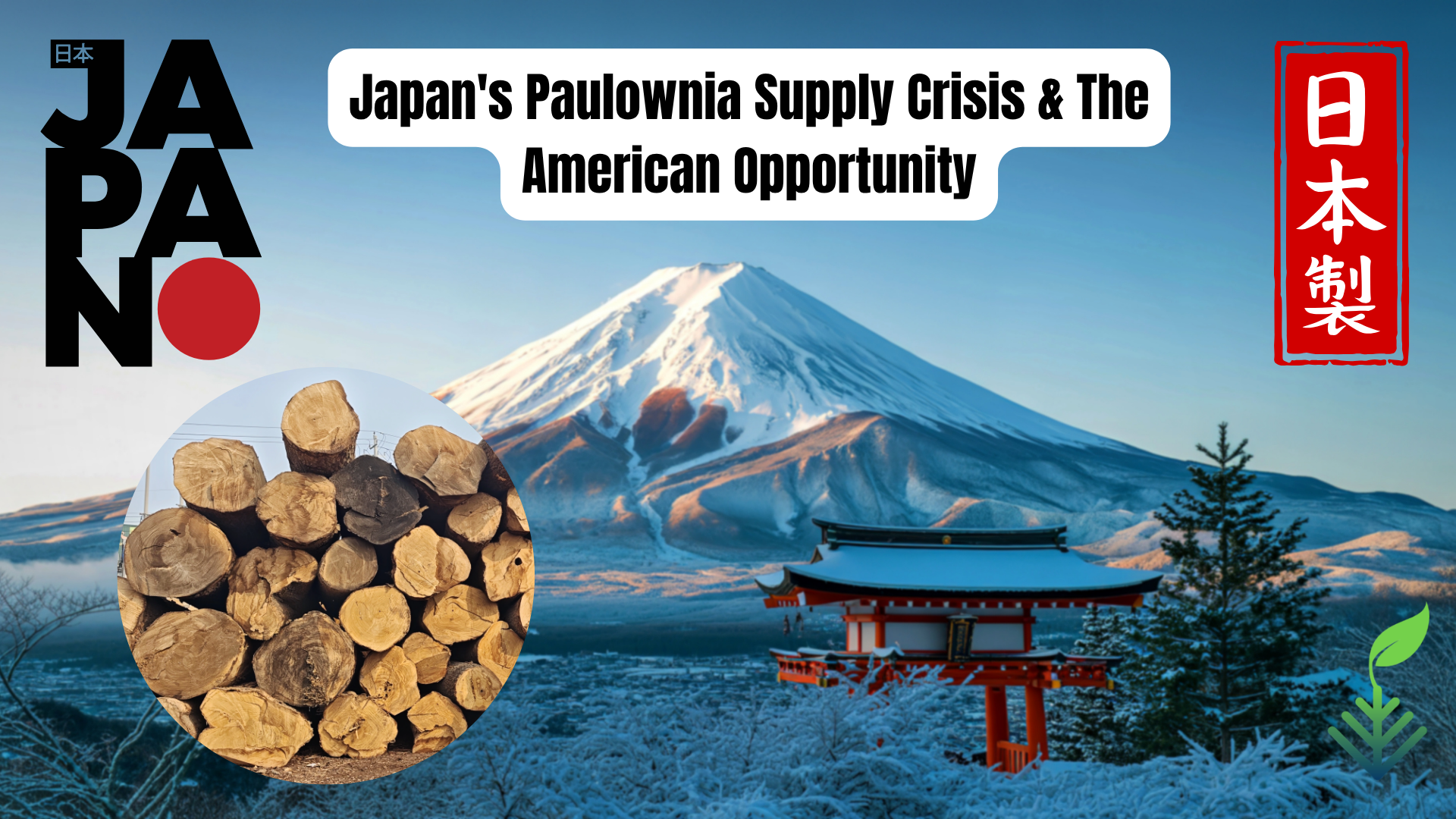
That is exactly what a supply-starved Japanese market needs to de-risk their supply chain.

Force #3: Currency Volatility Forcing Safe-Haven Purchasing

The third force is financial — and it is accelerating everything.

The Japanese Yen has faced immense pressure in recent months, briefly dipping to 160 JPY to the USD before massive multi-billion-dollar interventions by Japan’s Ministry of Finance stabilized it back to the 155 range. That kind of volatility — a 10%+ swing in the world’s third-largest economy’s currency — does not just affect tourists and exporters. It fundamentally changes how industrial procurement teams think about risk.

When your currency is this volatile, spot-market purchasing from fragmented regional brokers becomes a liability. Every purchase is a currency bet. Every shipment is a hedge that might not pay off.

The response from sophisticated Japanese industrial buyers is predictable and rational: lock down direct, secure supply chain partnerships with established North American feedstock operators. Hedge against future currency and supply shocks by securing volume commitments, predictable pricing structures, and direct relationships with producers who can guarantee consistency.

This is not a trend. This is a structural shift in how Japanese timber procurement works.

And BioEconomy Solutions is already receiving the calls.

PART C: SHIFT — The Lesson That Changes Everything

Here is what this moment teaches us — and it goes far beyond paulownia.

The global bioeconomy is not a future concept. It is a present reality being shaped right now by supply chain fractures, geopolitical disruptions, currency volatility, and the irreversible depletion of traditional natural resource pipelines.

The companies and landowners who position themselves correctly in the next 24 months will not just participate in this market. They will define it.

For too long, the narrative around paulownia in North America has been focused almost entirely on carbon credits and domestic timber markets. Both are real and valuable. But the Japanese inquiry changes the frame entirely.

This is not just a carbon story. This is a global supply chain story.

American-grown paulownia — produced at scale, to specification, with the consistency and traceability that international industrial buyers demand — is a strategic asset in a world where natural material supply chains are fracturing everywhere at once.

The lesson is this: When the world’s most quality-obsessed timber market starts calling your farm directly, you are not just a tree grower. You are a supply chain solution.

The question is whether you are ready to operate at that level.

BioEconomy Solutions is building the infrastructure — the plantation capacity, the drying and grading systems, the blockchain-verified traceability, and the direct buyer relationships — to be exactly that solution. Not just for Japan. For every market where the old supply chains are breaking and new ones need to be built.

The tree grows fast. The window to position is not.

BRICK 3 — BOOST THE SHARE (Shareability + CTA)

The bottom line:

Japan’s kiri crisis is not a niche story for timber traders.

It is a signal — one of the clearest signals we have seen — that the global demand for specification-grade, sustainably produced, traceable natural materials is accelerating faster than supply can respond.

Three forces are driving this simultaneously:

  • A petrochemical supply shock pushing industrial buyers back to natural wood alternatives
  • Multi-decade domestic depletion leaving Japan structurally dependent on foreign supply
  • Currency volatility forcing long-term direct partnerships over fragmented spot-market purchasing

American paulownia — grown right, graded right, and delivered with the consistency international buyers require — is positioned to fill a gap that no other supplier in the world is currently equipped to fill at scale.

BioEconomy Solutions is already in those conversations.

If you are a landowner, carbon developer, ESG investor, or industrial buyer who wants to understand what this supply shift means for your operation or portfolio — let’s talk.

The calls from Japan are already coming in.

The question is: will you be part of the supply chain that answers them?

What’s the biggest barrier you see to scaling American paulownia for international industrial markets? Drop it in the comments — I read every one.

Interested in exploring paulownia supply chain partnerships, carbon credit development, or plantation investment?

Book a private briefing: www.bioeconomysolutions.com/bookcall
Email: mail@bioeconomysolutions.com
Office: 843.305.4777

Learn More About Our Paulownia Trees Here: https://bioeconomysolutions.com/megaflora-tree-farms/

Need A Step-By-Step Guide

Review The Paulownia Growers Manual – BioEconomy Solutions E-BOOK

https://bioeconomy-solutions.kit.com/products/paulownia-growers-manual-bio-econom

Repost this if you know a landowner, timber buyer, or ESG investor who needs to understand what is happening in the global paulownia market right now.

#Paulownia #Bioeconomy #SupplyChain #ESG #CarbonCredits #SustainableForestry #Japan #Kiri #NaturalMaterials #CircularEconomy #TimberMarkets #BioEconomySolutions

Paulownia lumber just leveled up with the introduction of its Class A ASTM E84 Flame Spread Rating—a significant milestone that opens the door for its wider use in fire-resistant, sustainable construction.

Why Is This Important?

Here’s how this new rating ties into the bigger picture of reducing embodied carbon emissions while providing safe, eco-friendly alternatives to traditional building materials.


1. 🔥 Class A Flame Spread Rating: A Major Safety Upgrade

  • Fire-Resistant and Safe: The Class A flame spread rating from ASTM E84 places Paulownia lumber among the most fire-resistant materials available on the market. This rating indicates that the wood exhibits minimal flame spread and smoke development during fire testing—key safety considerations for buildings, especially in commercial or high-density residential spaces.

  • Safer High-Rise and Commercial Builds: With this fire safety certification, Paulownia wood is now a viable candidate for high-rise buildings, commercial spaces, and other fire-sensitive areas. In a post-Grenfell world, fire safety is a critical concern, and this certification makes Paulownia lumber a strong alternative to more traditional, carbon-intensive materials like steel and concrete, without compromising safety.


2. 🌱 Lower Embodied Carbon, Higher Safety Standards

  • Carbon-Friendly, Flame-Smart: Paulownia is already known for its rapid growth and carbon sequestration, absorbing CO₂ from the atmosphere as it matures. Now, with the Class A flame spread rating, it offers the best of both worlds: a low-carbon footprint and enhanced fire safety. This makes it an even more compelling choice for sustainable construction.

  • Carbon Savings with Safety: By using Paulownia lumber, builders can lower the embodied carbon emissions of their projects while adhering to safety regulations that are becoming stricter in fire-prone regions. It’s not just about carbon credits anymore—it’s about eco-friendly, fire-resistant materials that meet the highest safety standards.


3. 💡 Increasing Demand for Low-Carbon, Fire-Safe Alternatives

  • A Solution for “Buy Clean” Policies: With more and more cities and governments enforcing “buy clean” policies—which prioritize the use of low-carbon, environmentally friendly materials in public procurement—Paulownia lumber’s new flame rating positions it as a top-tier choice for government projects, school buildings, hospitals, and other public structures.

  • Enhanced Market Appeal: This development will attract builders and developers looking to meet green building certification standards (e.g., LEED, WELL), especially when combined with its rapid growth and carbon sequestration. With an increased demand for sustainable and fire-safe building materials, Paulownia’s Class A rating gives it a major competitive edge.


4. 🛠 A Game-Changer for Mass Timber and Sustainable Structures

  • Mass Timber with Safety and Sustainability: Paulownia’s strength-to-weight ratio, coupled with its fire-resistant properties, makes it an ideal choice for mass timber construction. Whether in glulam beams, cross-laminated timber (CLT), or timber-frame construction, the Class A flame rating adds an extra layer of confidence in projects where fire safety is a priority.

  • Sustainability Meets Structural Integrity: Builders can now use Paulownia mass timber in large structural components of buildings without compromising on safety. This allows for the reduction of steel and concrete—the most carbon-intensive materials—while ensuring that buildings are safe, durable, and compliant with fire safety standards.


5. 🌍 Paulownia Lumber: A Catalyst for Carbon Markets & Financial Incentives

  • Carbon Credits for Low-Carbon Builds: As Paulownia trees sequester significant amounts of CO₂, landowners and developers involved in Paulownia plantations can earn carbon credits for the environmental benefits of the wood. This makes the transition to sustainable, low-carbon materials more financially appealing, with the added incentive of earning revenue from carbon markets.

  • Class A + Carbon Credits = Double Benefit: Now, with Paulownia lumber’s Class A flame spread rating, builders can tap into both safety and carbon reduction benefits. They can reduce embodied carbon in their buildings, earn carbon credits, and enhance the financial returns of their projects while contributing to sustainability goals.


6. 🏗 Impact on the U.S. Construction Industry

  • Boosting Local Timber Economies: As the demand for fire-safe, sustainable materials increases, Paulownia lumber can become a key driver of economic growth in timber-producing regions of the U.S. This creates new opportunities for local farmers and foresters, boosting job creation in sustainable timber production and carbon management.

  • Alignment with U.S. Green Building Initiatives: The Class A flame rating aligns perfectly with the U.S. Green Building Council’s (USGBC) goals of promoting safe, low-carbon materials in construction. Paulownia lumber now has the necessary credentials to participate in green certifications, federal procurement, and net-zero initiatives across the country.


7. 📊 Setting the Stage for Future Innovation in Sustainable Building

  • Incentivizing R&D in Fire-Resistant, Low-Carbon Materials: As fire-resistant Paulownia lumber becomes more widely accepted, it will likely spark additional research and development into even more advanced low-carbon and fire-resistant building materials. This could lead to the creation of new construction systems that use even less carbon-intensive material without compromising safety.

  • Attracting Investment: The combination of sustainability, fire resistance, and carbon credits makes Paulownia lumber an attractive investment opportunity for venture capitalists and sustainability-focused funds. As demand for eco-friendly and safe materials rises, Paulownia lumber is positioned to be a key player in the construction sector’s green revolution.


Conclusion: Paulownia Lumber’s Class A Rating Is a Game-Changer for Sustainable Construction

With the new Class A ASTM E84 Flame Spread Rating, Paulownia lumber has cemented its role as a fire-safe, low-carbon building material for the future. Builders and developers now have a safer, eco-friendly alternative to traditional construction materials like steel and concrete—allowing them to meet green building certifications, reduce carbon emissions, and increase fire safety.

As the construction industry pushes toward net-zero emissions and carbon-neutral goals, Paulownia lumber offers a powerful solution that meets both environmental and safety standards—making it a game changer for sustainable construction and a low-carbon economy.


Bottom Line

A Class A ASTM E84 rating positions Paulownia as a safe, sustainable, and high-performance alternative in interior and potentially structural applications in the U.S. market. This could accelerate its adoption in architectural design, commercial construction, and green building sectors, provided it clears structural grading and durability hurdles.

Download: Flame-Retardancy-of-Paulownia-Wood-and-Its-Mechanism.pdf

🌿Where To Buy USA Paulownia Lumber?

Need paulownia for your next project?

Where to buy paulownia? We’re harvesting our mature U.S. South Carolina Paulownia Timber and have millions of board foot available. We can mill lumber for your business needs. Contact Us for detailsOffice: 843.305.4777 | Email: mail@bioeconomysolutions.com Here’s a link to our online calendar, schedule a conference call with us:

https://info586.youcanbook.me

USA Paulownia Wood Lumber For Sale – Need paulownia wood lumber for your next project? https://bioeconomysolutions.com/paulownia-lumber/

You will discover that paulownia wood is the “Light Strong Alternative Wood” used in many processes to obtain many types of products.

Weather you are a hobbyist or full time manufacturing company, paulownia wood grown in South Carolina USA may be a new expression of your talent.

We sell Custom Paulownia boards: rough sawn or planed, we offer various sizes and thicknesses. Our Paulownia boards are processed using sustainable Paulownia hardwood grown right here in South Carolina USA.

👉 If you’re interested in paulownia, want to grow or currently growing, Subscribe to our newsletter: https://bioeconomysolutions.com/carbonreport

LIKE|SHARE|COMMENT

If you enjoyed this article, you may also like “Do Wood Carvers Use Paulownia Wood?”

Join Our News Letter

Subscribe Right Here

Get a FREE copy of Paulownia Carbon Report

Get a FREE copy of Paulownia Carbon Report

U.S. Paulownia Hardwood Lumber

Paulownia USA Hardwood Lumber has officially achieved a “Class A” ASTM E84 Flame Spread Rating.

USA Paulownia Lumber now has “Class A” ASTM E84 Flame Spread Rating.

Download: Flame-Retardancy-of-Paulownia-Wood-and-Its-Mechanism.pdf

A Class A ASTM E84 flame spread rating for Paulownia lumber is highly significant for its advancement in the U.S. structural lumber and interior building materials market. Here’s why:


1. Compliance with Building Codes

  • Many U.S. building codes (e.g., International Building Code, NFPA standards) require interior wall and ceiling finishes to meet Class A or Class B flame spread ratings in commercial and residential structures.

  • Class A (0–25 FSI) allows Paulownia to be used in interior applications such as wall panels, ceilings, trim, and even in fire-sensitive areas, without requiring additional treatments.

  • This certification can reduce or eliminate the need for costly fire-retardant coatings or treatments, which are often necessary for traditional softwoods.


2. Competitive Positioning Against Other Woods

  • Most common U.S. lumber species like pine, fir, and spruce generally have Class C ratings (FSI 76–200) unless treated.

  • Paulownia achieving Class A naturally or with minimal treatment positions it as a premium, safer alternative for interior applications.

  • It offers an edge in markets that prioritize fire safety + sustainability, such as commercial buildings, schools, and multi-family housing.


3. Increased Acceptance in LEED and Green Building Markets

  • Paulownia is fast-growing, lightweight, and renewable, making it attractive for sustainable construction.

  • When combined with a Class A rating, it appeals to architects and developers aiming for LEED certification or other green building standards, as it reduces reliance on chemical fire retardants.


4. Potential for Structural Applications

  • While ASTM E84 addresses surface burning characteristics, structural use is governed by strength grading and code approvals (e.g., ASTM D245, D2555).

  • If Paulownia meets strength, dimensional stability, and durability requirements, its Class A rating could help it break into:

    • Glue-laminated beams

    • CLT (Cross-Laminated Timber) panels

    • Hybrid structural systems

  • Fire safety is a major barrier to wood in large-scale construction, so Paulownia’s rating provides a marketing advantage in mass timber projects.


5. Market Expansion Opportunities

  • Interior design: Wall panels, acoustic panels, cabinetry, decorative beams.

  • Public spaces: Hotels, offices, educational facilities where fire safety regulations are strict.

  • Prefab and modular construction: Class A rating simplifies compliance for off-site fabrication.

Challenges to Overcome

  • Need for code listing and ICC-ES approval for structural applications.

  • Market education about Paulownia’s properties (lightweight but strong enough | decay resistance).

  • Supply chain scaling to ensure availability and competitive pricing versus domestic species.


Bottom Line

A Class A ASTM E84 rating positions Paulownia as a safe, sustainable, and high-performance alternative in interior and potentially structural applications in the U.S. market. This could accelerate its adoption in architectural design, commercial construction, and green building sectors, provided it clears structural grading and durability hurdles.

Download: Flame-Retardancy-of-Paulownia-Wood-and-Its-Mechanism.pdf

🌿Where To Buy USA Paulownia Lumber?

Need paulownia for your next project?

Where to buy paulownia? We’re harvesting our mature U.S. South Carolina Paulownia Timber and have millions of board foot available. We can mill lumber for your business needs. Contact Us for detailsOffice: 843.305.4777 | Email: mail@bioeconomysolutions.com Here’s a link to our online calendar, schedule a conference call with us:

https://info586.youcanbook.me

USA Paulownia Wood Lumber For Sale – Need paulownia wood lumber for your next project? https://bioeconomysolutions.com/paulownia-lumber/

You will discover that paulownia wood is the “Light Strong Alternative Wood” used in many processes to obtain many types of products.

Weather you are a hobbyist or full time manufacturing company, paulownia wood grown in South Carolina USA may be a new expression of your talent.

We sell Custom Paulownia boards: rough sawn or planed, we offer various sizes and thicknesses. Our Paulownia boards are processed using sustainable Paulownia hardwood grown right here in South Carolina USA.

👉 If you’re interested in paulownia, want to grow or currently growing, Subscribe to our newsletter: https://bioeconomysolutions.com/carbonreport

LIKE|SHARE|COMMENT

If you enjoyed this article, you may also like “Do Wood Carvers Use Paulownia Wood?”

Join Our News Letter

Subscribe Right Here

Have you experienced the elegance and durability of Paulownia furniture, set to redefine bioeconomysolutions?

Discover the prowess of paulownia, also known as empress or kiri tree, for superior-quality furniture production.

Harness the economic benefits of paulownia lumber, strong yet lightweight, perfect for utilitarian tv tray uses or contemporary furniture designs.

Embrace the versatility of paulownia wood, a game-changer for your enterprise’s sustainability efforts.

Explore the strength of paulownia timber, harvested from kiri wood trees, ideal for making sturdy, stylish furniture.

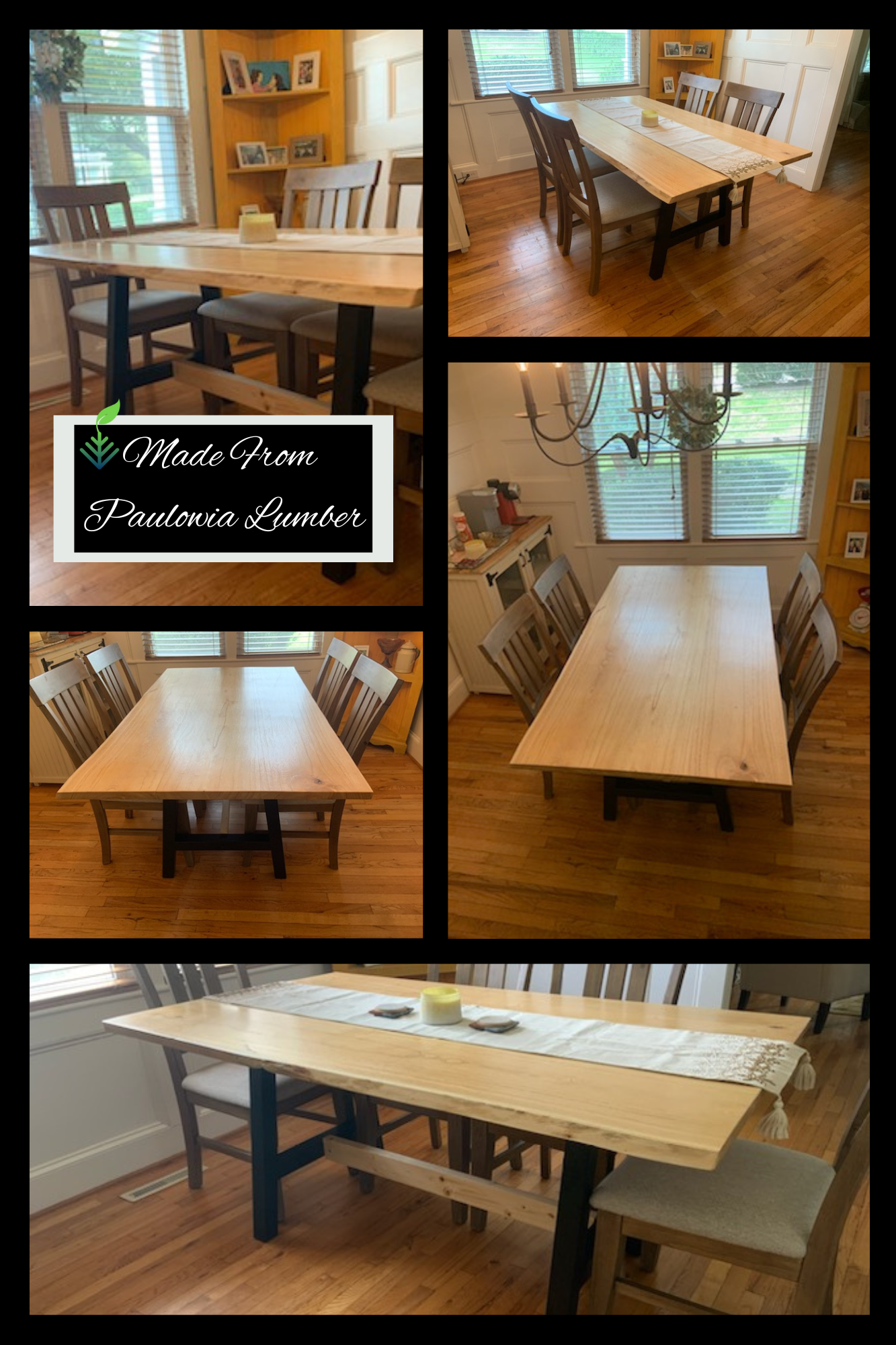
Paulownia Wood Dining Room Table

Uncover new frontiers in the lumber industry with kiri lumber, which is synonymous with high-quality furniture outcomes.

Create stunning pieces of furniture with the wood from the kiri tree, known for its extraordinary growth rate and sustainability.

Utilize empress tree lumber, a synonym for paulownia, to exhibit your commitment towards greener furniture solutions.

Explore paulownia veneer and wood veneer options for exquisite finishing touches to your Paulownia furniture.

Join the revolution right from South Carolina, bringing kiri timber and paulownia furniture into the mainstream, making USA paulownia wood and paulownia hardwood lumber the materials of choice for eco-responsible furniture production.

As business owners and entrepreneurs, you have the power to change the future with our royal paulownia trees, contributing to a sustainable and enriched ecosystem in the long run. Embrace the paulownia tree revolution and position your brand as the go-to carbon project partner. Act now, for the future is in your hands!

Where To Buy Paulownia? Paulownia Wood For Sale – QUESTIONS?

Visit our web page. https://bioeconomysolutions.com/paulownia-lumber/

We’re happy to organize a time to speak with you about our paulownia trees and lumber we have for sale. Please book your preferred time to speak directly.

Here’s a link to my online calendar/schedule:

www.bioeconomysolutions.com/bookcall

BioEconomy Solutions

mail@BioEconomySolutions.com

Office: 843.305.4777


#paulownia #furniture #woodfurniture