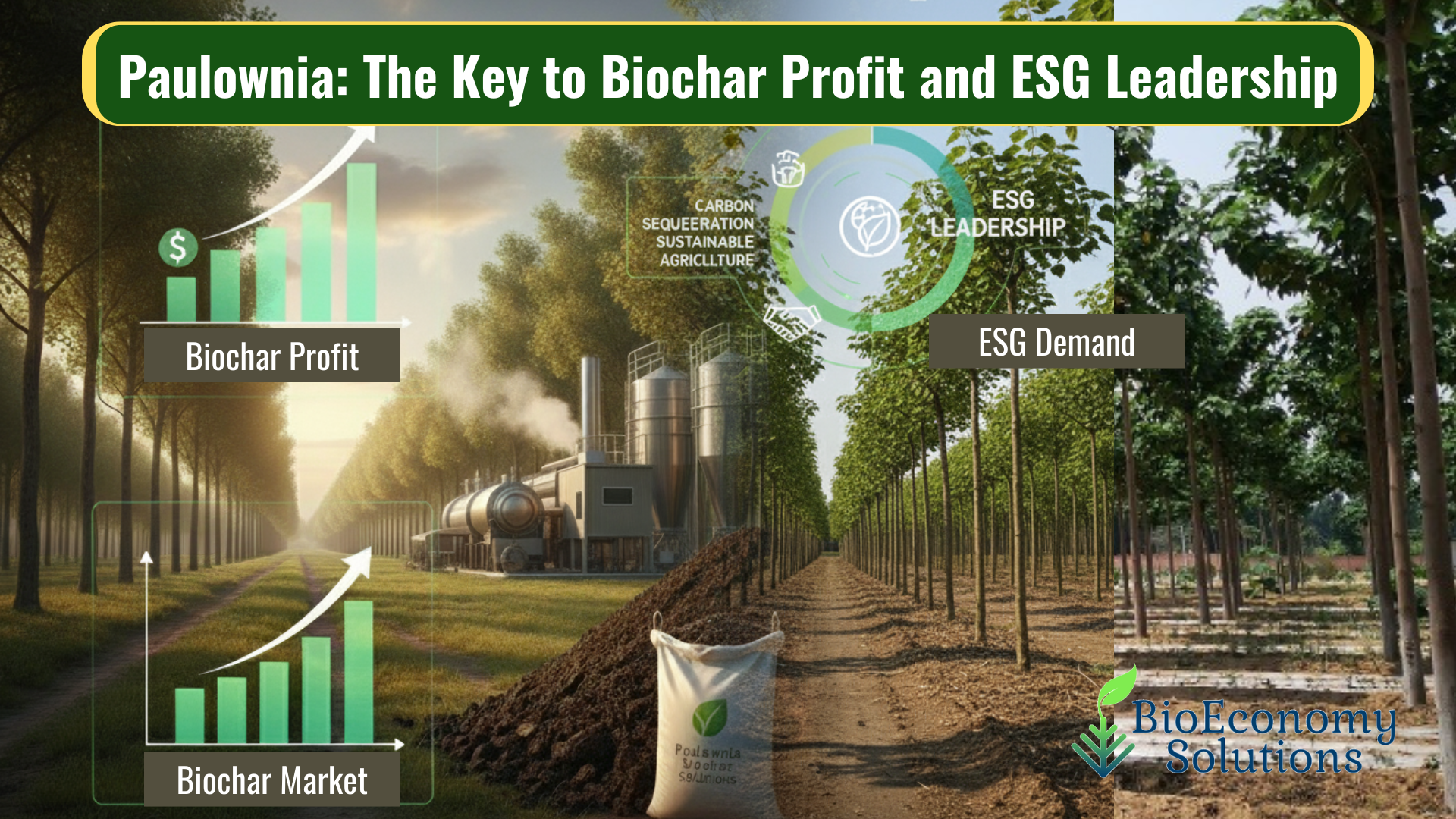
How Paulownia Trees Capture the $340M European Biochar Boom and $20B ESG Market.
The numbers are staggering:
European biochar market: $340M by 2030 US biochar market: $1.3B by 2033 European ESG market: $20.48B by 2030
But here’s what most people miss:
The feedstock bottleneck is about to choke growth.
The Supply Crisis Nobody’s Talking About
Current biochar production relies on:
- Agricultural waste (seasonal, inconsistent)
- Forest residues (limited, transportation costs)
- Energy crops (compete with food production)
Result: 180+ European biochar plants by 2023, but feedstock shortages limiting scale.
Enter Paulownia: The Biochar Game-Changer
Why Paulownia solves the feedstock crisis:
🌱 Consistent Supply:Coppices every 3-5 years, predictable biomass
🌱 High Yield:80-100 green tons per hectare annually
🌱 Purpose-Grown:Dedicated energy crops, not competing with food
🌱 Marginal Land:Grows on degraded soil, doesn’t displace agriculture
🌱 Mechanized Harvest: 80-100 tons/hour processing capacity
The Perfect Market Timing
European Biochar Drivers = Paulownia Advantages:
Sustainable Agriculture ✅
- Paulownia biochar improves soil structure and nutrient retention
- Intercropping capabilities support regenerative farming
- Grows on marginal land, restores degraded soils
Climate Mitigation ✅
- 2.5-3.3 carbon credits per ton of biochar produced
- Permanent carbon storage (1,000+ years)
- Dual sequestration: growth phase + biochar storage
Technological Advancement ✅
- Optimized for pyrolysis (low ash, high carbon content)
- Consistent feedstock quality for industrial-scale production
- Integrated biorefinery potential (biochar + biofuels + chemicals)
Regulatory Support ✅
- EU Taxonomy alignment for sustainable activities
- CSRD reporting requirements favor verifiable carbon removal
- Article 6 carbon market opportunities
ESG Market Integration Strategy
How Paulownia captures the $20B ESG opportunity:
Environmental (E)
- Verified Carbon Removal: Blockchain-tracked from tree to biochar
- Biodiversity Enhancement: Habitat corridors, pollinator support
- Soil Restoration: Degraded land rehabilitation, erosion control
- Water Management: Improved infiltration, reduced runoff
Social (S)
- Rural Development: Farmer partnerships, local job creation
- Community Investment: Processing facilities in rural areas
- Food Security: Intercropping capabilities, soil improvement
- Environmental Justice: Restoration of underserved communities
Governance (G)
- Transparency: Crystal Validator™ compliance controls
- Traceability: Registry serialization through Xpansiv
- Risk Management: Diversified revenue streams, climate resilience
- Stakeholder Engagement: Community-based growing programs
The Competitive Advantage
Traditional Biochar Feedstock:
❌ Seasonal availability
❌ Quality inconsistency
❌ Transportation costs
❌ Competing uses
Paulownia Biochar Feedstock:
✅ Year-round production planning
✅ Consistent quality parameters
✅ Local production networks
✅ Purpose-grown for biochar
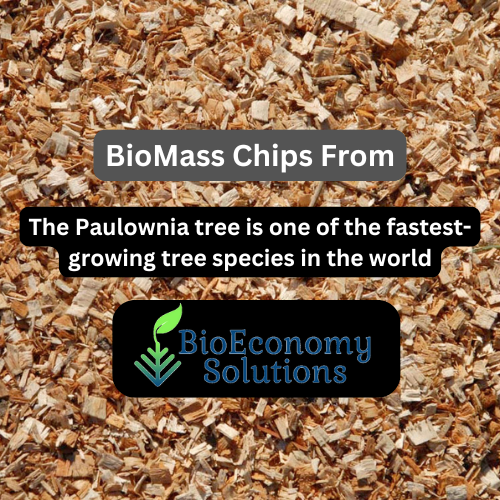
Market Capture Strategy
Phase 1: European Market Entry (2025-2026)
- Partner with existing biochar producers facing feedstock shortages
- Establish 5,000-hectare demonstration plantations
- Secure offtake agreements with industrial biochar facilities
- Target €125-145/ton biochar credit pricing (current CORCCHAR index)
Phase 2: Scale-Up (2027-2029)
- Expand to 50,000+ hectares across multiple EU countries
- Develop integrated biorefineries (biochar + biofuels + chemicals)
- Launch direct ESG partnerships with Fortune 500 companies
- Capture 5-10% of European biochar feedstock market
Phase 3: Market Leadership (2030+)
- Achieve 100,000+ hectare production network
- Establish Paulownia as premium biochar feedstock standard
- Export model to US market ($1.3B opportunity)
- Lead consolidation of fragmented biochar supply chains
Financial Projections
Conservative Market Capture (5% of European biochar market by 2030):
- Market opportunity: $17M annually (5% of $340M)
- Feedstock premium: 20-30% above agricultural waste
- Carbon credit revenue: Additional $50-75M annually
- Total addressable revenue: $67-92M from European market alone
ESG Integration Multiplier:
- Premium pricing for verified ESG impact: +25-40%
- Long-term offtake agreements: Reduced market risk
- Diversified revenue streams: Timber, carbon, biochar, data
The Regulatory Tailwind
EU Taxonomy Alignment:
- Climate change mitigation (carbon sequestration)
- Climate change adaptation (soil restoration)
- Sustainable use of water and marine resources
- Transition to circular economy (waste-to-value)
- Pollution prevention and control (soil remediation)
- Protection of healthy ecosystems (biodiversity enhancement)
CSRD Reporting Benefits:
- Quantifiable environmental impact metrics
- Verifiable carbon removal documentation
- Supply chain sustainability evidence
- Stakeholder engagement proof points
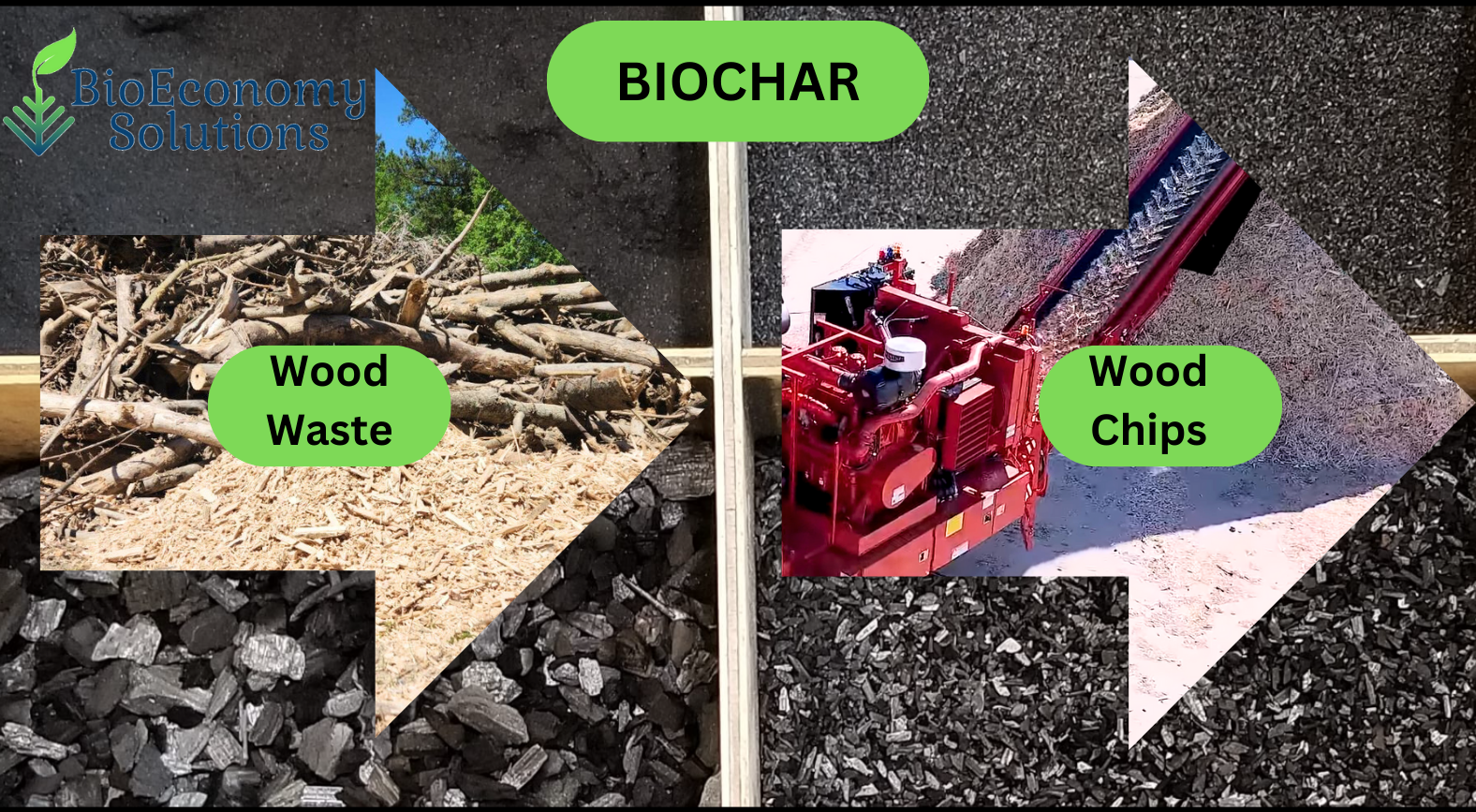
The Bottom Line
The biochar market is exploding, but feedstock supply is the bottleneck.
The ESG market demands verifiable impact, but most solutions lack transparency.
Paulownia solves both problems:
- Reliable, scalable biochar feedstock
- Integrated ESG impact with audit-grade documentation
- Multiple revenue streams reducing investment risk
- Regulatory alignment across EU frameworks
While competitors struggle with feedstock shortages and ESG compliance, Paulownia-based solutions capture both the $340M biochar opportunity and the $20B ESG market through integrated, verifiable impact.
The question isn’t whether these markets will grow—it’s whether you’ll be positioned to capture them.
Ready to explore how Paulownia can position your organization in the biochar and ESG growth markets? Contact BioEconomy Solutions to learn how purpose-grown feedstock and integrated ESG solutions create competitive advantages in rapidly expanding markets.
The biochar boom needs feedstock. The ESG market needs proof. Paulownia delivers both.
Contact Us for paulownia saplings and planning assistance.
Where To Buy Paulownia? Paulownia For Sale – QUESTIONS?
Learn more about paulownia carbon projects here: https://bioeconomysolutions.com/paulownia-carbon-credits/
We’re happy to organize a time to speak with you about our paulownia trees and lumber we have for sale. Please book your preferred time to speak directly.
Here’s a link to my online calendar/schedule:
www.bioeconomysolutions.com/bookcall
BioEconomy Solutions
Office: 843.305.4777
Download FREE Paulownia Carbon REPORT

Subscribe to our newsletter & get FREE Paulownia Carbon Report
