The GENIUS Act—short for “Guiding and Establishing National Innovation for U.S. Stablecoins—was signed into law on July 18, 2025, establishing the first comprehensive federal regulatory framework for dollar-backed, redeemable “payment stablecoins” in the U.S. Congress.


✅ What the GENIUS Act Does

  • Requires 1:1 backing of stablecoins with liquid assets—U.S. dollars or short-term Treasuries—held in segregated accounts, with monthly public disclosures and third-party audits.

  • Establishes a dual federal–state licensing system: large issuers go federal, smaller ones under $10 B can operate under a certified state regime.

  • Pre-empts state law for federally supervised issuers to simplify market entry.

  • Includes robust consumer protection and AML/sanctions rules, plus prioritizes stablecoin holders in issuer insolvency.

  • Excludes most algorithmic or crypto-native stablecoins from being payment stablecoins and leaves them under a Treasury study in the next year.

  • Adds foreign supervision equivalence rules, allowing foreign issuers—once deemed to have equivalent regulation—to operate in the U.S.

This legislation positions the U.S. stablecoin sector for rapid growth, potentially scaling from a $260B market to several trillion, and anchors more stablecoin backing in Treasuries—supporting U.S. debt markets & dollar dominance.


🌲 Implications for Paulownia‑Backed Tokenized Carbon Credits

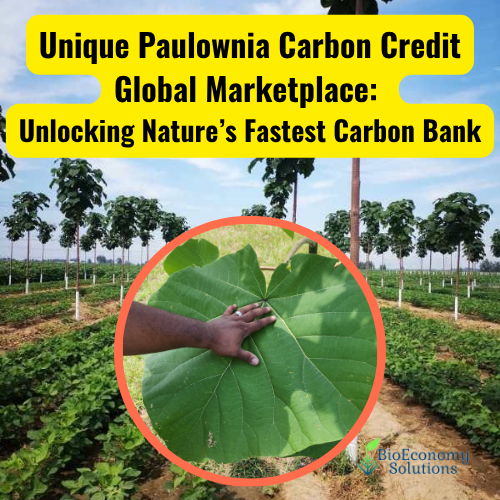
Paulownia trees are increasingly used in carbon sequestration projects because of their rapid growth and high CO₂ uptake. BioEconomy Solutions is tokenizing these carbon credits—tying each credit derivatively to a Paulownia tree or plantation, often via NFTs or tradable tokens.

While the GENIUS Act targets payment-oriented stablecoins, its regulatory principles spill over into tokenized asset markets, and here’s how they affect Paulownia carbon tokens:

  1. Stablecoin compliance frameworks don’t directly apply to carbon-credit tokens, since they’re not pegged to fiat. But the Act pre-empts ambiguity—it clarifies that “payment stablecoins” require 1:1 reserve backing, monthly disclosures, audits, and state/federal licensing (when used for payment). Tokenized assets used for trading or payments—like carbon-credit tokens—may attract scrutiny akin to stablecoin regulations, especially if they serve liquidation or transactional functions. In such cases, the Treasury or agencies could decide these fall under “other crypto-asset” rules queued for post-GENIUS Acts study.

  2. For environmental token projects, higher transparency and audit expectations set a new bar. If these tokens become tradable or payment instruments, similar compliance (reserves audits, AML/KYC, segregation of assets) may follow.

  3. Cross-border issuers of tokenized credits may need equivalent regulatory certifications—mirroring the approach for stablecoins—especially for foreign-based Paulownia credit issuers targeting U.S. buyers.

  4. The Act’s emphasis on liability prioritization could inspire analogous frameworks in tokenized carbon credits—ensuring token holders have clear claims on physical carbon assets if a project defaults.


🛠 What This Means for Paulownia Carbon‑Credit Token Projects

  • ❎ If your token is intended for trading or payment in the U.S., it may need to comply with AML, consumer protection, and asset-reserve audit-type principles—even if not strictly labeled a stablecoin.

  • ❎ Adapting audit models: Payment stablecoins now require monthly reserve audits. Carbon-credit tokens could adopt similar transparency practices to appeal to institutional and regulatory eyes.

  • ❎ Prepare for the Treasury study by engaging early with regulators, building compliant frameworks that anticipate potential classification as tokenized financial products.

  • ❎ Cross-jurisdiction coordination matters: foreign-based carbon token issuers targeting U.S. markets should track stablecoin-style foreign supervision equivalence modeling.

  • ❎ Bridge financing & DeFi integration: tokenized carbon credits might eventually serve as collateral in financial systems; lessons from stablecoin compliance (reserve requisites, audits) are vital.


STABLECOINS – TL;DR

While the GENIUS Act doesn’t mandate rules for carbon‑credit tokens directly, it sets a new regulatory benchmark for tokenized assets intended for payments or trading. Tokenized Paulownia carbon credits that become easily exchangeable, cross-border, or used in DeFi may soon need to adopt stablecoin‑level transparency, auditability, AML/KYC, and reserve-like structures—or else face classification as emerging crypto‑financial instruments. Token platforms should proactively align with these principles now to stay ahead of anticipated regulations.

Conclusion: A Tree for the Times

As the world reimagines land use and carbon policy, the Paulownia carbon credit market represents a bold convergence of ecology, technology, and finance. It’s not just about planting trees—it’s about planting the right tree, in the right system, with the right data to turn carbon into capital.

With scalable potential and scientifically engineered reliability, Paulownia is more than a fast-growing tree—it’s a catalyst for a climate-resilient future and a profit center for forward-looking investors and landowners.

⏱ Next Steps

  • ❎ Landowners: Explore converting acreage into Paulownia carbon farms.
  • ❎ Investors: Evaluate biochar and carbon forestry funds linked to high-sequestration species.
  • ❎ Buyers: Offset emissions with premium, verifiable Paulownia-based removal credits.
  • ❎ Policymakers: Incentivize regenerative agroforestry under national carbon strategies.

🧭 Contact Us – Schedule a Call

Want to see what real-time ESG compliance looks like in action? Or need help building your ESG tech stack? Let’s talk.

By converting its carbon, growth, and timber value into blockchain-based tokens, Paulownia CDR creates a transparent, inclusive, and sustainable financial model that aligns with the goals of the UNCCDParis Agreement, and global reforestation efforts.

Contact Us

Where To Buy Paulownia Core Materials? QUESTIONS?

We’re happy to organize a time to speak with you about our ESG compliance solutions.

⏰ Here’s a link to my online calendar/schedule:

www.bioeconomysolutions.com/bookcall

BioEconomy Solutions

mail@BioEconomySolutions.com

Office: 843.305.4777

Visit us at: https://bioeconomysolutions.com/paulownia-carbon-credits/ Let’s chat about paulownia tree solutions for sustainable Forest carbon credits projects.

LIKE|SHARE|COMMENT

Subscribe to our newsletter: https://bioeconomy-solutions.kit.com/45b34109e5 

Get a FREE copy of Paulownia Carbon Report

Get a FREE copy of Paulownia Carbon Report


Learn More - How The GENIUS Act Is BIG For Paulownia? Nature Based Carbon Dioxide Removal with paulwonia fast growing hybrid trees from BioEconomy Solutions

Learn More – How The GENIUS Act Is BIG For Paulownia?

Learn More – How The GENIUS Act Is BIG For Paulownia? Nature Based Carbon Dioxide Removal with Paulwonia fast growing hybrid trees from BioEconomy Solutions.
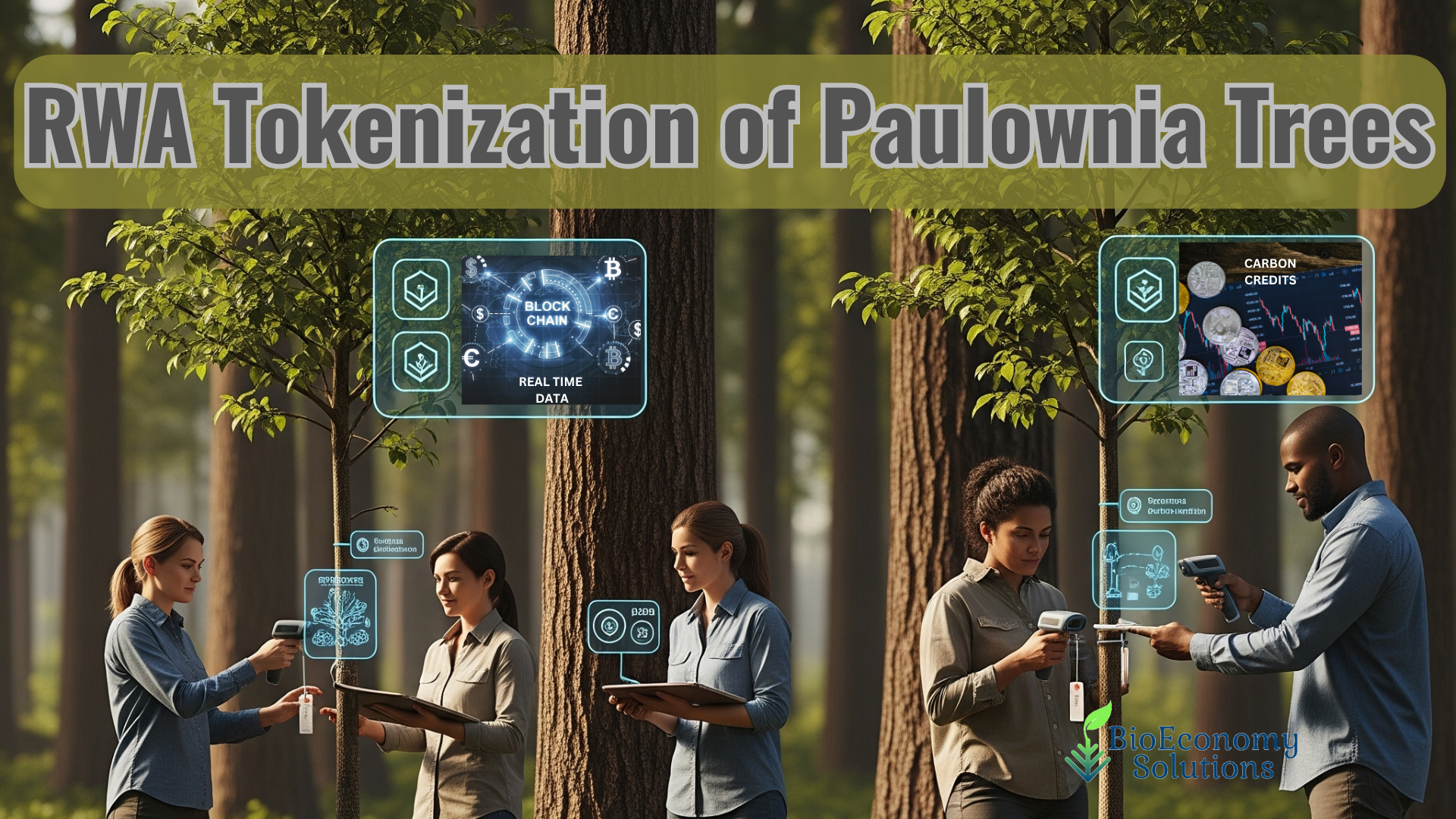
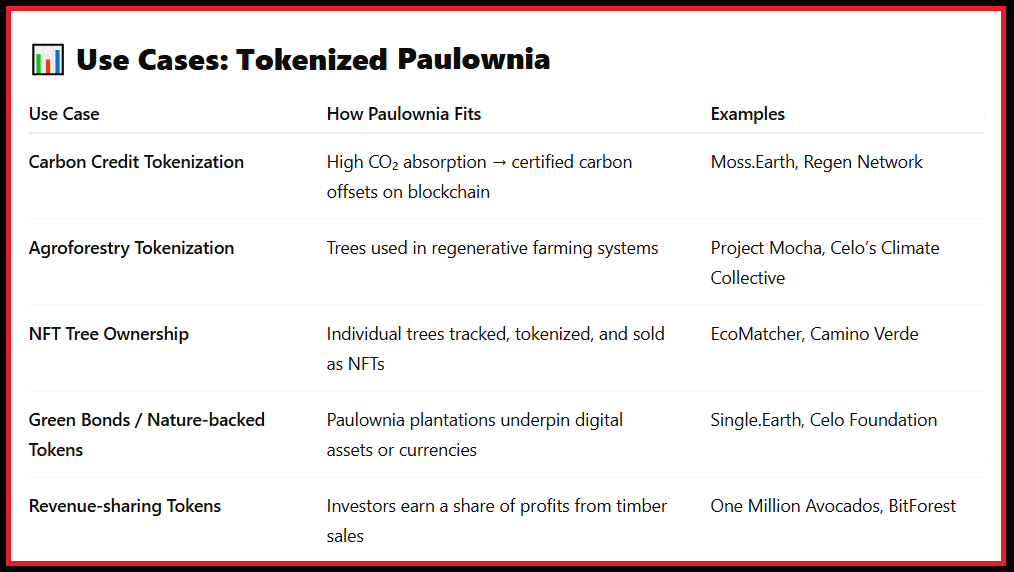
When considering Paulownia Tree Tokenizing Real-World Tree Assets. The Paulownia tree, known for its rapid growth, carbon absorption capacity, and economic value, is an ideal candidate for tree tokenization — a growing trend in climate tech and green finance. Here’s how Paulownia trees can be utilized within the tokenization framework to support environmental, economic, and social goals.

Tokenization of Paulownia Trees: How It Works and Why It Matters

What is Tokenization in this Context?
Tokenization involves converting ownership rights, carbon capture value, or economic benefits of a Paulownia tree (or a plot of them) into digital tokens on a blockchain. These tokens can be:

  • Sold or traded
  • Tracked transparently
  • Linked to real-world metrics like carbon sequestration or timber value

Why Paulownia is an Ideal Tree for Tokenization

1. High Carbon Sequestration

  • Paulownia trees absorb 10–20 times more CO₂ than many other tree species.
  • Their fast growth rate (up to 3–5 meters per year) means quicker and measurable carbon credit generation.
  • This makes them excellent for carbon offset tokens like those issued by other platforms.

2. Economic Value

  • The wood is lightweight, strong, and highly valuable in industries such as furniture, construction, and musical instruments.
  • Paulownia-based tokens can represent timber futures, making them attractive to investors — similar to the One Million Avocados or Project Mocha model.

3. Reforestation and Regenerative Agriculture

  • Paulownia trees can be used in reforestation and agroforestry, contributing to climate resilience and land restoration goals.
  • Like EcoMatcher or Camino Verde, projects can tokenize individual Paulownia trees using GPS tracking, growth data, and QR codes for transparency.

4. Shorter ROI Cycle

  • Due to their fast maturity (harvestable in 5–7 years), investors see returns sooner than with slow-growing trees.
  • This reduces risk and increases appeal for retail and institutional investors alike.

🔒 Benefits of Tokenizing Paulownia
✅ For Farmers: Upfront capital through token sales, improved livelihoods
✅ For Investors: Access to verified green assets, carbon offsets, or timber revenues
✅ For the Planet: Encourages tree planting, land restoration, and sustainable land use
✅ For Regulators: Easier monitoring and verification via immutable blockchain data

Strategic Path Forward
BioEconomy Solutions built a Paulownia tokenization platform by:

Partnering with forestry experts to establish high-quality plantations.
Working with carbon certifiers (like Net Eco Exchange, Verra or Gold Standard) to validate carbon offset.
Tokenizing assets using platforms like Polygon, Celo, or Ethereum.
Selling tokens to corporations, ESG investors, or climate-conscious individuals.

Today’s Real World Asset – Paulownia Trees

The Paulownia tree, thanks to its biological, economic, and environmental strengths, is perfectly suited for the tokenized future of forestry. By converting its carbon, growth, and timber value into blockchain-based tokens, Paulownia can help create a transparent, inclusive, and sustainable financial model that aligns with the goals of the UNCCD, Paris Agreement, and global reforestation efforts.

Contact Us

Where To Buy Paulownia Core Materials? QUESTIONS?

Visit our web page. https://bioeconomysolutions.com/paulownia-lumber/

What is paulownia wood? https://bioeconomysolutions.com/what-is-paulownia-wood/

We’re happy to organize a time to speak with you about our paulownia trees and lumber we have for sale. Please book your preferred time to speak directly.

Here’s a link to my online calendar/schedule:

www.bioeconomysolutions.com/bookcall

BioEconomy Solutions

mail@BioEconomySolutions.com

Office: 843.305.4777

Visit us at: https://bioeconomysolutions.com/paulownia-carbon-credits/ Let’s chat about paulownia tree solutions for sustainable Forest carbon credits projects.

LIKE|SHARE|COMMENT

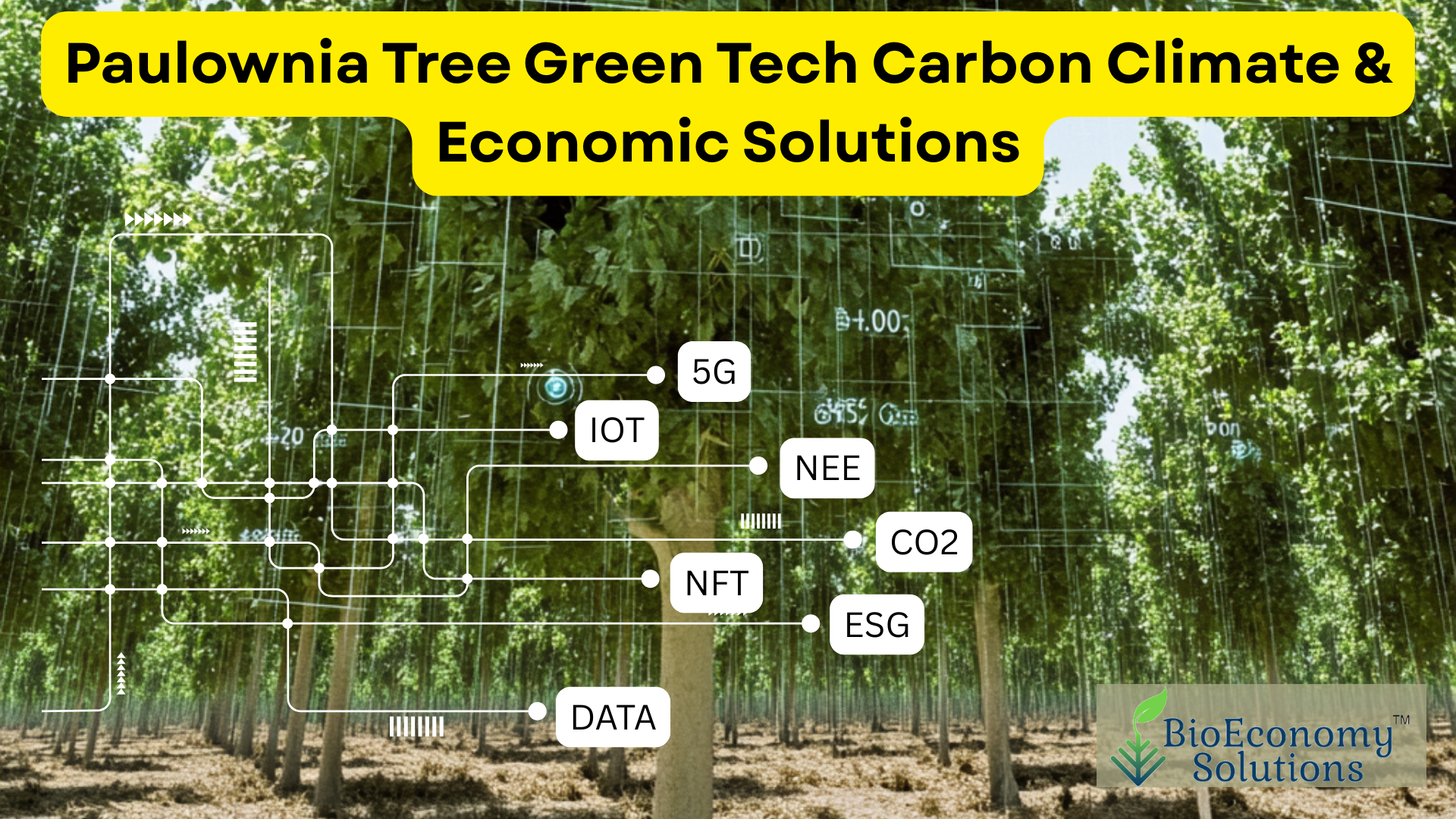
Paulownia Tree Green Tech Carbon Climate & Economic Solution

As regulatory frameworks tighten and stakeholder pressure grows, corporations face escalating demands to deliver transparent, measurable, and sustainable carbon removal solutions. Traditional carbon offsets are under scrutiny for lack of additionality, poor verification, and greenwashing risks. To meet ESG compliance mandates, businesses must adopt high-efficiency Carbon Dioxide Removal (CDR) strategies with real-time auditability—enter Paulownia-based reforestation, enhanced by IoT and blockchain tokenization.

Incase you missed it….? Here is our REPLAY of our live event on this subject. CLICK HERE

Why Paulownia? The ESG-Compliant Carbon Removal Powerhouse

Paulownia, often called the “Empress Tree,” is renowned for its rapid growth, reaching maturity in just 5-7 years compared to decades for traditional hardwoods. Its enormous leaves and high photosynthetic efficiency allow it to absorb up to 103 tons of CO₂ per hectare per year, far surpassing most other tree species.

Key Benefits of Paulownia for CDR:

Extreme CO₂ Absorption– 10x more efficient than typical trees.

Fast Growth– Matures in 5-7 years, enabling quicker carbon capture cycles.

High Biomass Production– Ideal for bioenergy and sustainable timber.

Drought & Disease Resistant– Thrives in diverse climates.

Soil Regeneration – Improves degraded land through deep root systems.

No Replanting – Post harvest, the tree regrows from the stumpage.

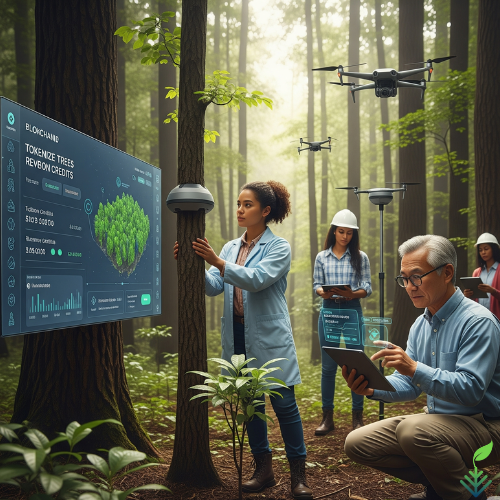
Paulownia’s unmatched CO₂ sequestration (10x more than average trees) and rapid growth make it ideal for high-impact ESG portfolios. But scalability alone isn’t enough—verifiability is key. By integrating IoT sensors and blockchain-tracked carbon data, corporations can transform Paulownia plantations into digitally verified carbon sinks, ensuring:

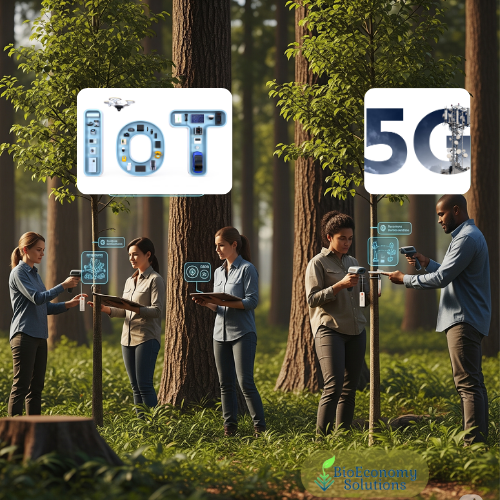
Real-Time Monitoring– IoT devices track CO₂ absorption, soil health, and tree growth.

Immutable Carbon Ledger– Blockchain records every ton of CO₂ removed, preventing double-counting.

Automated ESG Reporting– Smart contracts generate auditable reports for SEC, EU CSRD, and voluntary disclosures.

Tokenized Carbon Credits – Carbon removal verified on-chain, tradable as NFTs or security tokens in compliance with financial regulations.

Corporate Use Case: Tokenized Paulownia Carbon Projects

  1. A Fortune 500 company invests in a Paulownia reforestation project.
  2. IoT sensors transmit growth and CO₂ data to a DeFi-enabled carbon registry.
  3. Each ton of CO₂ removed is minted as a tokenized carbon credit (e.g., ERC-1155 or ERC-3643 for compliance).
  4. Smart contracts auto-settle carbon credit sales, with proceeds funding further CDR expansion.

Blockchain + IoT: The Future of ESG-Compliant Carbon Markets

Current carbon markets suffer from fragmented registries, opaque pricing, and verification delays. Tokenizing Paulownia’s CDR impact solves this by:

  • Enabling Liquid Carbon Markets – Corporations trade tokenized credits on regulated digital asset exchanges.
  • Ensuring Auditability – Every credit is backed by IoT-verified sequestration data stored on-chain.
  • Meeting CSRD & SEC Climate Rules – Real-time reporting aligns with EU’s Corporate Sustainability Reporting Directive (CSRD) and SEC climate disclosure mandates.

Monetizing Carbon Removal: From Compliance to Revenue

No longer is your ESG program a loss leader, It’s now a profit center to be recognized by CFOs and sustainability officers.

Paulownia-based CDR isn’t just a compliance cost—it’s a new revenue stream:

💰 Carbon Credit Sales– Tokenized offsets sold to net-zero buyers.

💰 Sustainable Timber & Biomass– Additional income from certified wood products.

💰 Biomass Energy – Fast-renewable feedstock for clean energy.

💰 ESG-Linked Financing – Lower borrowing costs via sustainability-linked bonds (SLBs) tied to verifiable CDR.

💰 Critical Mineral Production – Fast-renewable feedstock for biochar, graphite & graphene.

The Path Forward: Scaling Paulownia CDR with Corporate Adoption

To meet net-zero pledges, leading firms must:

Partner with AgriTech providers to deploy IoT-monitored Paulownia plantations.

Integrate blockchain carbon ledgersinto ESG accounting systems.

Lobby for standardized tokenized carbon policies to ensure regulatory acceptance.

Carbon Is Now a Digitally Native Asset

Paulownia’s biological efficiency, combined with blockchain transparency and IoT precision, creates a new class of ESG-compliant carbon removal. Corporations that adopt this model will not only meet compliance—they’ll lead the next generation of high-integrity carbon markets.

The future of CDR is verifiable, tradable, and profitable. Are you ready to tokenize your carbon strategy?


WHAT IS NEXT?

Next Steps for Corporations:

🔗 Contact BioEconomy Solutionsfor ESG IoT-enabled Paulownia CDR projects.

🔗 Explore EDMA carbon tokenization platformto digitize offsets.

🔗 Align with TCFD, CSRD, and SEC reporting frameworks using blockchain-audited data.


ABOUT BIOECONOMY SOLUTIONS

About BioEconomy SolutionsWe Develop Eco-Friendly Agricultural Crops For Energy, Timber & Food. 🌲#trees 💱 #carbonmining

Contact Us

FREE Guide – “Carbon Credits & Paulownia Trees”

Subscribe to our newsletter