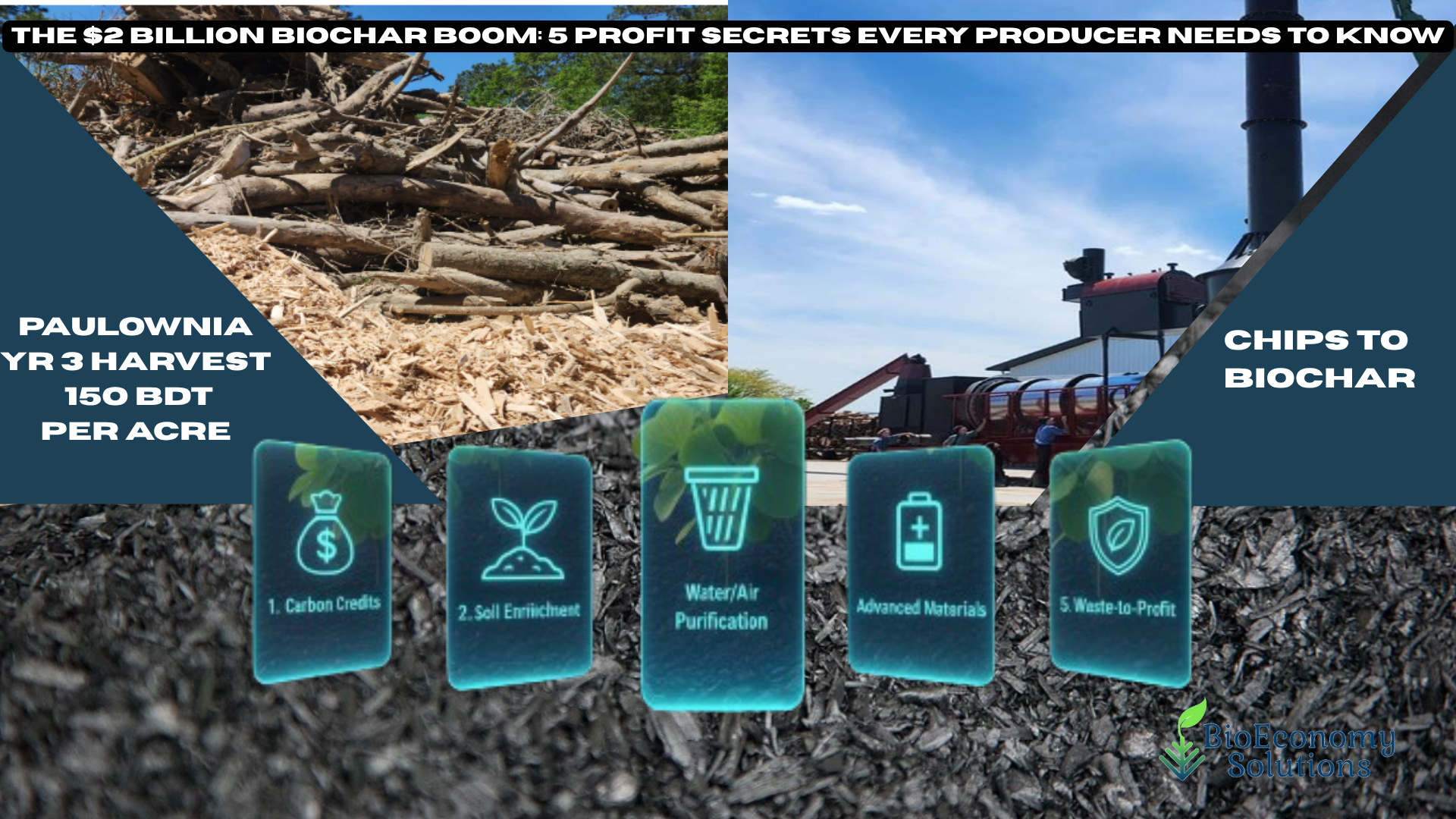
Most biochar companies are leaving money on the table.

Here’s how the smartest producers are turning waste into a goldmine—while everyone else is stuck chasing commodity prices.


The Profitability Crisis Nobody Talks About

You can have the best technology, the greenest mission, and the most passionate team—but if your biochar business isn’t profitable, it won’t last.

The brutal truth:
Most biochar startups struggle with high costs, inconsistent feedstock, and razor-thin margins.

But the market is exploding:

  • $641M in 2022 → $2.1B by 2030
  • Profit margins: 20% to 50%+
  • Premium products: $2,000+/ton

So why are so many companies missing out?


The 5 Profit Levers That Separate Winners from Losers

1. Feedstock Sourcing: The 40% Cost Secret

  • Smart producers co-locate near agricultural or forestry waste sources
  • Tipping fees turn a cost into a revenue stream ($30-50/ton)
  • Result: Up to 40% reduction in total feedstock costs
2. Energy Integration: Turn Waste Gas into Free Power

  • Use syngas from pyrolysis to power your plant
  • Eliminate external energy bills—save $50-100/ton
  • Result: Lower operating costs, higher margins

3. Scale Up or Get Left Behind

  • Bigger plants = lower costs: 20-30% per-ton savings at 10,000 tons/year vs. 2,000 tons/year
  • Better labor and equipment utilization
  • Result: Scale is the fastest path to profit

4. Specialize to Command Premiums

  • Custom blends (compost, nutrients, fungi) sell for 50-150% more than raw biochar
  • Target high-value markets: agriculture, horticulture, water treatment
  • Result: Move from commodity to premium pricing
5. Make It Easy for Customers

  • Pellets, granules, prills—user-friendly forms justify 20-40% price increases
  • Easier transport, storage, and application
  • Result: Higher sales, happier customers

The Playbook for Biochar Profitability

What the best producers do differently:

  • Secure negative-cost feedstock (tipping fees, local partnerships)
  • Integrate energy systems to cut costs and boost sustainability
  • Invest in scale—don’t stay small and hope for the best
  • Develop value-added products for premium markets
  • Get certified (IBI, EBC) to unlock new customers and higher prices

The bonus revenue streams:

  • Carbon credits: Monetize your climate impact
  • Co-products: Bio-oil, syngas for energy or sale
  • New markets: Construction, animal feed, industrial uses

The bottom line:
Biochar isn’t just about saving the planet—it’s about building a business that lasts.


Ready to turn your biochar operation into a profit engine?

Stop chasing commodity prices. Start building a premium, diversified, and scalable business.

Want the full playbook? Contact Us.


CONTACT US
Contact BioEconomy Solutions for a confidential biodiversity credit portfolio assessment.

Your next audit could be a profit opportunity instead of a compliance expense.

Visit our web “Paulownia Carbon Credits” page.

We’re happy to organize a time to speak with you about our paulownia trees and lumber we have for sale. Please book your preferred time to speak directly.

Here’s a link to my online calendar/schedule:

www.bioeconomysolutions.com/bookcall 

BioEconomy Solutions

mail@BioEconomySolutions.com

Office: 843.305.4777

LIKE|SHARE|COMMENT

Join Our Newsletter – Get a FREE copy of Paulownia Carbon Report

#Biochar #Profitability #Sustainability #AgTech #CircularEconomy #StartupGrowth
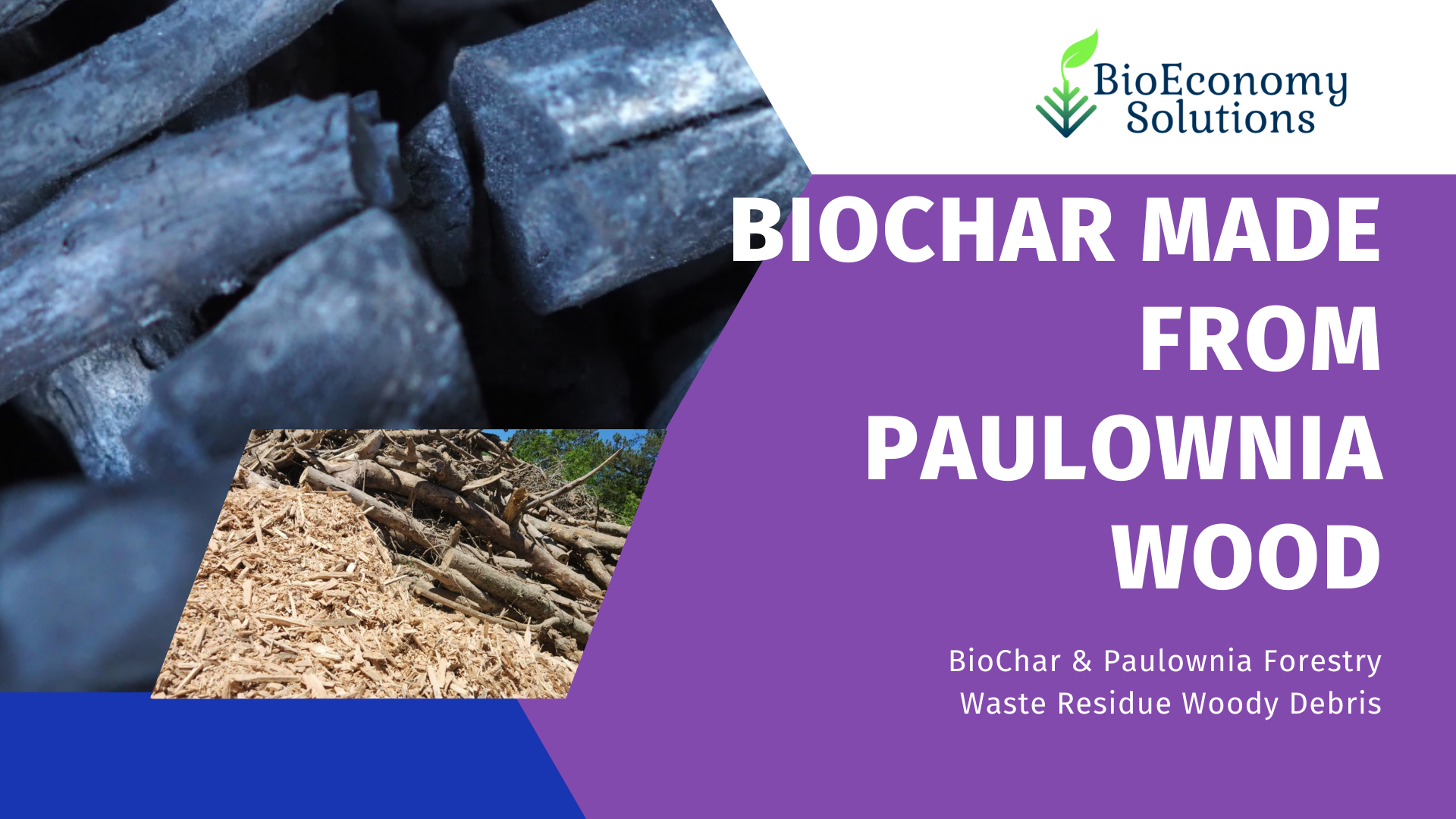
The world has moved toward decarbonization and sustainable land use practices, Paulownia treesare emerging as a powerful tool in the fight for positive ecosystem restoration, economic advancement and against climate change.

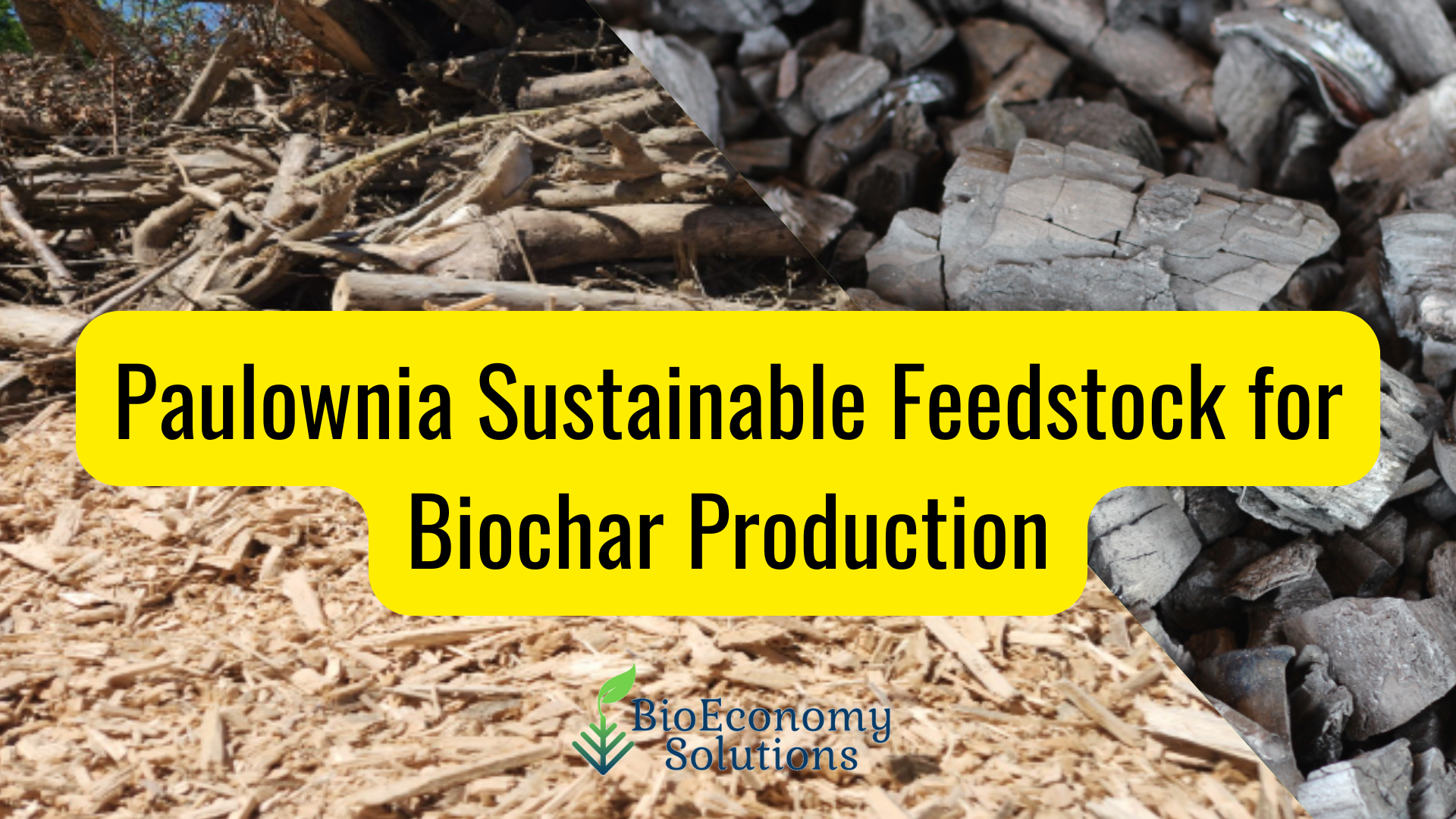
Paulownia trees are known for their exceptionally fast growth, lightweight, durable wood, and high commercial value, Paulownia trees are being reconsidered not just for timber, but as a promising feedstock biomass source for biochar production, where diversification of biomass sources is a growing need.

What Is Paulownia?

What Is BioChar?

Why Paulownia Trees?

Paulownia’s biological traits make it uniquely suited for biomass applications:

  • Rapid Growth: Capable of reaching maturity in as little as 7–10 years, Paulownia yields significantly more biomass per hectare than many native or commonly grown species.
  • Efficient Nutrient Use: Its extensive root system excels at absorbing nutrients, including from marginal or degraded soils, making it an ideal candidate for bioremediation.
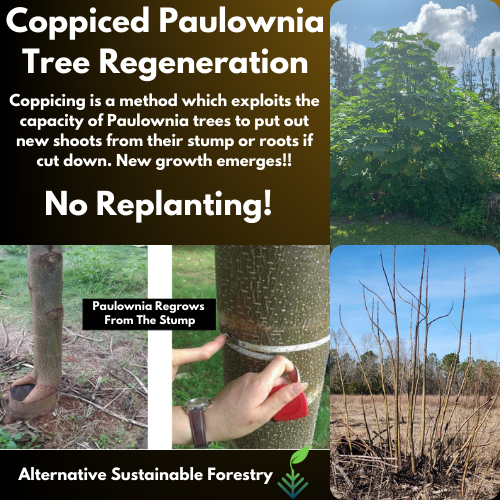
  • Drought Tolerance & Regrowth: Once established, Paulownia coppices vigorously, offering repeated harvests without replanting.
  • Intercropping Compatibility: Its canopy allows light penetration, supporting dual-use land systems.

Paulownia for Biochar: Technical and Environmental Advantages

1. High Drying Efficiency

Paulownia wood air drys quickly, which drastically reduces the energy inputs typically required for biomass processing:

  • Air-drying Lumber: As little as 30–39 days to reach <20% moisture content.
  • Drying Biomass Chips: Down to 10–12% moisture in 48 hours with air only.
  • The Contrast: With willow, which often requires energy-intensive drying.
  • Cost Reduction: Eliminates the need for expensive drying equipment.

Implication: Lower energy input means a higher net carbon benefit during biochar production, making Paulownia more climate-positive.

2. Ideal Physical Properties

Paulownia’s low density (14–19 lb/ft³) and stable dimensional shrinkage (2.2% radial, 4% tangential) allow easy handling and consistent biochar quality. The specific gravity of 0.23–0.30 means it is nearly one-third the weight of oak, facilitating logistics and reducing processing wear-and-tear.


3. High-Yield Carbon Removal

Paulownia enables robust carbon sequestration during pyrolysis. When converted to biochar, its structure:

  • Stabilizes carbon in soils for hundreds of years
  • Improves soil fertility and water retention
  • Can be integrated into carbon credit schemes for Carbon Dioxide Removal (CDR)

Additional Benefits

  • Leaf Use as Fodder: Paulownia leaves are high in protein and low in lignin,great as livestock fodder—adding economic value to the biomass system.
  • Bioremediation Potential: Its rapid nutrient uptake may help remediate land contaminated with excess nitrogen, phosphorus, or even heavy metals.

Opportunity for Biochar Biomass Feedstock

Despite its absence from most forestry portfolios, Paulownia offers a novel biomass solution. It could:

  • Diversify woody biomass sources beyond willow
  • Enable low-energy biochar production aligned with net-zero targets
  • Create value through timber, carbon credits, fodder, and soil health

Paulownia aligns well with agroforestry & permaculture, offering income diversification for farmers and landowners while supporting national climate goals.


Contact Us – Carbon Dioxide Removal (CDR) Project Developer

Paulownia’s combination of fast growth, low energy processing, and carbon sequestration potential makes it an ideal feedstock for biochar production. Its integration into sustainable land use strategies can create a circular economy model linking biomass, biochar, and carbon removal finance—a win for farmers, ecosystems, economies, people, and the climate.

BioEconomy Solutions is a Carbon Dioxide Removal (CDR) Project Developer. Talk to us about our biochar processing technology.

We’re happy to organize a time to speak with you about our paulownia trees and lumber we have for sale. Please book your preferred time to speak directly.

Here’s a link to my online calendar/schedule:

www.bioeconomysolutions.com/bookcall

BioEconomy Solutions

mail@BioEconomySolutions.com

Office: 843.305.4777

Visit us at: https://bioeconomysolutions.com/paulownia-carbon-credits/ Let’s chat about paulownia tree solutions for sustainable Forest carbon credits projects.

LIKE|SHARE|COMMENT

Enjoy this article? You may also enjoy “Carbon Developers Choose Paulownia Trees” https://www.linkedin.com/pulse/carbon-developers-choose-paulownia-trees-victor-garlington-imh4e/