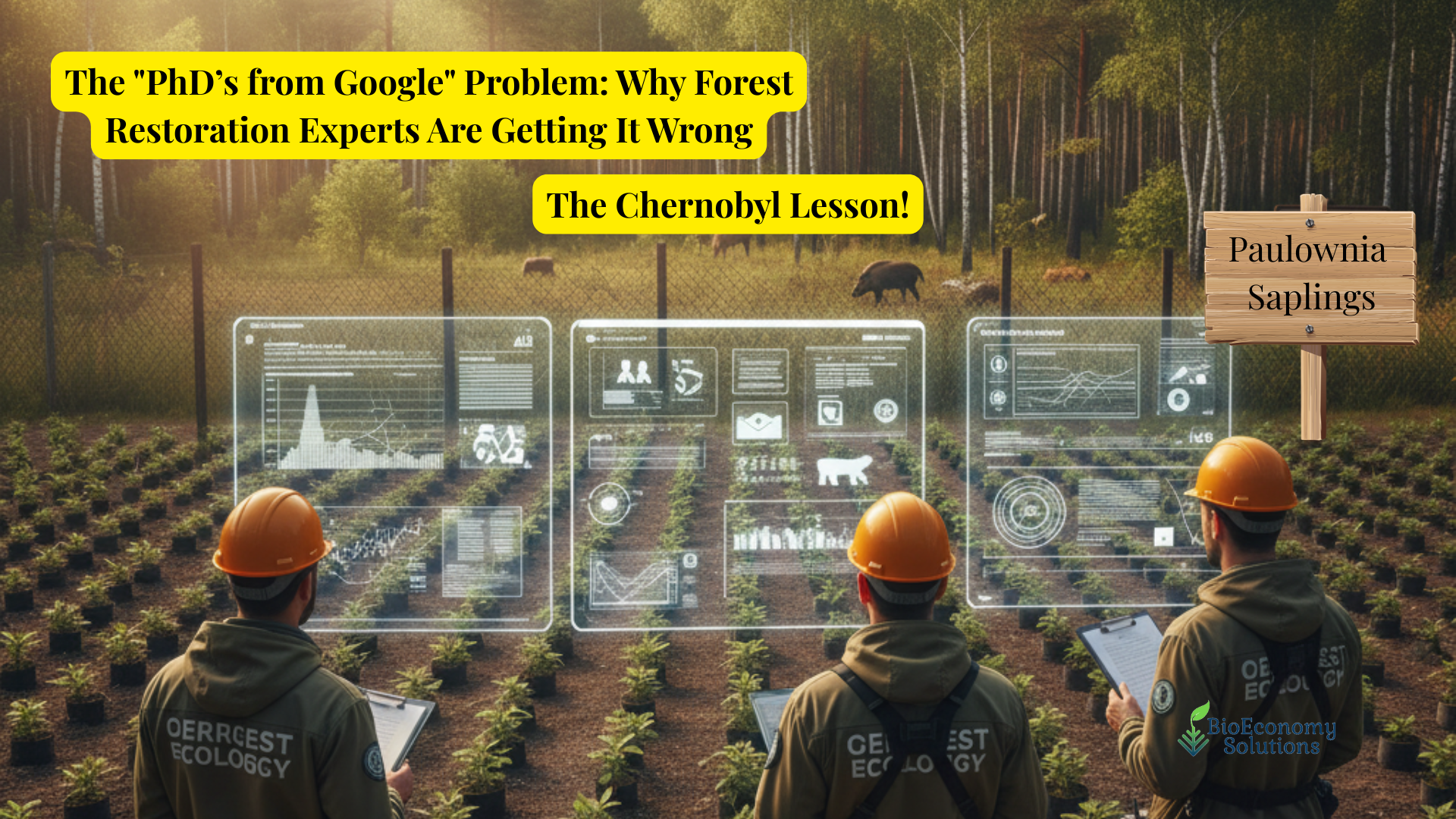
The “PhD from Google” Problem: Why Forest Restoration Experts Are Getting It Wrong (And What Chernobyl Teaches Us)!
They have PhDs in ecology. They study forest restoration for decades.
But they’re missing the biggest lesson hiding in plain sight.
While forest restoration experts debate the evils of “monoculture” tree planting, there’s a radioactive wasteland that became Europe’s most biodiverse ecosystem—without a single PhD managing it.
The lesson from Chernobyl changes everything we think we know about restoration.
The Academic Blind Spot
Walk into any forest restoration conference and you’ll hear the same refrain:
- “Tree planting is just monoculture!”
- “Single species plantations create green deserts!”
- “We need natural diversity, not fast-growing exotics!”
They’re not wrong about the problem.
Most large-scale tree planting does create ecological dead zones:
- Single species (pine, eucalyptus) for easy management
- No understory diversity
- Vulnerable to pests and disease
- Poor soil health and nutrient cycling
- But they’re missing the solution hiding in their own backyard.
The Chernobyl Revelation
April 26, 1986: Nuclear disaster creates 2,600 km² exclusion zone.
What happened next shocked ecologists:
The most contaminated place on Earth became Europe’s most biodiverse ecosystem.
How is this possible?
The answer reveals everything wrong with modern restoration thinking:
Human Absence > Perfect Management
What Chernobyl eliminated:
- Hunting and trapping
- Industrial agriculture
- Logging and development
- Chemical inputs
- Intensive land management
The result:
- Wolf populations 7x higher than surrounding areas
- Brown bears returned after century-long absence
- Elk, deer, boar thriving despite radiation
- Diverse habitats: forests, meadows, wetlands, abandoned settlements
- The brutal truth: Removing human interference worked better than decades of restoration science.
The Rewilding Revolution
Smart farmers are learning from Chernobyl’s accidental lesson.
The new trend: Agricultural rewilding
Instead of fighting nature, they’re stepping back and letting ecological processes lead.

Two Rewilding Models:
Land Sparing:
Convert marginal land entirely to rewilding
Intensify sustainable production on best land
Create wildlife corridors and habitat patches
Land Sharing:
Integrate nature recovery across entire farm
Agroecology, rotational grazing, wide margins
Harmonize food production with biodiversity
The Economic Breakthrough:
Traditional farming: Single revenue stream, high input costs
Rewilding farms: Multiple income sources
Ecotourism and nature experiences
Government environmental payments
Carbon and biodiversity credits
Reduced input costs (fertilizers, pesticides)
Why Forest Experts Miss the Point
The academic trap: Perfect is the enemy of good.
While PhDs debate species composition and natural succession, degraded land sits empty for decades waiting for the “perfect” restoration plan.
Meanwhile, practical solutions exist:
The Guardian Species Approach
Instead of monoculture OR natural diversity, smart restoration uses pioneer species that enable native recovery.
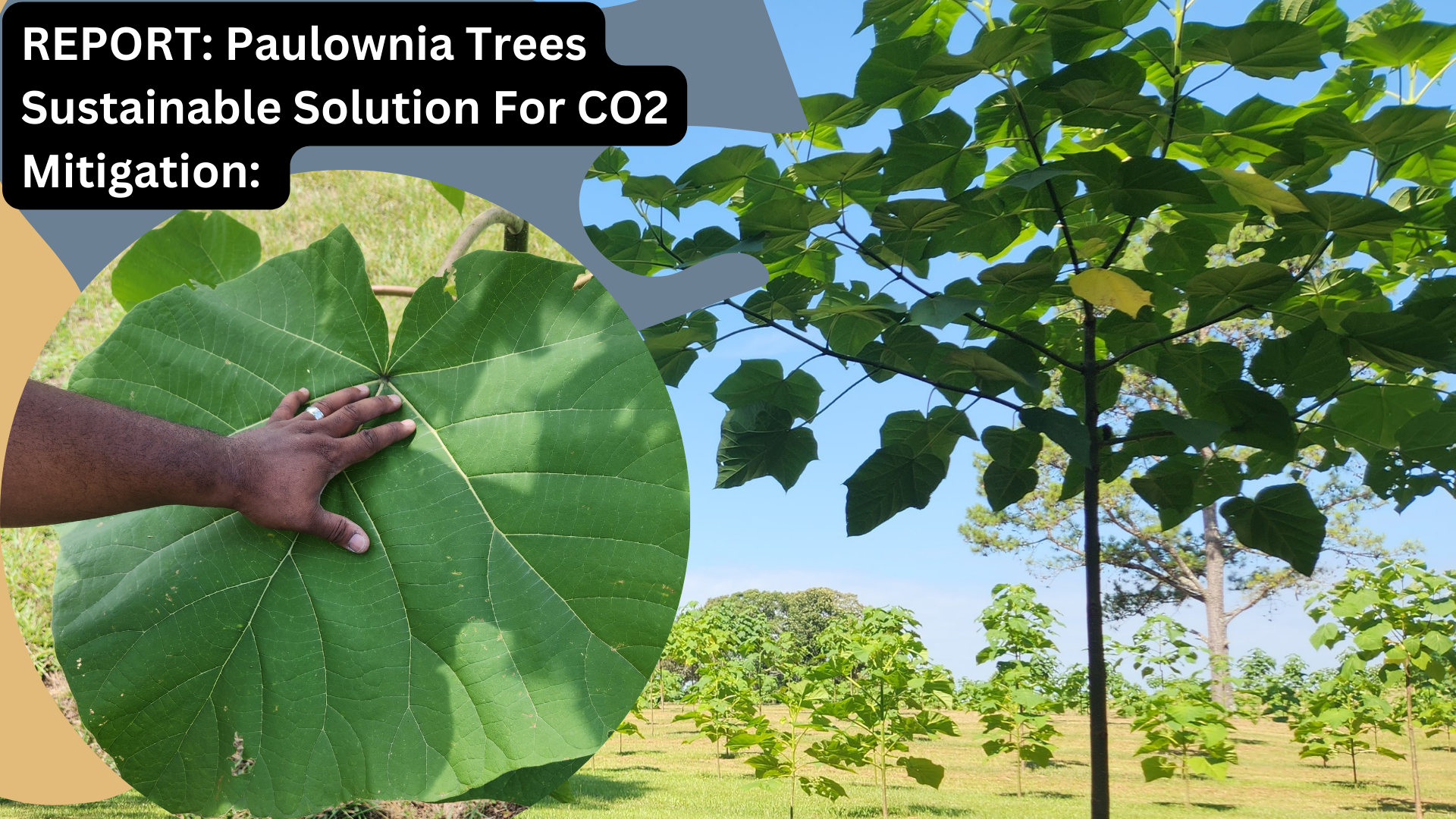
Example: Paulownia as ecosystem catalyst
Fast establishment: Creates habitat structure in 3-5 years vs. decades
Soil improvement: 15-foot taproots break hardpan, increase organic matter 400%
Microclimate creation: Large leaves provide shade, reduce evaporation
Native species enablement: 85% survival rate for native seedlings vs. 30% on bare land
This isn’t monoculture—it’s strategic succession.
The Intercropping Advantage
Academic view: Single species = bad
Reality: Strategic species can support incredible diversity
Paulownia plantations support:
Food crops (soybeans, groundnuts) between rows
Pollinator habitat from flowers
Wildlife corridors and nesting sites
Soil biology restoration
Water retention and erosion control
The Data That Changes Everything
China’s Loess Plateau: World’s largest ecosystem restoration project
35,000 square miles of degraded land restored
Pioneer species approach using fast-growing trees
Result: 2.5 million people lifted from poverty while sequestering massive carbon
Costa Rica’s forest recovery:
Forest cover increased from 24% to 54% in 30 years
Strategy: Fast-growing species + native conservation
Economic model: $500 million forest economy
The pattern: Successful restoration combines speed with diversity, economics with ecology.
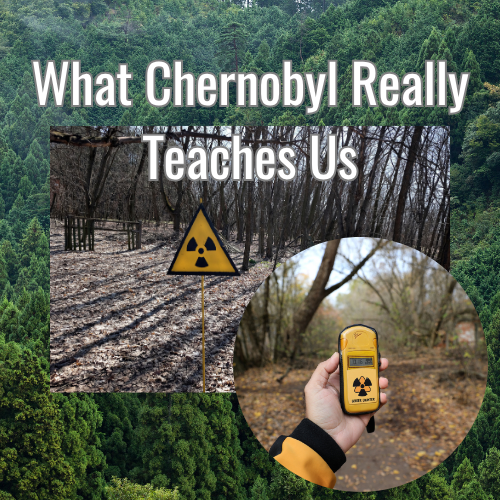
What Chernobyl Really Teaches Us
Lesson 1: Absence of harm > presence of perfection
Sometimes the best management is minimal management.
Lesson 2: Nature is more resilient than we think
Even radiation couldn’t stop ecological recovery when human pressure was removed.
Lesson 3: Diversity emerges from opportunity, not planning
Create the right conditions, and biodiversity follows naturally.
Lesson 4: Time scales matter
Chernobyl’s 40-year recovery timeline shows patience pays off—but strategic intervention can accelerate the process.
The New Restoration Paradigm
Old thinking: Plan perfect ecosystem, plant native species, wait decades
New thinking: Create conditions for natural recovery, accelerate with strategic species
The Practical Framework:
Phase 1: Rapid Establishment (Years 1-3)
Plant fast-growing pioneer species (like Paulownia)
Establish basic habitat structure
Improve soil conditions and microclimate
Phase 2: Diversity Integration (Years 3-7)
Introduce native species in improved conditions
Allow natural colonization from seed sources
Manage for increasing complexity
Phase 3: Ecosystem Maturation (Years 7-20)
Reduce management intervention
Allow natural succession processes
Monitor and adapt as needed
The Economic Engine:
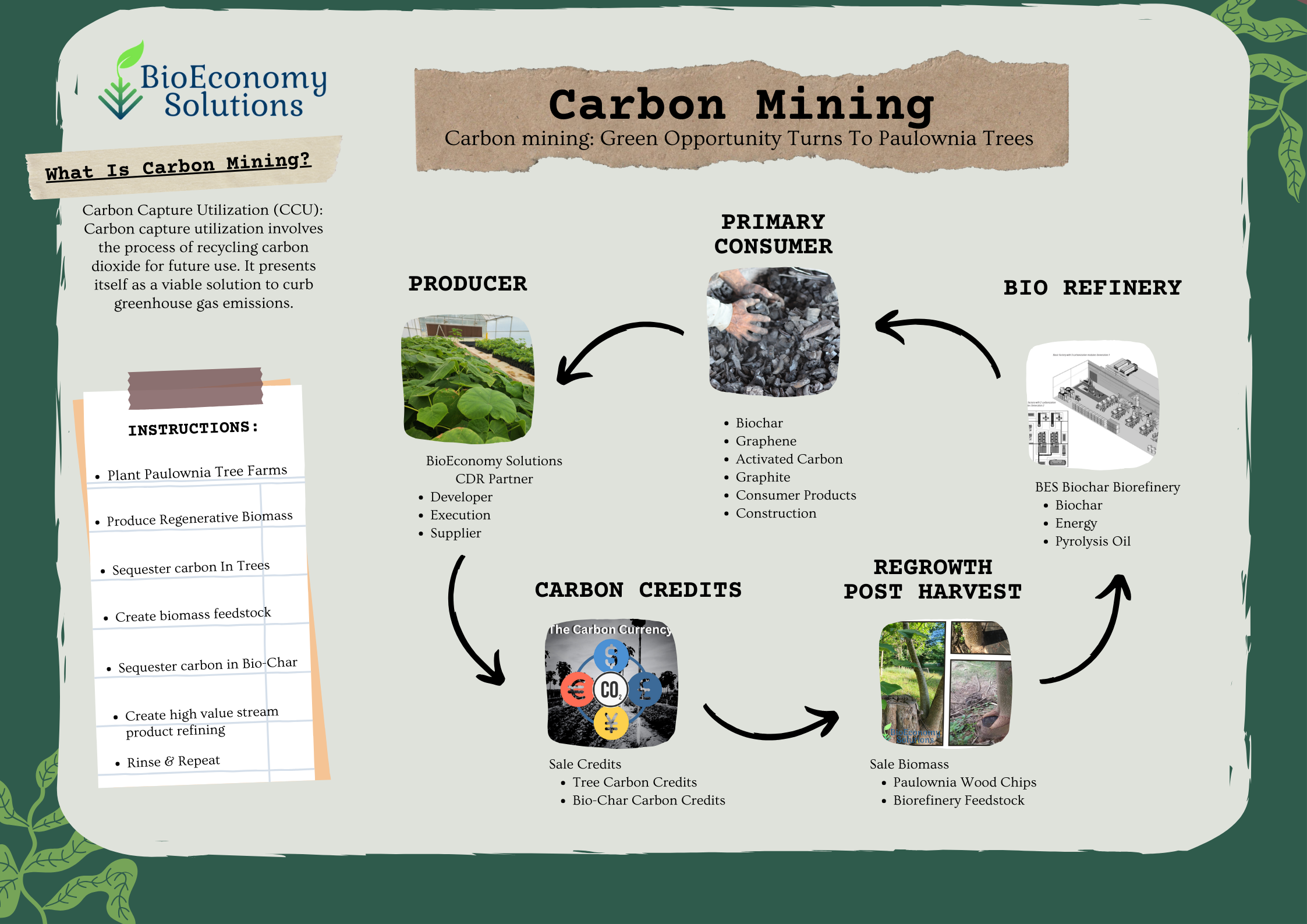
Revenue streams fund restoration:
Timber from pioneer species
Carbon credits from sequestration
Biodiversity credits from habitat creation
Sustainable products from managed harvests
Self-funding restoration: Projects pay for themselves while delivering ecological benefits.
Why This Matters Now
The restoration challenge is massive:
2 billion hectares of degraded land globally
Climate targets requiring rapid carbon sequestration
Biodiversity crisis demanding habitat restoration
Economic pressures on rural communities
Traditional approaches are too slow:
Decades for native forest establishment
High failure rates on degraded soils
Limited economic incentives
Academic debates while land stays degraded
The Chernobyl lesson:
Sometimes stepping back and letting nature lead—with strategic assistance—works better than micromanagement.
The Path Forward For restoration practitioners:
Embrace pioneer species that enable native recovery
Design for economic sustainability from day one
Focus on ecosystem function over species purity
Learn from natural succession patterns
For policymakers:
Support restoration approaches that combine speed with diversity
Create economic incentives for ecosystem services
Reduce regulatory barriers to innovative restoration
Fund long-term monitoring and adaptive management
For landowners:
Consider rewilding marginal or degraded land
Explore multiple revenue streams from restoration
Partner with restoration experts and carbon markets
Think in decades, not years
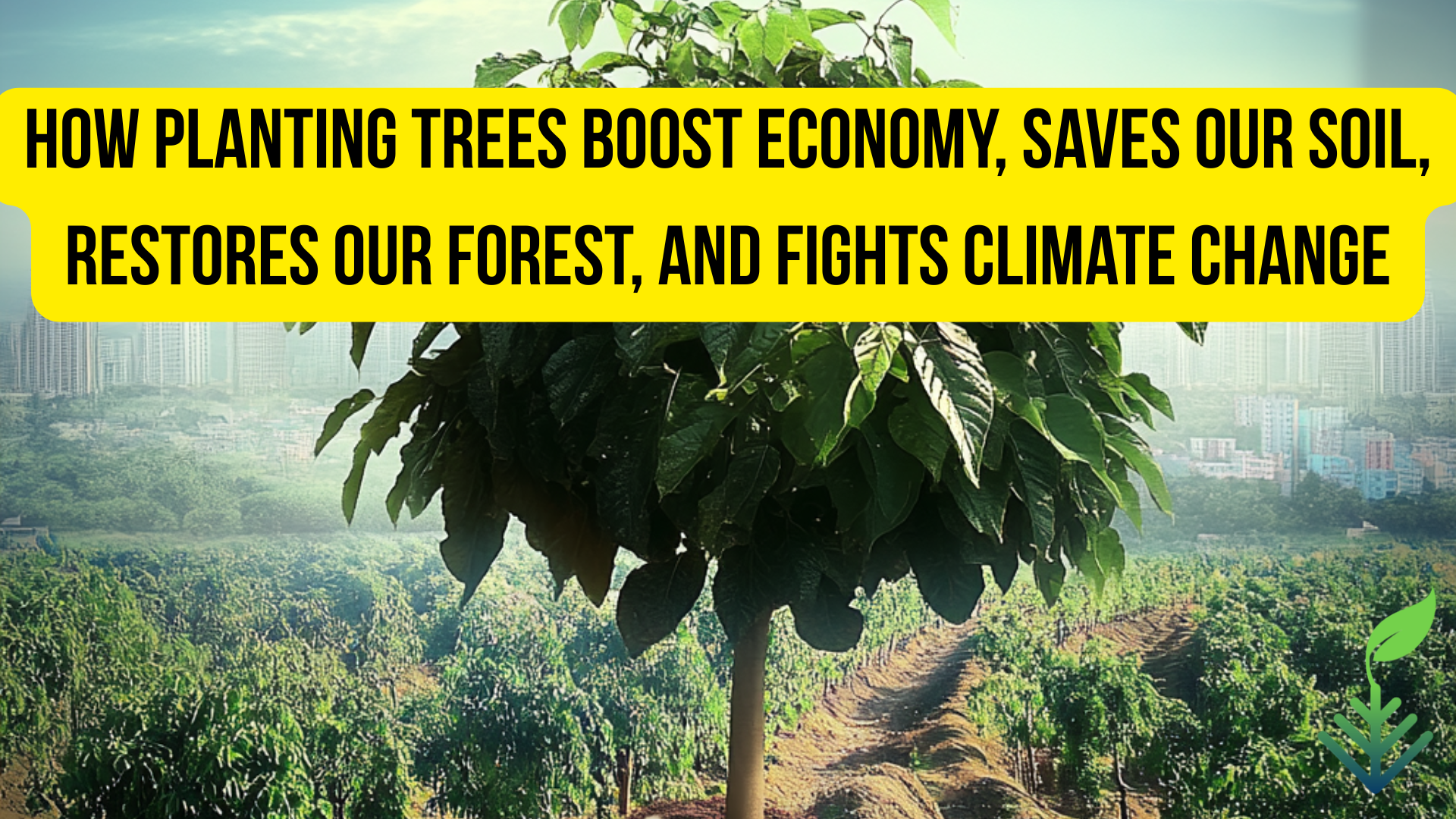
The Bottom Line
The forest restoration debate isn’t really about monoculture vs. diversity.
It’s about perfection vs. progress.
While academics debate ideal species compositions, degraded land sits empty. While experts plan perfect ecosystems, climate change accelerates.
Chernobyl’s accidental lesson: Nature is incredibly resilient when given the chance to recover—even under the worst possible conditions.
The practical solution: Strategic intervention that accelerates natural processes while creating economic incentives for long-term stewardship.
The choice: Wait decades for perfect restoration, or start now with good restoration that improves over time.
Sometimes the best forest management is knowing when to step back and let nature lead.
But first, you have to create the conditions for success.
That’s where strategic species selection, economic sustainability, and long-term thinking converge.
The radioactive wasteland that became a biodiversity hotspot shows us the way.
Ready to rethink restoration? The lessons from Chernobyl, rewilding farms, and successful ecosystem recovery projects point toward a new paradigm: strategic intervention that enables natural recovery while creating economic incentives for long-term success.
The forest restoration revolution isn’t about choosing between human management and natural processes—it’s about finding the sweet spot where both work together.
CONTACT US
Contact BioEconomy Solutions for afforestation, reforestation & carbon portfolio assessment.
Your next audit could be a profit opportunity instead of a compliance expense.
We’re happy to organize a time to speak with you about our paulownia trees and lumber we have for sale. Please book your preferred time to speak directly.
Book a Conversation: Here’s a link to my online calendar/schedule:
www.bioeconomysolutions.com/bookcall
BioEconomy Solutions
mail@BioEconomySolutions.com
Office: 843.305.4777
LIKE|SHARE|COMMENT
Join Our Newsletter – Get a FREE copy of Paulownia Carbon Report

Subscribe to our newsletter