The BES hybrid Paulownia model directly and positively interacts with these “Colors of Carbon” primarily through its highly efficient Green Carbon sequestration, while also offering solutions that mitigate the negative effects of Black, Brown, and Red Carbon by providing a clean, sustainable alternative to traditional industrial practices.
The Paulownia tree is a unique asset for ESG-aligned investment due to its rapid growth and wide-ranging environmental and social benefits. It directly addresses key risks and opportunities across all three ESG pillars.
Here is how the BES hybrid Paulownia trees interact with each carbon source:
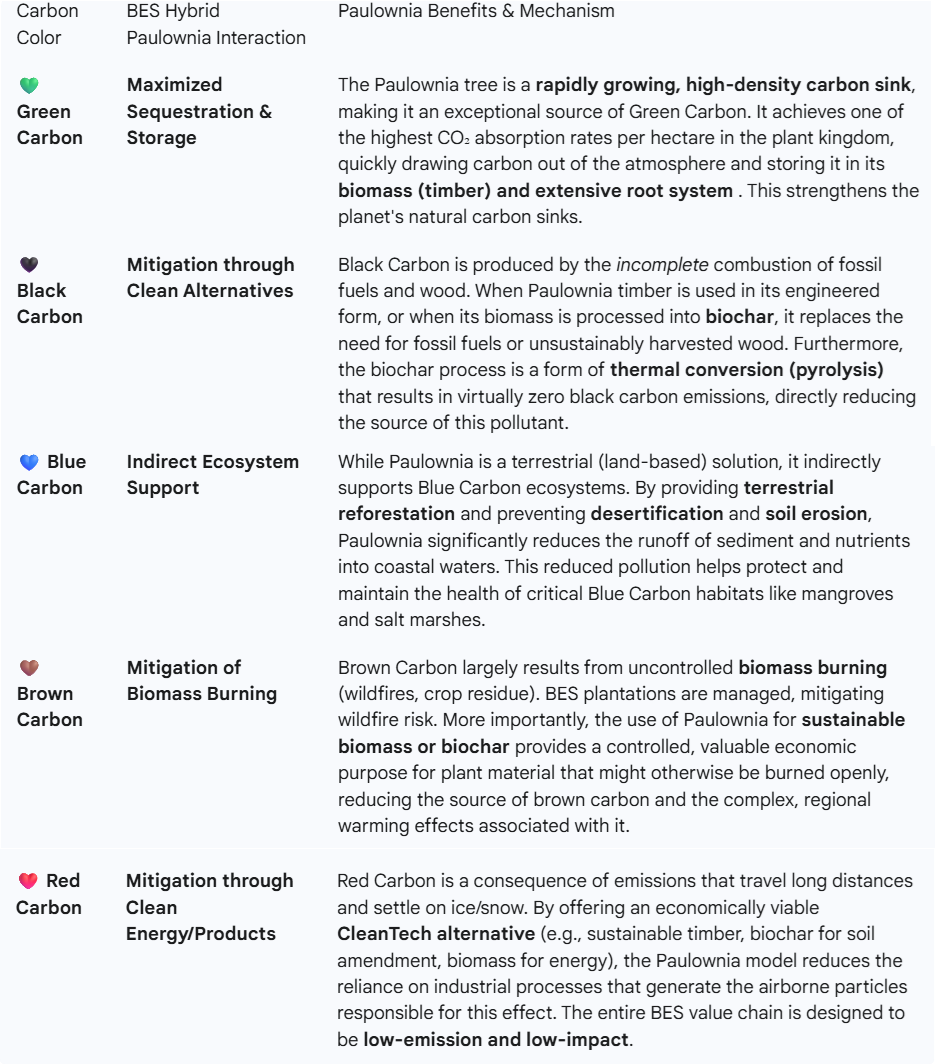
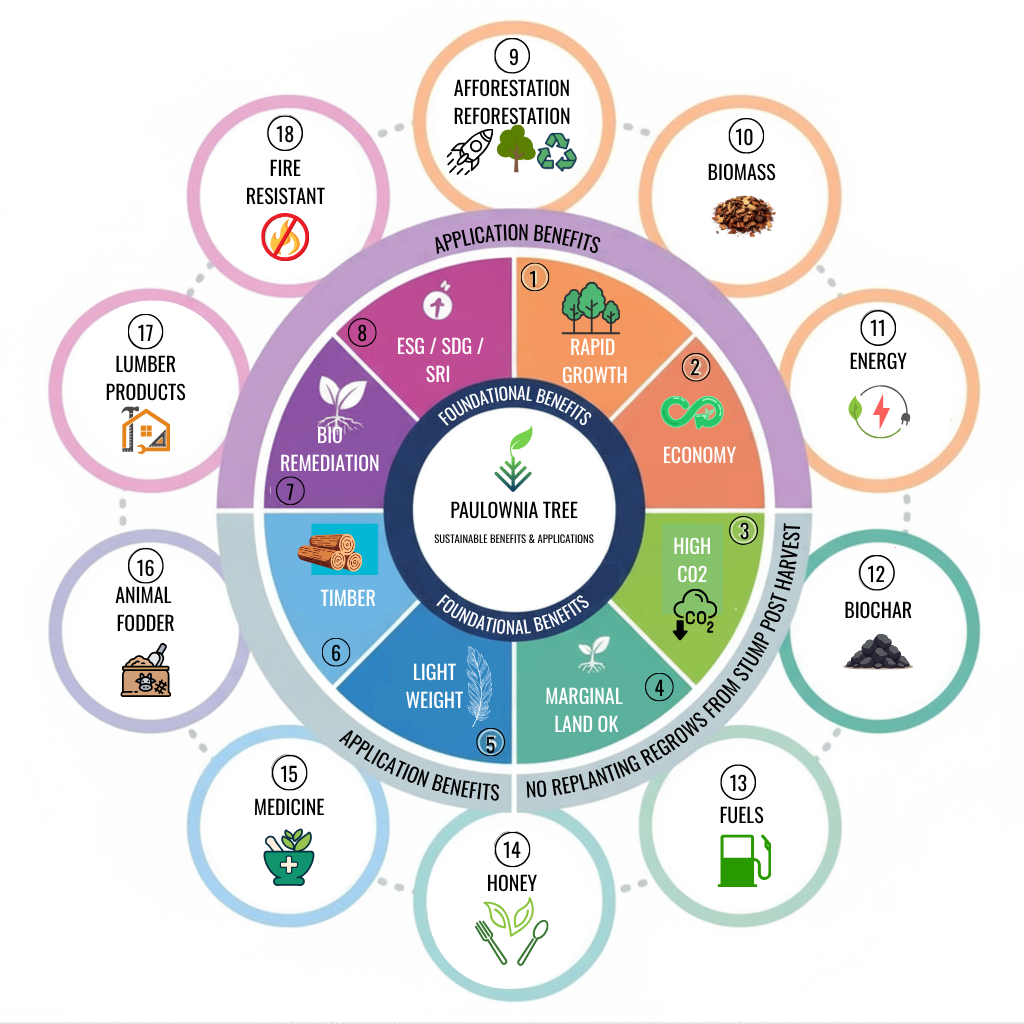
Key Hybrid Paulownia Benefits
Paulownia: The Fast-Track to ESG Alpha in Sustainable Investing
In today’s market, Environmental, Social, and Governance (ESG) performance isn’t just a compliance issue—it’s a leading indicator of long-term value. For investors seeking tangible, nature-based solutions, the Paulownia (or “Empress”) tree is becoming a vital asset, fundamentally reshaping forestry and land use.
Here’s a breakdown of how Paulownia plantations can positively affect all three ESG factors in your investment portfolio:
E – Environmental: Carbon & Circular Economy
Paulownia sequesters large amounts of CO₂, restores degraded land, improves soil health, and supports biodiversity. Its rapid growth and ability to regrow after harvest (coppicing) make it ideal for sustainable forestry and carbon credit generation.
- Hyper-Efficient Carbon Sequestration: Paulownia is one of the fastest-growing trees globally. Its rapid growth cycle means it sequesters $\text{CO}_2$ at a rate significantly higher than many other species, offering a powerful, verifiable asset for Carbon Credit generation.
- Sustainable Timber: The wood is lightweight, durable, and naturally fire/pest-resistant. It matures in 5-10 years (vs. 25-50+ for conventional hardwoods), providing a highly renewable raw material that reduces pressure on old-growth forests and supports the circular economy.
- Soil and Land Remediation: Its deep, extensive root system fights soil erosion, improves water infiltration, and can even be used for bioremediation on degraded or copper contaminated land brownfield / superfund sites, turning “stranded assets” into productive, green capital.
S – Social: Community & Development
Paulownia projects create rural jobs, support local communities, enable farmer partnerships, and can be integrated with food crops (intercropping), enhancing food security and livelihoods.
- Agroforestry & Food Security: Paulownia’s unique canopy structure and deep roots make it ideal for intercropping, allowing food crops to grow between the trees. This diversifies income for farmers and enhances food security in local communities.
- Job Creation: Fast-cycle forestry creates predictable, long-term employment in rural economies, covering plantation management, harvesting, and wood processing.
- Community Resilience: Plantations can be structured to support local cooperatives, providing economic opportunities that are fundamentally linked to positive environmental stewardship.
G – Governance: Transparency & Risk Mitigation
Paulownia-based projects can be tracked and verified using real-time MRV (Measurement, Reporting, Verification) systems, ISO certification, and blockchain, ensuring transparency, auditability, and compliance with global ESG standards (CSRD, SEC, GRI).
- Verifiable Metrics: The rapid, measurable growth of Paulownia makes it excellent for establishing clear, auditable metrics for ESG reporting, which is essential for compliance (e.g., CSRD, SFDR).
- Supply Chain Stability: Investing in domestic or local Paulownia plantations diversifies and shortens the timber supply chain, mitigating risks associated with volatile global imports and geopolitical instability.
- Climate Resilience: The tree’s tolerance for various climates and poor soils reduces operational risk compared to more sensitive mono-cultures, ensuring a more stable return on capital for investors.
Download The Carbon Credit Audit Checklist

Key Hybrid Paulownia Benefits Details
The BES Paulownia model goes beyond simple sequestration, creating a multi-faceted solution often referred to as a Carbon Stack due to its numerous co-benefits:
Soil Restoration: The deep, fast-growing roots stabilize soil, prevent erosion, and promote microbial life, making it a powerful tool for reversing desertification .
Economic Yield: The wood is light, strong, and highly valued (like balsa wood), maturing in just 5–7 years, offering a significantly faster return on investment than conventional forestry (which can take 40–80 years).
Revenue Stacking: It creates multiple income streams (timber, high-quality carbon credits, biochar, biomass energy, and even honey), which de-risks the investment compared to single-product forestry.
Air and Water Purification: The large leaves and high photosynthetic efficiency act as natural air filters, while the dense root structure is excellent at phytoremediation (removing toxins from the soil), improving local water quality.
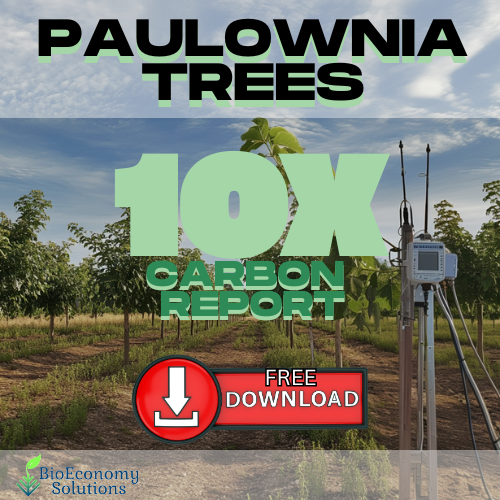
Conclusion: This explains how Paulownia trees are positioned as a nature-based solution for ESG (Environmental, Social, and Governance) goals.
For investors prioritizing both impact and return, Paulownia is not just a tree—it’s an infrastructure asset. It aligns capital with the future of sustainable material science, verifiable climate action, and equitable rural development.
CONTACT US
Contact BioEconomy Solutions for a carbon portfolio assessment.
Your next audit could be a profit opportunity instead of a compliance expense.
Visit our web page. https://bioeconomysolutions.com
We’re happy to organize a time to speak with you about our paulownia trees and lumber we have for sale. Please book your preferred time to speak directly.
Book a Conversation: Here’s a link to my online calendar/schedule:
www.bioeconomysolutions.com/bookcall
BioEconomy Solutions
Office: 843.305.4777
LIKE|SHARE|COMMENT
Join Our Newsletter – Get a FREE copy of Paulownia Carbon Report

Subscribe to our newsletter