
The GENIUS Act—short for “Guiding and Establishing National Innovation for U.S. Stablecoins“—was signed into law on July 18, 2025, establishing the first comprehensive federal regulatory framework for dollar-backed, redeemable “payment stablecoins” in the U.S. Congress.
✅ What the GENIUS Act Does
-
Requires 1:1 backing of stablecoins with liquid assets—U.S. dollars or short-term Treasuries—held in segregated accounts, with monthly public disclosures and third-party audits.
-
Establishes a dual federal–state licensing system: large issuers go federal, smaller ones under $10 B can operate under a certified state regime.
-
Pre-empts state law for federally supervised issuers to simplify market entry.
-
Includes robust consumer protection and AML/sanctions rules, plus prioritizes stablecoin holders in issuer insolvency.
-
Excludes most algorithmic or crypto-native stablecoins from being payment stablecoins and leaves them under a Treasury study in the next year.
-
Adds foreign supervision equivalence rules, allowing foreign issuers—once deemed to have equivalent regulation—to operate in the U.S.
This legislation positions the U.S. stablecoin sector for rapid growth, potentially scaling from a $260B market to several trillion, and anchors more stablecoin backing in Treasuries—supporting U.S. debt markets & dollar dominance.
🌲 Implications for Paulownia‑Backed Tokenized Carbon Credits
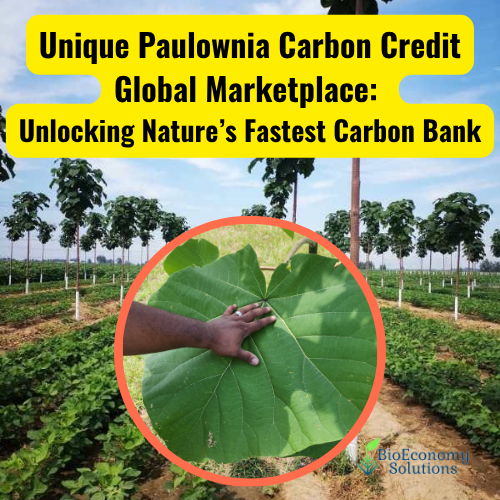
Paulownia trees are increasingly used in carbon sequestration projects because of their rapid growth and high CO₂ uptake. BioEconomy Solutions is tokenizing these carbon credits—tying each credit derivatively to a Paulownia tree or plantation, often via NFTs or tradable tokens.
While the GENIUS Act targets payment-oriented stablecoins, its regulatory principles spill over into tokenized asset markets, and here’s how they affect Paulownia carbon tokens:
-
Stablecoin compliance frameworks don’t directly apply to carbon-credit tokens, since they’re not pegged to fiat. But the Act pre-empts ambiguity—it clarifies that “payment stablecoins” require 1:1 reserve backing, monthly disclosures, audits, and state/federal licensing (when used for payment). Tokenized assets used for trading or payments—like carbon-credit tokens—may attract scrutiny akin to stablecoin regulations, especially if they serve liquidation or transactional functions. In such cases, the Treasury or agencies could decide these fall under “other crypto-asset” rules queued for post-GENIUS Acts study.
-
For environmental token projects, higher transparency and audit expectations set a new bar. If these tokens become tradable or payment instruments, similar compliance (reserves audits, AML/KYC, segregation of assets) may follow.
-
Cross-border issuers of tokenized credits may need equivalent regulatory certifications—mirroring the approach for stablecoins—especially for foreign-based Paulownia credit issuers targeting U.S. buyers.
-
The Act’s emphasis on liability prioritization could inspire analogous frameworks in tokenized carbon credits—ensuring token holders have clear claims on physical carbon assets if a project defaults.
🛠 What This Means for Paulownia Carbon‑Credit Token Projects
-
❎ If your token is intended for trading or payment in the U.S., it may need to comply with AML, consumer protection, and asset-reserve audit-type principles—even if not strictly labeled a stablecoin.
-
❎ Adapting audit models: Payment stablecoins now require monthly reserve audits. Carbon-credit tokens could adopt similar transparency practices to appeal to institutional and regulatory eyes.
-
❎ Prepare for the Treasury study by engaging early with regulators, building compliant frameworks that anticipate potential classification as tokenized financial products.
-
❎ Cross-jurisdiction coordination matters: foreign-based carbon token issuers targeting U.S. markets should track stablecoin-style foreign supervision equivalence modeling.
-
❎ Bridge financing & DeFi integration: tokenized carbon credits might eventually serve as collateral in financial systems; lessons from stablecoin compliance (reserve requisites, audits) are vital.
STABLECOINS – TL;DR
While the GENIUS Act doesn’t mandate rules for carbon‑credit tokens directly, it sets a new regulatory benchmark for tokenized assets intended for payments or trading. Tokenized Paulownia carbon credits that become easily exchangeable, cross-border, or used in DeFi may soon need to adopt stablecoin‑level transparency, auditability, AML/KYC, and reserve-like structures—or else face classification as emerging crypto‑financial instruments. Token platforms should proactively align with these principles now to stay ahead of anticipated regulations.

Conclusion: A Tree for the Times
As the world reimagines land use and carbon policy, the Paulownia carbon credit market represents a bold convergence of ecology, technology, and finance. It’s not just about planting trees—it’s about planting the right tree, in the right system, with the right data to turn carbon into capital.
With scalable potential and scientifically engineered reliability, Paulownia is more than a fast-growing tree—it’s a catalyst for a climate-resilient future and a profit center for forward-looking investors and landowners.
⏱ Next Steps
- ❎ Landowners: Explore converting acreage into Paulownia carbon farms.
- ❎ Investors: Evaluate biochar and carbon forestry funds linked to high-sequestration species.
- ❎ Buyers: Offset emissions with premium, verifiable Paulownia-based removal credits.
- ❎ Policymakers: Incentivize regenerative agroforestry under national carbon strategies.
🧭 Contact Us – Schedule a Call
Want to see what real-time ESG compliance looks like in action? Or need help building your ESG tech stack? Let’s talk.
By converting its carbon, growth, and timber value into blockchain-based tokens, Paulownia CDR creates a transparent, inclusive, and sustainable financial model that aligns with the goals of the UNCCD, Paris Agreement, and global reforestation efforts.
Contact Us
Where To Buy Paulownia Core Materials? QUESTIONS?
We’re happy to organize a time to speak with you about our ESG compliance solutions.
⏰ Here’s a link to my online calendar/schedule:
www.bioeconomysolutions.com/bookcall
BioEconomy Solutions
Office: 843.305.4777
Visit us at: https://bioeconomysolutions.com/paulownia-carbon-credits/ Let’s chat about paulownia tree solutions for sustainable Forest carbon credits projects.
LIKE|SHARE|COMMENT
Subscribe to our newsletter: https://bioeconomy-solutions.kit.com/45b34109e5

Get a FREE copy of Paulownia Carbon Report
Learn More – How The GENIUS Act Is BIG For Paulownia?
Learn More – How The GENIUS Act Is BIG For Paulownia? Nature Based Carbon Dioxide Removal with Paulwonia fast growing hybrid trees from BioEconomy Solutions.