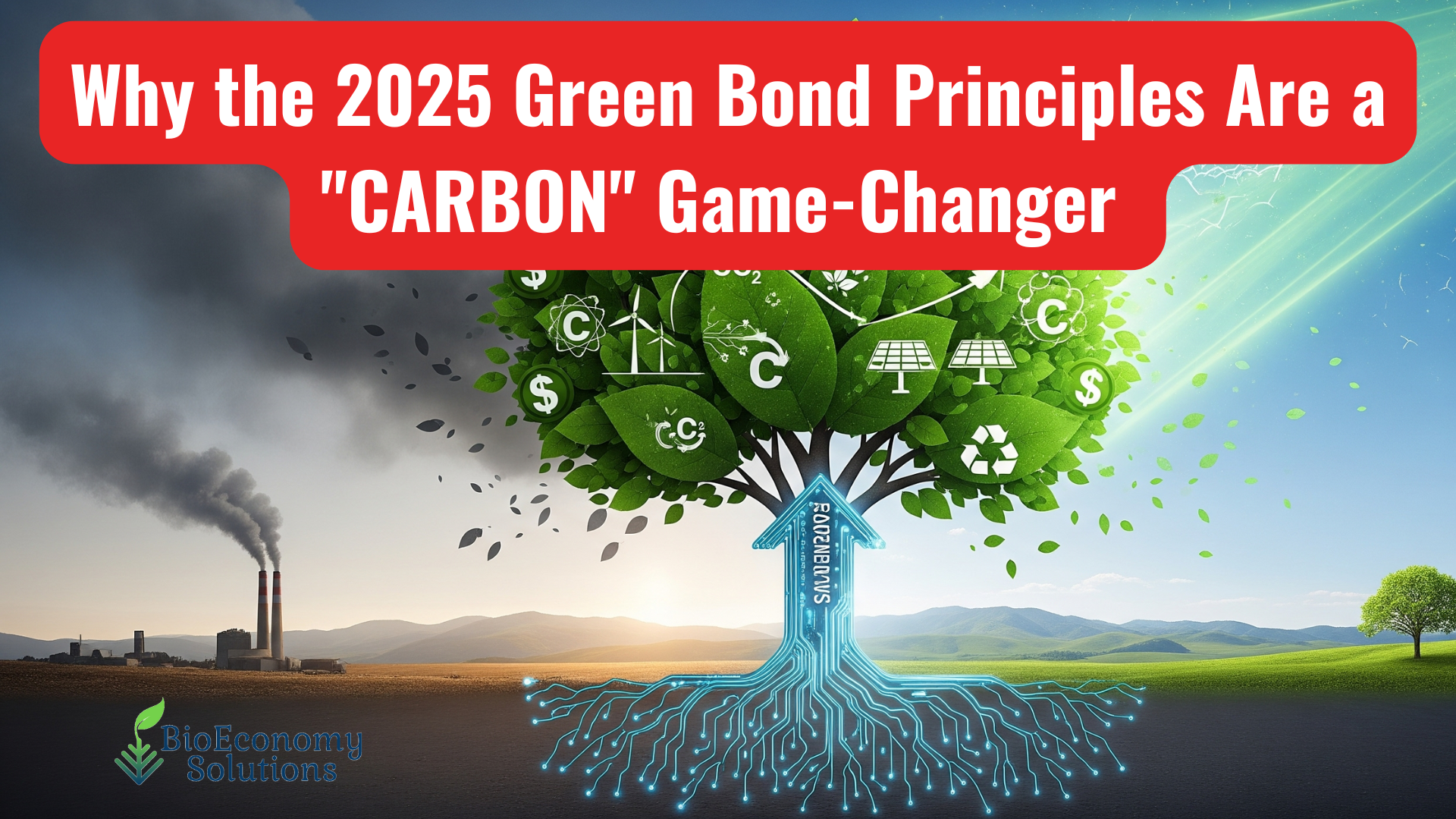
Why the 2025 Green Bond Principles Are a Game-Changer for Nature-Based Carbon Projects. We’re not planting trees. We’re building a regenerative asset class—and the bond market just caught up.
The world is waking up to a new generation of climate finance—and BioEconomy Solutions is at the forefront.
With the release of the 2025 Green Bond Principles (GBP) by ICMA, the door is now open for companies like ours to raise sustainable capital for nature-based solutions rooted in science, scalability, and impact.
International Capital Market Association’s (ICMA)
The International Capital Market Association’s (ICMA) Green Bond Principles (GBP) are voluntary guidelines that promote transparency and integrity in the green bond market. The June 2025 update clarifies how the Green Enabling Projects Guidance is linked to the GBP and expands the definition of “Green Projects” to include “activities” in addition to assets and investments.

The GBP’s four core components for alignment are:
- Use of Proceeds
- Process for Project Evaluation and Selection
- Management of Proceeds
- Reporting
The principles aim to help issuers finance environmentally sound and sustainable projects that support a net-zero emissions economy and protect the environment. They also provide categories for eligible Green Projects, such as renewable energy, clean transportation, and sustainable water management, and encourage issuers to report on the use of proceeds to improve transparency and track the environmental impact.
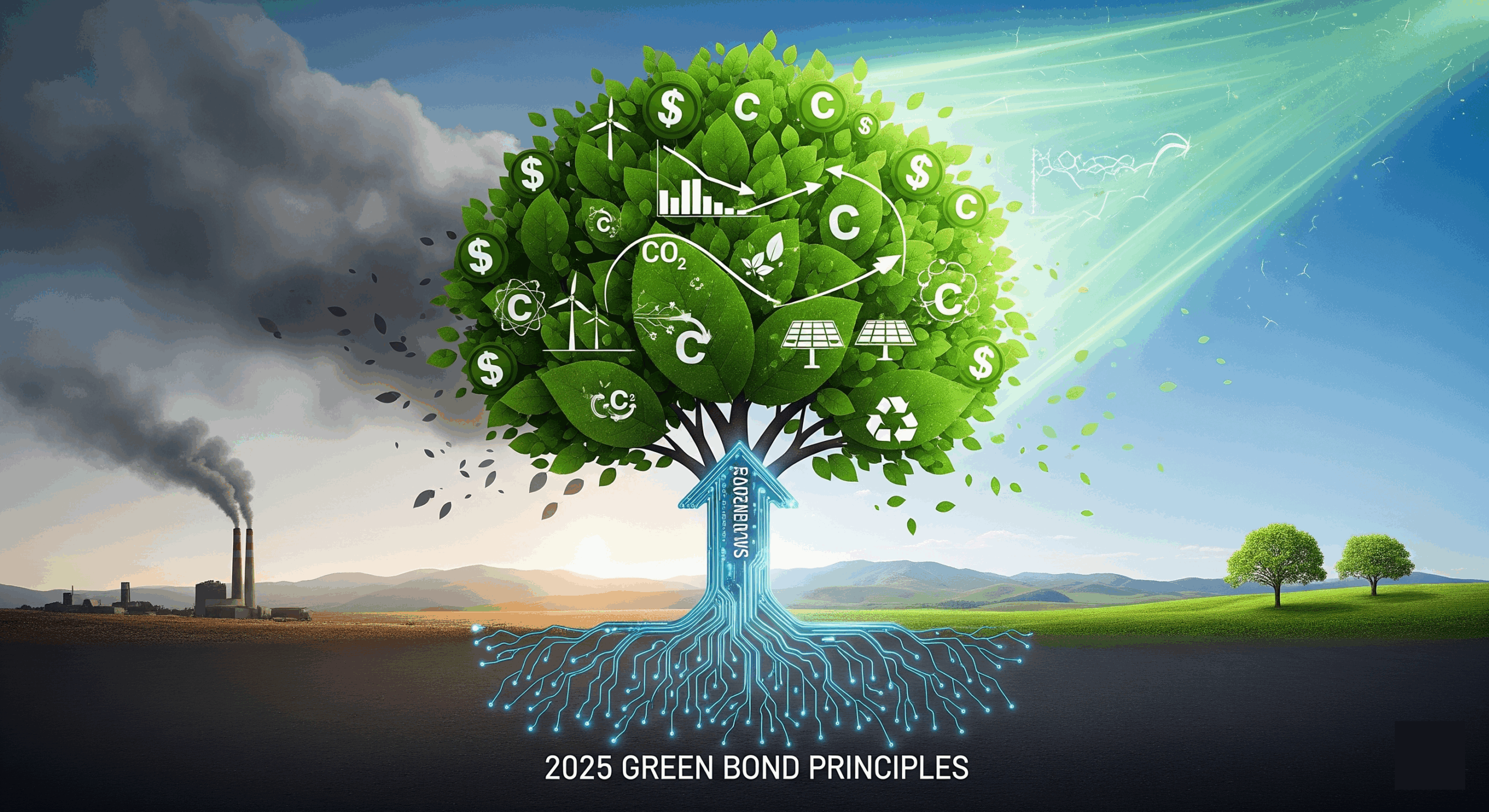
Core Updates in 2025 Version
1. Expanded Definition of “Green Projects”
- Now explicitly includes “activities” such as R&D and supporting actions in addition to assets and investments.
- Aligns with new Green Enabling Projects Guidance (June 2024), recognizing enabling infrastructure (e.g. manufacturing of components) as eligible if they support broader green initiatives.
2. Four Core Components Remain Foundation
- Use of Proceeds: Funds must go exclusively to eligible green assets, investments, or activities, with quantified environmental benefits.
- Project Evaluation & Selection: Clear disclosure of selection process, sustainability objectives, and risk mitigation.
- Management of Proceeds: Net bond proceeds must be tracked via specific sub-accounts or portfolios, adjusted until full allocation; external verification is encouraged.
- Reporting: Annual and timely impact reports required, including list of funded projects, descriptions, amounts allocated, and expected environmental impact figures—using ICMA’s Harmonised Framework where feasible.
3. Strengthened Recommendations
- Green Bond Frameworks: Issuers are expected to publish frameworks or legal documentation aligning with the four core components and situate disclosure within broader sustainability strategy (e.g. references to taxonomies, Paris-aligned transition plans, or Climate Transition Finance Handbook).
- External Reviews: Pre- and post‑issuance reviews by qualified third parties are recommended. Providers should disclose credentials and scope; templates are available on ICMA’s site.
Green Enabling Projects Guidance
- Clarifies that some projects not directly delivering environmental impact may be eligible if they form enabling elements of broader green initiatives (e.g. infrastructure manufacturing).
- Mapped to existing GBP categories, these should still avoid locking in high emissions and monitor risks like double-counting in impact reporting.
Related 2025 Releases
- A Practitioner’s Guide: Sustainable Bonds for Nature was launched concurrently, introducing a thematic overlay for nature‑related projects and allowing issuers to use the secondary label “Nature Bond.” It also offers nature-related KPIs for inclusion in SLBs or sustainability frameworks.
- Updates were issued to ICMA’s Guidance Handbook, Allocation Reporting Guidance, and Q&A sections, alongside other frameworks like the Social Bond Principles (SBP) and Sustainability‑Linked Loans financing Bonds Guidelines.
Why Paulownia?
Every hectare of Paulownia under cultivation can sequester up to 560 tons of CO₂ annually, while restoring degraded land, and produces Class A fire-rated lumber—making it ideal for low-carbon construction.
It’s a WIN WIN for the local economy & environment!
Combined with our nature-based methodologies and end-to-end traceability, we’re ready to turn regenerative forestry into a green financial instrument.

Contact Us!
📣 If you’re an investor, policy leader, or sustainability advocate—we invite you to connect. Let’s put capital to work in nature-based carbon sequestration that delivers at scale.
This isn’t just green finance. This is regenerative economics.
BioEconomy Solutions is a Carbon Dioxide Removal (CDR) Project Developer. Talk to us about our TREE PLANTING strategies with Paulownia trees.
We’re happy to organize a time to speak with you about our paulownia trees and lumber we have for sale. Please book your preferred time to speak directly.
Here’s a link to my online calendar/schedule:
www.bioeconomysolutions.com/bookcall
BioEconomy Solutions
Office: 843.305.4777
Visit us at: https://bioeconomysolutions.com/paulownia-carbon-credits/ Let’s chat about paulownia tree solutions for sustainable Forest carbon credits projects.
LIKE|SHARE|COMMENT
Enjoy this article? You may also enjoy “Carbon Developers Choose Paulownia Trees” https://www.linkedin.com/pulse/carbon-developers-choose-paulownia-trees-victor-garlington-imh4e/

Get a FREE copy of Paulownia Carbon Report